
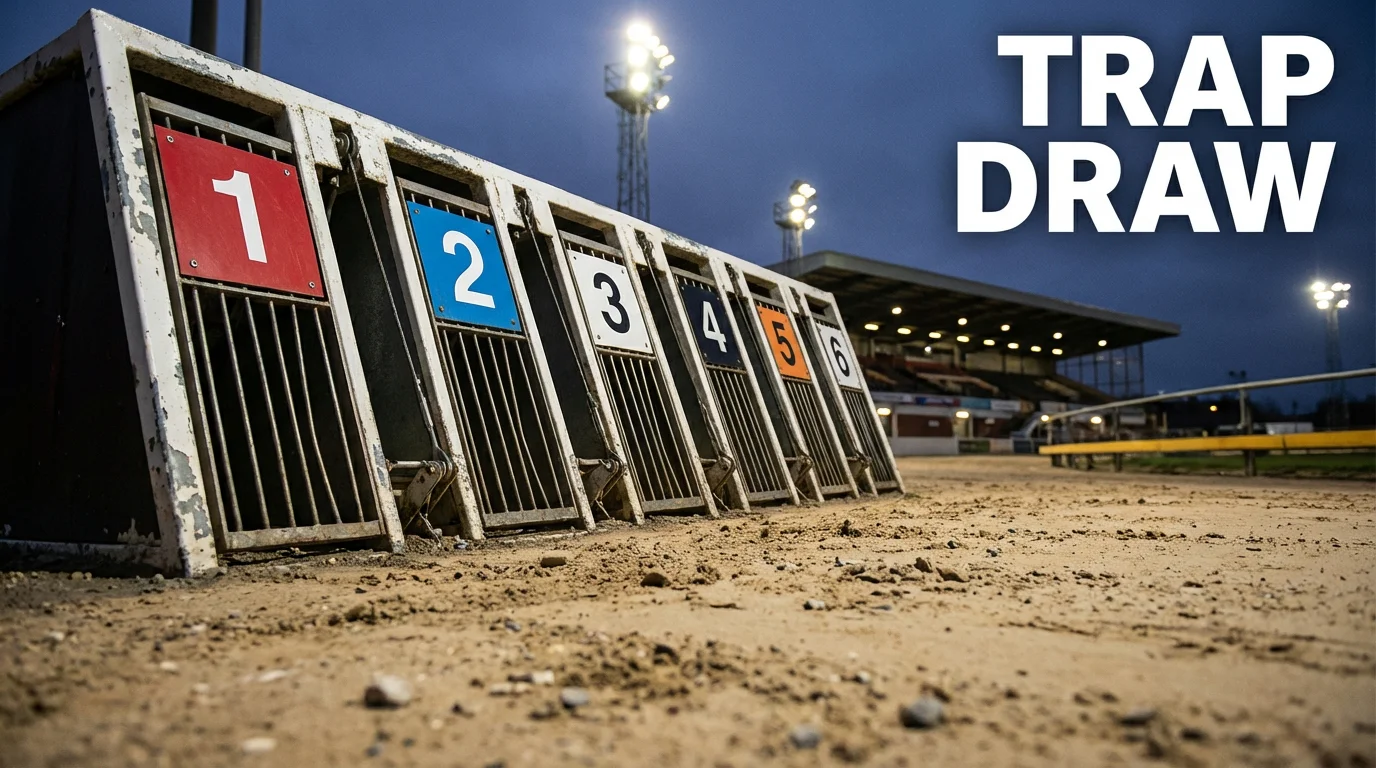
What Is Trap Bias in Greyhound Racing?
Trap bias is the statistical tendency for dogs drawn in certain traps at a specific track to win, place, or lead at the first bend more often than their random probability would suggest. In a perfectly neutral six-trap race with equally capable dogs, each trap would produce a winner approximately one sixth of the time — around 16.7%. Trap bias is the measurable deviation from that baseline. At some tracks and some distances, the deviation is significant enough to be consistently exploitable. At others, it is minor and largely irrelevant to betting decisions.
The bias arises from track geometry: the physical layout of the bends, the width of the track, the starting trap positions relative to the first bend, and the surface condition all interact to give dogs in certain traps a structural advantage in the opening seconds of a race. Since greyhound races are typically decided in the first bend — the dog that clears the bend cleanly and in front tends to dictate the remainder of the race — the starting position matters more in greyhound racing than in almost any other form of racing.
Bias is not uniform across all distances or all race types at the same track. A track may show a strong trap-1 bias at its standard sprint distance while showing a more neutral draw at a longer distance, because the geometry of the track relative to the starting traps changes with distance. The first bend at a 480-metre race is approached from a different starting configuration than at a 265-metre race, and the resulting bias profile can be completely different. Reading track bias data without filtering by distance is one of the most common analytical errors in greyhound betting.
The GBGB does not publish official trap bias statistics, but the data is available through Racing Post’s greyhound section, which provides trap win rate percentages by track, distance, and time period. Understanding how to read that data, and more importantly how to contextualise it, is a foundational skill for any punter who intends to use trap analysis systematically.
How Trap Bias Develops at UK Tracks
Trap bias at UK greyhound tracks develops through a combination of permanent structural factors and variable surface conditions. Understanding which type of bias you are looking at determines how reliably you can use it in betting decisions — permanent structural biases are more consistent and predictable; surface-driven biases are more variable and require more frequent updating of your data.
The permanent structural factors are determined by the physical design of the track. The radius of the first bend is the most important single variable. At a tight-turning track with a short run to the first bend, the inside traps — typically Trap 1 and Trap 2 — have a shorter distance to travel to reach the bend and are less likely to be interfered with by dogs coming in from wider positions. They are, by geometry, already on the inside line. At a wider-turning track with a longer run to the first bend, the race opens up more before the first bend, reducing the pure positional advantage of the inside draw and giving faster wide runners more time to establish a leading position before the turn. Romford, with its tight turns, is a classic example of a track where inside trap advantage is structurally embedded. Wimbledon historically showed different bias patterns partly because of its different geometry.
Surface conditions add a second layer of variability. Greyhound tracks use sand, shale, or similar all-weather surfaces that change in character with temperature, moisture, and usage patterns. A track running heavy after rainfall may favour different traps than it does in dry summer conditions, because the surface affects grip and therefore the ability of dogs to hold their line through bends. Rail-side dogs who run tightly to the inside rail may benefit more from firm conditions; wide runners who swing out on the bends may be less disadvantaged in softer conditions. Seasonal shifts in surface condition are one reason why bias data should be refreshed regularly rather than used as a static reference.
Schooling patterns also contribute. Trainers who school dogs specifically to track well out of certain traps at a specific venue can create a bias signal at the individual-dog level that looks like a general trap tendency in aggregate. If the most competent kennel at a track consistently places its best dogs in Trap 1, the statistical bias data will show Trap 1 overperforming — but the underlying cause is trainer selection, not pure geometry. Separating these effects requires looking at individual dog trap histories as well as aggregate track data, and it is one reason why blind reliance on trap statistics without cross-referencing individual form is analytically incomplete.
Trap bias also evolves over time. Resurfacing, drainage improvements, track widening, or changes in the running direction can all alter a track’s bias profile. The Romford trap-1 advantage that existed in 2018 may not be identical to what exists in 2026. Always check the date range of your trap data source and prioritise recent data — last 30 to 90 days at minimum — over longer historical averages when making live betting decisions.
Trap Win Rates: UK Track Data
Published trap win rate data for UK greyhound tracks reveals consistent patterns that persist across seasons, though the precise figures shift with surface conditions and track changes. The following reflects general patterns visible in long-run GBGB track data; punters should verify current figures against Racing Post’s trap statistics for the specific track, distance, and recent time period.
Romford is consistently cited as one of the most inside-biased tracks in UK greyhound racing. Trap 1 at the standard 400-metre distance has historically shown win rates in the range of 20–25% — substantially above the neutral 16.7% baseline. Trap 2 also overperforms at most distances. Traps 5 and 6 at Romford are among the weakest in the draw at most distances, particularly at the sprint trip. This is one of the most documented biases in BAGS racing and it is priced into the market to some degree, but the degree of market adjustment is inconsistent — underfancied trap-1 runners at Romford are a productive hunting ground for the value-oriented punter who can confirm the draw advantage is not already fully reflected in the available odds.
Crayford, another major London BAGS track, shows different patterns. The track is known for being more friendly to wide runners at certain distances, and trap bias is less pronounced than at Romford in the aggregate, though specific distance and going combinations can still show meaningful deviations from neutral. Trap 6 at Crayford performs relatively well compared to its counterparts at tight tracks, which is unusual enough in UK greyhound racing to be worth noting.
Monmore in the Midlands has shown patterns that favour inside traps at its primary sprint distances, though the bias is less pronounced than at Romford. Hall Green has at times shown relatively neutral trap distributions at its standard distances, which makes it a slightly different analytical environment — without a strong structural bias to factor in, the individual dog analysis becomes a higher proportion of the betting decision. Sheffield (Owlerton) has documented inside bias at several distances but is also sensitive to surface conditions, making it a track where seasonal data is particularly important to check.
Sunderland, a BAGS fixture in the north-east, has shown varying bias profiles at different distances. At its shorter sprint trips, inside traps tend to perform above the neutral baseline, consistent with the general pattern at tight-turning tracks. At longer distances, the field has more time to spread before the first bend, and the bias flattens. This distance-dependent pattern is common across UK tracks and is worth bearing in mind when extrapolating bias data from one trip to another at the same venue.
The key takeaway from aggregate trap data is that no two tracks behave identically, and national averages are misleading as a betting tool. The punter who knows that “inside traps win more often in general” and applies that assumption uniformly across all tracks is using a generalization that will be correct at some tracks and actively wrong at others. Track-specific data, filtered by distance and refreshed for recent conditions, is the only reliable form of trap bias analysis.
Rail Runners vs Wide Runners
The trap draw shapes which dogs benefit from structural bias, but the individual dog’s running style determines whether the draw advantage is actually realised in the race. A rail runner placed in Trap 1 at a track with documented inside bias is in the optimal position for its natural running pattern. A wide runner placed in the same trap at the same track is structurally misplaced — and that mismatch matters.
Rail runners are dogs that naturally track the inside rail. They tend to cut tight through bends, maintain their inside line, and avoid the wider arc that costs time and distance on turns. At a tight track like Romford, a rail runner in Trap 1 or Trap 2 is running the shortest geometric distance to the finish line while occupying the physically preferred lane. These dogs often have high early pace that translates into first-bend leads, and once established on the rail, they are difficult to pass without a wide dog running a significantly longer course.
Wide runners take a different path. They naturally swing to the outside on bends, which is a longer distance but can be advantageous at tracks where the track is wide enough to allow them to avoid traffic and run freely. At tracks with a long run-in to the first bend and wide turns — where dogs have time to open up before the bend — wide runners from traps 4, 5, or 6 can establish a lead before the inside dogs have closed the positional gap. At tight tracks with a short approach to the first bend, the wide runner faces a structural disadvantage before the race begins.
The practical betting application: when you identify a trap-biased race, cross-reference the individual dog’s running style with the trap draw. A rail runner in an advantaged inside trap is the confirmation you want — both the structural and individual factors align. A wide runner in an inside trap at a track with inside bias is a different scenario: the trap statistics suggest advantage, but the dog’s running style may not allow it to realise that advantage. Similarly, a wide runner drawn in an outside trap at a wide-track venue where outside dogs historically perform well is a different proposition than the same dog in the same trap at a tight track.
Running style information is available on Racing Post greyhound cards as part of the form narrative, and experienced form readers extract it from the sectional times and race reports. A dog that consistently records fast early sectional times from inside traps is a rail runner. A dog that consistently produces its best times from outside traps or shows strong finishes from wide positions is a wide runner. That classification should be matched against the trap draw before reaching a conclusion about whether the draw confers the expected advantage in a specific race.
There is also a third category worth acknowledging: the middle runner. Some dogs are neither strongly rail-biased nor wide-biased but run best from middle traps — 3 or 4 in a six-trap race — where they have space on both sides and are less exposed to first-bend crowding. These dogs show inconsistent results from traps 1 and 6 relative to their performances from central draws, and recognising them avoids the mistake of crediting a draw advantage that the dog cannot exploit.
Using Trap Data in Your Betting Decisions
Trap bias data is useful only to the extent that it is integrated into a broader betting decision process, not applied as a standalone selection filter. A dog drawn in Trap 1 at a track with documented inside bias is not automatically worth backing — it is worth examining more carefully than a dog drawn in Trap 6 at the same track. The distinction matters because the process that follows the trap analysis is what actually determines whether there is value in the bet.
The first practical step is to confirm that the bias is relevant to the specific distance and conditions of the race you are analysing. Pull the trap win rate data from Racing Post for the track, filtered by the exact distance and a recent time window — 30 to 90 days is a useful starting range, though at tracks with fewer meetings you may need to extend this to three or six months to get a statistically meaningful sample. If the inside trap advantage is meaningful at this distance under current conditions, it is a factor. If the data shows a more neutral distribution, the trap draw is a lower-priority variable.
The second step is to check whether the dog in the advantaged trap has a running style that suits it. A dog confirmed as a rail runner, with a track record at this venue showing it has made good use of inside draws previously, is the complete picture. A dog with no track record here, or one whose previous form shows poor bend technique, reduces the value of the draw advantage significantly.
The third step is to assess whether the draw advantage is already priced into the available odds. If a dog in Trap 1 at Romford is available at 4/5 and your assessment of its individual form — ignoring the trap — suggests it is closer to 6/4, the trap advantage is already more than fully priced in. The odds reflect the draw premium, and there is no additional value to extract. The useful trap analysis is the kind that identifies an underfancied dog — one the market has not fully credited for its positional advantage — not one that confirms a favourite’s favouritism.
Trap bias data should also be used negatively: to identify dogs in structurally disadvantaged traps who are being underpriced relative to the genuine difficulty of their draw. A dog in Trap 6 at a track with a strong inside bias, priced at 4/1 when its individual form might suggest 5/2, is being offered at a price that under-compensates for the draw disadvantage. This is not the same as recommending against it — sometimes wide dogs do win from trap 6 at inside-biased tracks, and sometimes those wins are at large prices. But the systematic application of trap bias awareness means being more demanding about the price before backing against a documented structural trend, not just when backing with it.
The Draw Is Your Starting Point, Not Your Answer
The trap draw is your starting point for race analysis, not its conclusion. That distinction is what separates a systematic punter from one who has learned a single heuristic and applies it mechanically. Trap bias is real, it is measurable, and at certain tracks and distances it is substantial enough to be a genuine edge. But it is an edge that depends on the conditions being right — the right track, the right distance, the right surface conditions, a dog whose running style matches the draw advantage, and a price that has not already absorbed the entire advantage into the odds.
No algorithm can fully account for the interaction between trap bias and individual dog characteristics at a specific track under current conditions, because the data required to do so is spread across multiple sources and requires interpretation. That is precisely where the attentive, track-specialist punter has an advantage that persists. A bettor who has studied Romford or Monmore specifically — who knows which dogs run well from which traps, which trainers set their dogs up for the inside draw, how surface conditions shift the bias profile across seasons — is operating with a level of granularity that market compilers building prices across sixty or more races per day simply cannot match. The trap draw is not a shortcut. It is one layer of a properly constructed analysis. Used that way, it is genuinely valuable.