
UK Greyhound Betting: Complete Guide to Betting on Dogs
 Available in US
From trap draw to tricast — the only guide you need to start betting on British dog racing with confidence.

What Greyhound Betting Actually Is
Greyhound betting is not a simpler version of horse racing — it runs on different math, different markets and a very different pace. Six dogs break from numbered traps, cover 480 metres or less, and the result is settled in under thirty seconds. There are no jockeys, no tactics, no mid-race decisions by a human on board. The dog either runs its race or it doesn’t. What looks like a stripped-down sport conceals a surprisingly rich set of betting variables, and most newcomers who walk in treating it like a smaller horse meeting walk out puzzled about why their instincts misfired.
The fundamental differences start with the structure of competition. Greyhound racing operates on a graded system where dogs are continuously sorted into narrow bands of ability — an A3 dog runs against other A3 dogs, and getting drawn in the wrong trap at the wrong track against the right opponents is often the single variable that determines whether the bet has any value at all. You are not betting on a horse whose form spans varied fields and distances across multiple months. You are betting on an animal whose last six performances at one specific venue in one specific grade paint a very precise picture — if you know how to read it.
The Tote pools, the forecast markets, the trap draw, the BAGS schedule — these are not incidental details. They are the architecture of the market. A punter who walks into greyhound betting with horse-racing assumptions will consistently misread the odds, undervalue certain exotic markets and overpay for straight win bets that look appealing but carry a structurally poor price. The betting patterns here reward specialist knowledge over broad instinct, which is either a frustration or an opportunity depending on how you approach it.
In the UK, greyhound betting operates within a UKGC-licensed ecosystem, which means every bookmaker you use for dogs must meet the same compliance, consumer protection and anti-money-laundering standards as any other licensed operator. The racing itself is governed by the Greyhound Board of Great Britain, which sets welfare standards, sanctions meetings and maintains the integrity framework that underpins the betting product. That structure matters to bettors because it directly affects data availability, race reliability and the fairness of the prices you are offered.
Key fact: UK greyhound racing operates across 21 GBGB-licensed tracks, with BAGS providing a near-continuous betting schedule throughout the day — typically from late morning to early evening on every weekday and most weekends.

GBGB-Licensed Tracks — The Official Circuit
The infrastructure behind British dog racing is more organised than most punters realise. The Greyhound Board of Great Britain is the sport’s governing body in Britain, and the 21 venues holding current GBGB licences form the only official circuit. These include major commercial tracks such as Romford, Wimbledon, Crayford, Monmore, Hall Green, Sheffield (Owlerton), Sunderland, Newcastle, Nottingham and several others spread across England and Wales. Each venue must meet strict standards covering track safety, kennel facilities, veterinary provision and race integrity — conditions that are reviewed as part of the licensing process.
For bettors, the significance of GBGB licensing is practical rather than philosophical. Licensed tracks are required to maintain detailed race records and make them available to official data suppliers, which means the form data accessible through Racing Post, the GBGB website and bookmaker platforms is comprehensive and reliable. When you are analysing a dog’s last six runs, you are working from a complete, verified record — not a patchwork of self-reported results. That data integrity is the foundation on which any serious form analysis rests.
Beyond data, GBGB licensing connects directly to betting integrity. The board investigates unusual betting patterns, works with bookmakers and the Gambling Commission on race-fixing concerns, and has the authority to suspend meetings, penalise trainers and refer cases to law enforcement. It is not a perfect system, but it is a functioning one — and it is meaningfully more robust than what you will find at the unlicensed alternative described below.
BAGS Racing — The Bookmakers’ Backbone
BAGS stands for Bookmakers’ Afternoon Greyhound Service, and it is the arrangement that turns UK greyhound racing from a sport into a betting product with near-industrial consistency. The scheme was established decades ago as a commercial agreement between bookmakers and greyhound tracks: the tracks provide races during daytime hours specifically to give betting shops and online platforms content to price up. In 2026, the schedule runs across multiple venues simultaneously, with races typically starting from around 11am and continuing through to late afternoon, Monday to Saturday.
What this means for the punter is straightforward: if you want to place a greyhound bet at 2pm on a Tuesday, there will be races available. The bookmakers guarantee this because BAGS is contractually structured to ensure it. Participating tracks receive a fee per meeting in exchange for holding races to a BAGS timetable, which means the schedule is planned well in advance and remarkably stable. The current fixture list is published on individual track websites and through data aggregators, and any BAGS-participating bookmaker will reflect the full schedule on their greyhound pages.
The practical consequence for betting strategy is significant. BAGS races are high-frequency, short-turnaround events. The typical gap between races at a BAGS meeting is around fifteen minutes, and the price compilers at major bookmakers are setting markets on dozens of simultaneous races. That speed and volume create inefficiencies in pricing that attentive bettors can exploit — particularly in the forecast and combination markets, which receive less analytical attention per race than the straightforward win market.
Independent and Flapper Tracks
Outside the GBGB circuit sit a number of independent greyhound venues, historically referred to as “flapper tracks.” These venues operate without GBGB oversight, run their own grading systems and keep their own records. Some are well-established local institutions with loyal followings; others are more informal affairs. The key point for anyone interested in betting is blunt: you almost certainly cannot bet on them through a licensed UK bookmaker. Major operators do not price up flapper meetings because the data standards, integrity oversight and regulatory accountability required for a bookmaker to offer a market simply do not exist at these venues.
That is not a judgment on the events themselves. Plenty of flapper meetings are entirely legitimate local sporting occasions. But from a betting perspective, if a track does not appear in the BAGS schedule or on a major bookmaker’s greyhound page, it is a flapper, and the absence is intentional. For bettors, this distinction matters only in the sense that knowing it exists prevents confusion — if a meeting you have heard about does not appear on your bookmaker of choice, that is likely why.
BAGS broadcasts over 3,000 greyhound meetings per year — more scheduled racing content than any other British sport, giving bookmakers and punters a near-unbroken stream of live events throughout the working week.
Bet Types: From Simple to Exotic
Most punters know two or three bet types. The bookmakers know twenty. Greyhound racing supports a wider range of exotic bet formats than almost any other UK sport, including several that are unique to dogs — or at least structured differently here than anywhere else. The win bet is the entry point, but it is not the only option, and for a significant number of races it is not even the best-value option. Understanding the full menu is not about placing complicated bets for their own sake; it is about knowing which format suits the race in front of you.
Win and Each-Way Bets on Greyhounds
The win bet is exactly what it sounds like: you back a dog to finish first and collect if it does. The odds are expressed as a decimal or fraction, the stake is risked in full, and the result is binary. It is the cleanest, most liquid greyhound market and the one that receives the most pricing attention from bookmakers — which also means it is the one where the margin is most reliably priced against you.
Each-way betting on greyhounds works on the same two-part structure as horse racing — a win portion and a place portion — but the place terms are set differently based on field size, and getting those terms wrong is one of the most common and costly errors a newcomer makes. The rules are as follows:
- 6 runners: Each-way pays on 1st and 2nd at one-quarter (1/4) of the win odds.
- 7–8 runners: Each-way pays on 1st, 2nd and 3rd at one-quarter (1/4) of the win odds.
Standard greyhound races field six runners, which means the place terms cover only the first two positions. In a six-runner race, backing each-way at 1/4 odds for two places is a reasonable proposition if you hold a dog at a price that looks generous — but it is not the same hedge you might get in a horse race with a larger field and three or four places.
To illustrate: if your selection is priced at 5/1 and you place a £5 each-way bet (total stake £10), the win part returns £30 (£25 profit + £5 stake) if the dog wins. The place part pays 1/4 of 5/1 = 5/4 odds on the place stake, so a second-place finish returns £6.25 (£1.25 profit + £5 stake). If the dog finishes third in a six-runner field, both parts of the bet lose. The maths rewards you for selectivity rather than defensive covering.
Each-way bets on greyhounds make most sense in fields where one or two selections are genuinely hard to split but one is marginally more likely to hit the frame. Placing each-way on an odds-on favourite in a six-runner race is almost always bad arithmetic — the place return at 1/4 odds from a short price will barely cover the each-way stake cost in most scenarios.
Forecast and Reverse Forecast
A straight forecast requires you to predict the first and second-placed dogs in the correct order. It is a harder bet than a win, pays accordingly and is more interesting than it first appears — because the payout is not determined by multiplying the two win prices together. UK bookmakers typically settle forecasts using the Computer Straight Forecast (CSF) method, a formula that calculates a dividend based on the starting prices of the two selections. The result is that CSF payouts are sometimes higher than you would expect from raw price multiplication, and sometimes lower, depending on the structure of the market.
The reverse forecast covers both orders: selection A first and B second, and selection B first and A second. It costs double the unit stake because it is effectively two bets running simultaneously. If either combination finishes 1st and 2nd, the bet wins. The reverse forecast is the pragmatic answer to situations where you are confident about the two dogs who will dominate a race but are genuinely uncertain about which will lead home.
The important caveat on CSF: it is calculated using starting prices, not early prices or enhanced prices. If you have taken an early price on a win bet to lock in value before the market shortens, that does not transfer to a CSF forecast. The forecast dividend is always a SP product. Some bookmakers offer an alternative fixed-odds forecast, particularly on major meetings — these pay a pre-agreed multiplier rather than the CSF formula. Fixed dividends are predictable but often less generous; CSF tends to reward the punter more in races with open markets and multiple viable combinations.

Combination Forecast and Tricast
A combination forecast takes two or more selections and covers every possible 1st/2nd permutation between them. Select three dogs — A, B and C — and a combination forecast covers AB, AC, BA, BC, CA and CB: six bets at your unit stake each. Four selections produce twelve bets. The coverage increases rapidly, and so does the cost. The appeal is that you can identify three or four likely race leaders, cover all the combinations between them, and collect as long as any two of them fill the first two spots — regardless of which one leads home.
The tricast is the harder, higher-reward version: predict the first three finishers in the exact correct order. A combination tricast covers all possible 1st/2nd/3rd permutations across your selected dogs. With three selections, that is 3 × 2 × 1 = 6 combinations. With four selections it is 4 × 3 × 2 = 24 combinations. The payout formula uses a Computer Tricast (CT) dividend analogous to CSF.
Combination tricasts are most useful in races where the field has a clear quality tier — three or four dogs that are obviously superior to the rest — but the exact finishing order within that tier is difficult to predict. They are not low-cost bets; a four-selection combination tricast at a £1 unit means £24 on the table. Treat them as a considered allocation, not a casual hedge.
Accumulators and Exotics
Greyhound accumulators work on the same mechanic as football or horse-racing accas: you select multiple dogs across different races and all must win for the bet to pay. Given the speed of BAGS meetings, you can build a same-day accumulator across five or six different races with returns settled inside an hour. The main difference from horse-racing accas is that the individual prices tend to be tighter in greyhounds — there are rarely big-priced outsiders with genuine winning chances — so the multiplier effect is less dramatic but more repeatable if your selection process is disciplined.
The Tote operates pool betting on greyhound racing through two primary formats. The Tote Jackpot requires you to pick the winner of six consecutive nominated races at a meeting; the pool rolls over if nobody lands all six, which means dividends can accumulate to significant sums on rollover days. The Placepot, which is more accessible, asks you to find a placed dog in each of the same six races — a placed finish being first or second in standard six-runner fields. Placepot dividends are smaller but the bet is easier to land, and with a small-unit investment covering several combinations it can provide consistent returns over a season.
Some bookmakers also offer Trap Challenge markets, where you back a specific trap number to produce the most winners across a defined set of races at a meeting. These are novelty products rather than core betting tools, but they illustrate the depth of the greyhound-specific market that major operators maintain. When assessing any accumulator or exotic pool bet, always check whether the market settles at SP or uses a fixed-price product — it affects both the cost and the expected return significantly.
Reading Greyhound Form
Bet selection is the problem that all the market structure and odds knowledge eventually has to solve. A greyhound’s form card is a denser data set than most people give it credit for. The string of numbers and letters printed next to a dog’s name is not decoration; it is a compressed history of performance that, if read correctly, tells you more about a dog’s current state than any amount of tipster commentary. The key word is “correctly.” A raw sequence of finishing positions tells you almost nothing without the accompanying context — which track, which grade, which trap, which distance, how the dog travelled through the race. Strip those variables out and you have noise; keep them in and you have information.
What separates useful form analysis from casual form-reading is the willingness to cross-reference. The position number in the form string means one thing at Romford and a different thing at Monmore, because the tracks are structurally different. A dog with a string of 3s that has been racing at a wide-draw track may look mediocre until you realise it has consistently been drawn in the worst possible trap. Same dog, different trap assignment, different race. That is not an exotic insight — it is the basic literacy of the discipline.
Form String Breakdown
The standard form string on a Racing Post greyhound card reads left to right with most recent form on the right. Each run is represented by its finishing position — 1 through 6, with 0 indicating a finish outside the top six (in fields larger than six, which occur at some events) or a non-completion. Hyphens or pipes separate runs at different meetings or different months; slashes are sometimes used to separate different seasons or venues.
The columns surrounding the form string carry the critical context:
- Trap number: which box the dog started from in each recorded run.
- Track code: abbreviated venue identifier (e.g., Rm for Romford, Wm for Wimbledon, Mn for Monmore).
- Distance: the race distance in metres — typically 400m, 480m, 500m or similar depending on venue.
- Grade: the class level the dog ran in for that specific outing.
- Going: track condition at the time — standard, good, slow, fast. Conditions affect sectional times and trap bias differently at different venues.
- SP (Starting Price): the price at which bets settled. Reviewing SP trends tells you whether a dog has been well-supported or drifting in the market.
- Sectional times: where available, split times showing the dog’s speed through different parts of the race — early pace versus staying pace.
When working through a card on Racing Post, filter the form string by venue first. A dog’s last twelve runs may span four different tracks; only the runs at tonight’s venue are directly relevant. Everything else is context — useful for the dog’s general profile, not for tonight’s specific race.
Trap Bias and Draw Analysis
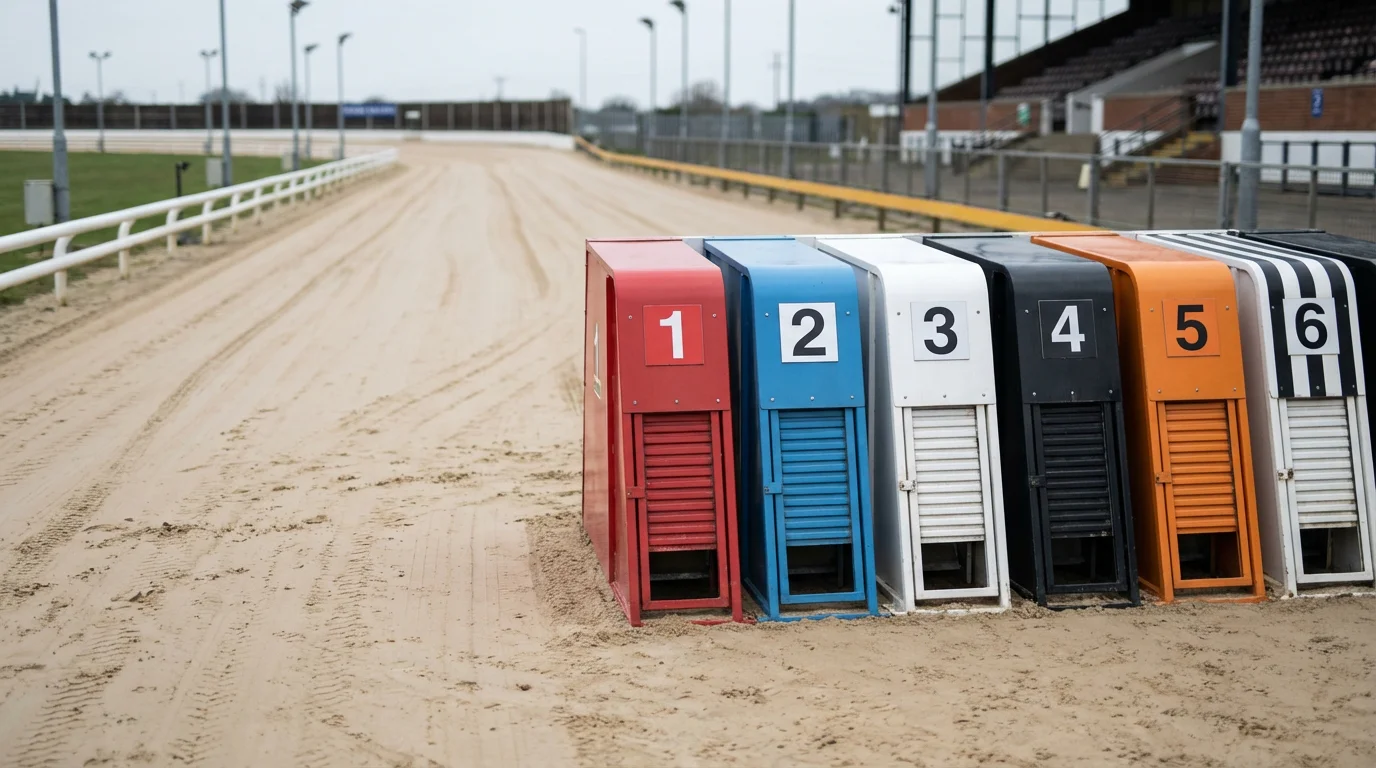
Trap bias in greyhound racing is real, measurable and consistently underexploited by casual punters. At Romford — one of the highest-volume BAGS tracks in the country and a clockwise circuit with a tight first bend — trap 1 has historically produced a disproportionate share of winners over sprint distances. The inside runner gets first crack at the rail, can find the fastest line through the opening bend, and in a short race that early advantage is often decisive. The bias is not absolute — a slow-breaking trap 1 dog in a field of quick-trapping wideners can still get beat — but the statistical baseline is skewed enough to be meaningful.
Wimbledon operates differently. As a clockwise track with a longer run to the first bend compared to tighter sprint circuits, dogs drawn in wider traps — particularly traps 5 and 6 — can find a clear run and avoid early crowding. The geometry rewards wide runners with pace, and the trap bias at Wimbledon reflects this. The point is not that one trap is always good and another always bad; the point is that each track has its own bias pattern, and that pattern is derived from the physical geometry of the circuit and the prevailing racing style of dogs competing there.
The practical method for cross-referencing trap performance is straightforward. Take the last 30 days of results at the specific track you are analysing — most bookmaker data services and the GBGB’s own results section provide this. Calculate win rates by trap for the distance category you are betting on. Then look at the individual dog: does its racing style match the advantaged traps? A rail-hugging inside runner in trap 1 at Romford on a sprint is a different proposition to the same dog drawn in trap 6. A wide-running galloper in trap 6 at Wimbledon over a middle distance is being handed its preferred ground.
Individual dog preference matters as much as statistical trap bias. A rail runner in trap 1 at a track with a proven inside bias is a different proposition to the same dog drawn in trap 6. Check both elements — the track’s aggregate trap stats and the individual dog’s preferred running line — before assuming the bias works in your favour.
Grade and Class Levels
The GBGB grading system sorts every licensed dog into a narrow band of competition. The primary scale runs from A1 — the fastest dogs at a given venue — down through A8. B grades cover staying distances, S grades cover sprints. A1 at Romford is not the same standard as A1 at a smaller track; grade is always relative to the venue, not absolute across the sport.
Grade changes are the most readable signal on a form card. A promotion from A4 to A3 after a run of wins is earned performance; the question is whether the step up is too large. A drop from A3 to A4 after a run of losses may reflect a trainer placing a dog deliberately — recovering confidence, or setting up a win in a weaker grade. Experienced greyhound trainers manage grade strategically, and a class drop combined with a trainer known for accurate placement is worth tracking. If a dog is running consistently below its recent grade history with no clear explanation, the question is always why — and the answer is usually in the trainer’s pattern.
Trap bias is track-specific and season-specific. Always check the last 30-day trap stats for the specific venue you are betting on, not national averages — track surfaces, maintenance schedules and competitive populations shift the bias patterns through the year.
Odds, Value and the Bookmaker Edge
SP on greyhounds is taken later and moves faster than horse racing — the window for value closes in seconds. In horse racing, a market might be open for hours before the off, with prices drifting and shortening in response to stable money, public sentiment and tipping activity. In greyhounds, the early price window is short and the market is thinner. When the money comes, it comes fast, and bookmakers respond quickly. The punter who has done the work in advance — assessed the form, identified a price that looks generous, and is ready to act — has a genuine edge over the one waiting to see what the market does first.
How Greyhound Odds Are Compiled
Bookmakers compile greyhound prices from a combination of internal pricing models and external data — mainly the official form data supplied by the track and aggregated by data services such as SIS (Sports Information Services) and Timeform. The starting point is a “tissue price,” an internal estimated probability for each dog based on recent form, trap draw and grade. The tissue is adjusted based on any market intelligence the bookmaker has access to — weight of money on early prices, known trainer activity, any unusual betting patterns. By the time the race is a few minutes away, the prices on the board reflect a combination of statistical form assessment, market positioning and the bookmaker’s own margin.
The bookmaker’s margin on a standard six-runner greyhound race typically sits between 15% and 25% — higher than most horse racing markets. The excess over 100% when you sum the implied probabilities of all six runners represents the overround — the bookmaker’s structural edge. This means backing selections randomly results in a long-run loss regardless of how well you read form. Finding genuine value — prices that exceed the true probability — is the only route to positive expectation. Given the speed and volume of BAGS racing, compilers are not infallible on every race, and the attentive punter who focuses on a small number of tracks will find genuine value more often than a generalist model expects.
Tote vs Fixed-Odds
Pool betting through the Tote operates on a fundamentally different economic model to fixed-odds. Rather than the bookmaker setting a price and taking a position, pool bettors all contribute to a single pot. After the race, the Tote deducts its margin (typically around 16–17%) and divides the remainder proportionally among winning ticket holders. The dividend is not known in advance — it is determined by how the public has distributed its money across the six runners.
When does Tote pay better than fixed-odds? The sweet spot is a race where the public overbacks the favourite and underbacks the eventual winner. If the market’s expectation is wrong and a dog that attracted only a small fraction of pool money wins, the dividend can be significantly higher than the SP. Conversely, if the public backs the right dog and it wins, the dividend will often be lower than the fixed-odds price — the money was already there, bidding down the return.
For short-priced favourites in straight win markets, fixed-odds will almost always pay better than Tote. For forecast and combination bets, the calculus changes. The Tote Jackpot — covering the winners of six nominated races — and the Placepot — covering placed dogs across the same six — can produce returns that are structurally unavailable in the fixed-odds market. A Placepot ticket covering multiple combinations across a six-race card can cost a few pounds and return several hundred if the meeting produces results that spread the pool among a small number of winning tickets. The variance is high, but so is the ceiling.
Betting Exchanges for Greyhounds
Betfair is the dominant exchange for greyhound betting in the UK; Smarkets offers an alternative with a slightly lower commission structure. The fundamental difference between an exchange and a bookmaker is that on an exchange you are betting against other users rather than against the house. When you back a dog at 4.0 on Betfair, someone else has laid that dog at 4.0 — they are betting it will not win. The exchange takes a commission on net winnings (Betfair’s standard rate is 5%, though premium charges apply to profitable long-term accounts) rather than building a margin into the price itself.
Exchange prices on greyhound markets are typically better than bookmaker prices, sometimes materially so. The overround in a bookmaker’s six-runner market often sits above 20%; the exchange market for the same race might operate at a fraction of that, with the implicit margin close to the commission percentage alone. For a punter making regular bets over a long period, the difference in prices between taking SP at a bookmaker and trading pre-race on Betfair can represent a substantial improvement in expected return.
Lay betting — unique to exchanges — means backing a dog not to win, acting as the bookmaker for that outcome. The liability is stake × (price − 1): laying a 6.0 shot at £10 means a £50 payout if it wins. In-play exchange trading on greyhounds is theoretically possible but practically negligible — the market suspends before the first bend.
Once you understand where value hides in the market — whether in SP, the Tote, or the exchange — the next decision is which operator actually gives you the best access to that value and the markets that matter.
Best Bookmakers for Greyhound Betting UK
Not every bookmaker treats greyhound punters the same — some are built for it, others tolerate it. The criteria that separate a strong greyhound book from a mediocre one are specific: does the operator offer the full range of forecast and tricast markets? Do they cover the entire BAGS schedule? Is Best Odds Guaranteed available on greyhound win bets? Is there live streaming of races? Can you cash out a greyhound accumulator? These are not features every bookmaker prioritises equally, and the gaps are real.

Betfair is the standout for punters who want the best available prices — the exchange side consistently beats fixed-odds prices on greyhound win markets, and BAGS coverage with streaming is comprehensive. William Hill is among the strongest traditional bookmakers for dogs: full BAGS coverage, BOG on greyhounds for selected meetings, and forecast and tricast markets across the schedule. Ladbrokes provides strong streaming and carries the full BAGS rota with an accessible form guide. bet365 leads on market range with combination forecast, tricast, Tote and accumulator cash-out all available; BOG is less consistently applied to greyhounds here, so check terms. Coral is strong on CSF forecast markets. Note that Coral and Ladbrokes share the Entain group structure — limits and promotions are aligned across both, so treat them as one pool rather than two independent accounts.
The single most impactful feature for a regular punter is BOG availability combined with full BAGS coverage. BOG means that if you take an early price and SP comes in higher, you are paid at SP. On greyhounds, where markets can shift materially in the final minutes, BOG protects the value of early selection. Not every bookmaker offers it on dogs, and the terms are worth confirming before you place.
- Check BOG availability before placing ante-post greyhound bets — terms vary between operators and are not always applied uniformly to dogs.
- Use odds comparison tools when placing each-way forecast markets — price differences of 10–15% between operators on the same race are common.
- Assume all bookmakers offer CSF — some settle forecasts at fixed dividends only, which can be less generous depending on the race outcome.
- Open multiple accounts at Ladbrokes and Coral treating them as independent operators — they share limits and promotional eligibility under the Entain group structure.
UK Greyhound Betting Regulation and Legality
Greyhound betting in the UK sits inside one of the most tightly regulated gambling frameworks in the world. The primary legislation is the Gambling Act 2005, which established the UK Gambling Commission (UKGC) as the independent regulator responsible for issuing licences, setting standards and enforcing compliance. Every bookmaker legally offering greyhound betting in the UK — whether in a betting shop, online, or via a mobile app — must hold a current UKGC operating licence. Checking that licence number, which is displayed in the footer of every compliant operator’s website, is the single simplest protection available to any punter.
The UK Gambling Commission sets the rules for what operators can and cannot do: how they handle customer funds, what responsible gambling tools they must provide, how they respond to problem gambling indicators, and how they manage the integrity of markets. Operators are required to have anti-money-laundering procedures, age verification processes and self-exclusion mechanisms in place. Failure on any of these fronts carries significant consequences — several major operators have faced multi-million-pound penalties in recent years under UKGC enforcement action. The regulator’s official website maintains a public register of licensed operators.
From the taxation side, UK bettors do not pay tax on their winnings — a position that has been in place since 2001. Operators pay a 15% Point of Consumption Tax (POC) on all gross gambling yield generated from UK customers, regardless of where the operator is based. This was introduced in 2014 to level the playing field between UK-based and offshore operators and currently applies to all licensed remote gambling activity. The customer never sees this tax as a line item; it is absorbed into the bookmaker’s pricing model and reflected in the overround.
The GBGB welfare standards connect directly to betting integrity. Tracks operating under GBGB licence maintain veterinary oversight at every meeting, record all injuries and report unusual incidents. A sport where dogs routinely underperform due to undisclosed conditions or interference has a pricing problem that harms bettors. The welfare framework is not incidental to the betting product; it is part of its foundation. In 2026, affordability checks and enhanced safer gambling obligations introduced following the Gambling Act review are now in effect across UK-licensed operators — most casual bettors will not notice them, but higher-stakes accounts may be asked to provide evidence of income at lower thresholds than previously applied.
In-Play and Virtual Greyhound Betting
Live betting on greyhounds is a different discipline — the race is over before most people finish reading the markets. The fundamental challenge with in-play greyhound betting is time: a standard 480-metre race lasts approximately 28–30 seconds. By the time the traps have opened and the first bend has been navigated, a significant portion of the available event has elapsed. Most bookmakers respond to this by suspending in-play greyhound markets at or very shortly after the off, leaving only a narrow window in which in-play activity is technically possible.
On exchanges, Betfair technically maintains an in-play greyhound market, but liquidity dries up almost immediately and suspension comes before the first bend in most cases. In-play trading on greyhounds is a highly specialist activity that bears no resemblance to patient form-based betting.
Virtual greyhound betting is a separate product entirely. Virtual greyhounds are computer-generated simulations using RNG (random number generator) systems to determine race outcomes. The visual presentation is designed to look like real racing — animated dogs in numbered traps, finishing in apparently realistic ways — but the outcomes are statistically random, without any form, trap history or class system to analyse. Virtual greyhound betting markets are available round the clock and run on cycles of a few minutes between races, which makes them attractive for entertainment and immediate action but structurally unsuitable for any form-based strategy.
The appeal of virtual dogs for some bettors is the pace and availability — they are always running, and the results come quickly. The honest assessment is that virtual greyhound betting is a pure RNG product and should be treated as such. The margins on virtual markets are often higher than on real racing, and no amount of trap analysis or form reading applies. If you are using real greyhound form skills to try to beat virtual markets, you are applying the wrong tool.
Pre-Race Checklist — Real Greyhound Bets
- Check trap bias data for this specific track, not national averages — last 30 days minimum.
- Confirm BOG or early price advantage before placing — know which operator applies it to greyhound markets today.
- Verify the dog’s last five runs at this grade and distance at this venue specifically.
- Set your stake limit before opening the bet slip — not after you have already decided on the selection.
Frequently Asked Questions
Three questions that come up every time someone starts betting on greyhounds.
How does each-way betting work on greyhounds?
An each-way bet is two equal stakes: one on the win, one on the place. In standard six-runner greyhound races, each-way pays on the first two places at one-quarter (1/4) of the win odds. In seven or eight-runner races, three places are paid at the same fraction. The win and place portions settle independently. If your selection wins, both parts pay out; if it finishes second in a six-runner race, only the place portion pays. Example: a £5 each-way bet on a 6/1 shot costs £10 total. A win returns £67.50 profit; a second-place finish returns a net £2.50 profit after the win stake is lost. Each-way makes sense when you have a genuine reason to think the dog will hit the frame — not as a general hedge when you are uncertain about the race.
What is a forecast bet in greyhound racing?
A forecast bet requires you to predict the first and second-placed dogs. In a straight forecast, they must finish in the named order. In a reverse forecast, both orders are covered at double the stake. UK forecast bets settle using the Computer Straight Forecast (CSF) — a dividend calculated at starting prices. Early prices taken on a win bet do not affect the CSF payout; forecasts always settle at SP. Some bookmakers offer fixed dividends instead of CSF; these are more predictable but often less generous. When two closely-matched dogs are likely to dominate a race and you cannot confidently call the order, the reverse forecast is the better option — it covers both outcomes at twice the unit stake.
Which bookmakers offer the best greyhound odds in the UK?
William Hill and Coral offer competitive fixed-odds prices with BOG on selected greyhound meetings. bet365 and Ladbrokes cover the full BAGS schedule with forecast and tricast markets available. For pure price quality, Betfair’s exchange typically beats all bookmaker fixed-odds on greyhound win markets — the structural margin is lower because you are betting against other users rather than against the house. Before taking early prices on greyhounds, always confirm BOG availability on your chosen operator — terms vary and are not always applied as consistently to dogs as to horse racing. All operators mentioned hold current UKGC licences; check the Gambling Commission’s register before opening a new account.
Gambling responsibly: If you are concerned about your gambling, BeGambleAware provides free confidential support. Self-exclude from all UKGC-licensed sites at once through GamStop. Never bet more than you can afford to lose. Under-18s cannot legally gamble in the UK.
Six Dogs, One Straight: The Punter’s Real Edge
The track doesn’t lie — but the form card only tells you what already happened. Greyhound betting rewards specificity in a way that few other markets do. The punter who spends three months studying Romford’s trap bias across sprint and middle-distance grades, who tracks the win rates of the yard with the highest strike rate on the Monday BAGS fixture, who knows which dogs run their best races on firm going — that punter is operating with a genuine informational edge over the algorithmic pricing model that has to cover thirty simultaneous races across six venues.

The algorithmic model is fast, consistent and broadly accurate across the full card. It is not deeply accurate on any single race, and it cannot account for the local knowledge that comes from systematic focus. That asymmetry is where the retail punter’s edge lives.
The practical prescription is straightforward. Specialise by track rather than trying to cover the entire BAGS schedule. Pick two or three venues where you are willing to build a working knowledge of the geometry, the trap bias patterns and the grading structure. Build a form-reading routine that starts with venue-specific results before broadening to the dog’s general history. Use exotic bets — forecasts, combination tricasts, Tote Placepots — as deliberate tools for specific race types, not as routine replacements for the win bet. And treat staking as seriously as selection: a correct selection at the wrong stake size, or a correct selection followed by a panic accumulator, erases the edge that the form work created.
Dog racing is one of the few markets in the UK where a retail punter with a notebook, a disciplined approach and a willingness to specialise can genuinely outperform a generalised pricing model on local knowledge. The races run fast. The information is publicly available. The edge is there for the punter who builds it methodically — and consistently loses for the one who arrives looking for a shortcut.
