
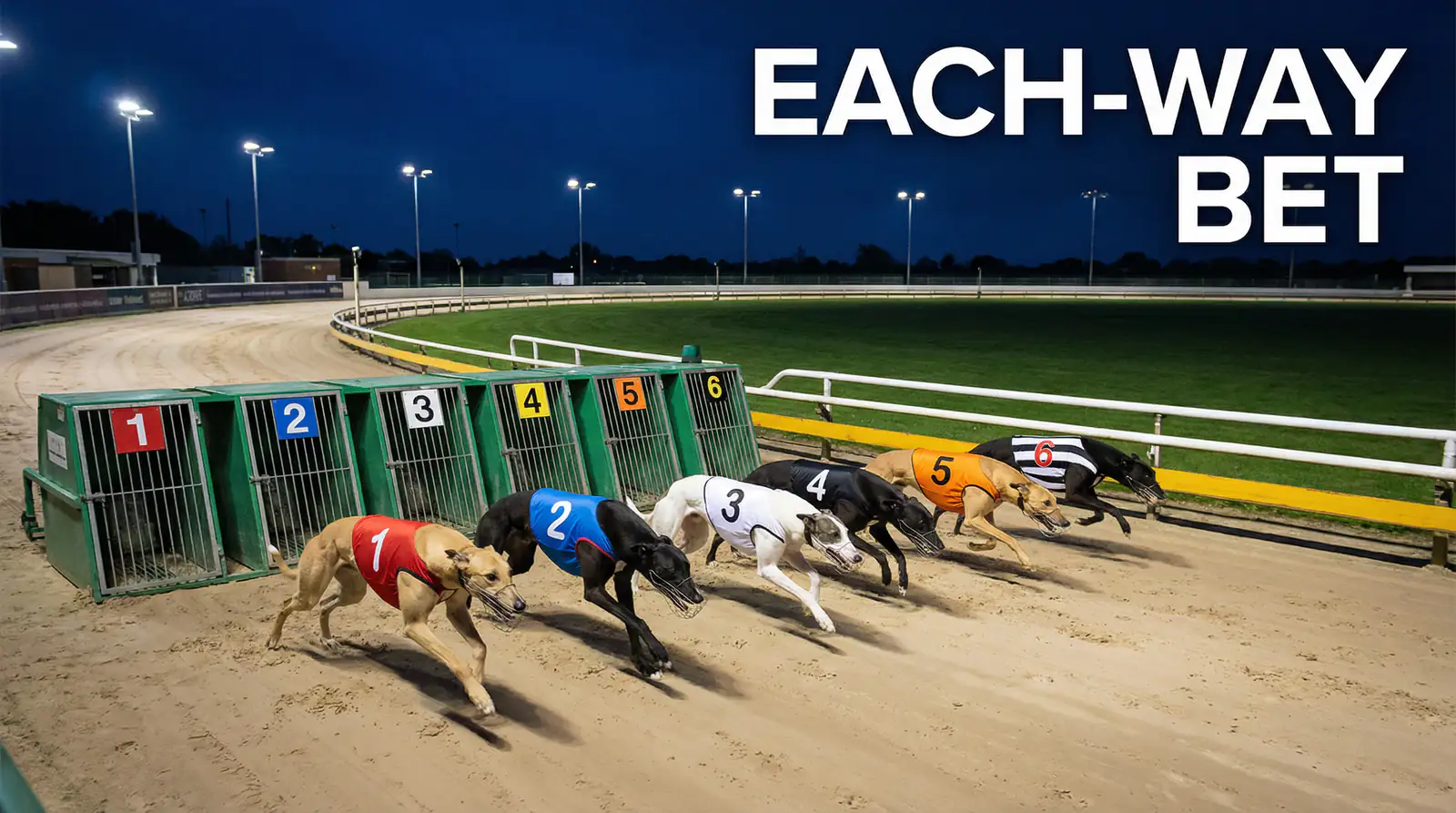
Each-Way Basics for Greyhound Bettors
An each-way bet is two bets placed simultaneously at the same unit stake: one on the selection to win, and one on it to finish in a specified place. If the dog wins, both the win part and the place part pay out. If it finishes in a place position without winning, only the place part pays. If it finishes outside the places, both parts lose. The total cost of a £1 each-way bet is therefore £2 — a fact that trips up more casual punters than any other aspect of the market.
In horse racing, each-way betting is deeply embedded and extensively promoted. In greyhound racing, it is available but less universally applied — not every race is eligible, and the place terms vary significantly by field size in a way that has a direct mathematical effect on whether the bet makes sense. Understanding those terms is not optional. Placing each-way bets on greyhounds without checking the applicable place terms first is the equivalent of accepting a dividend without knowing the fractions used to calculate it.
The place part of an each-way bet pays at a fraction of the win odds. In greyhound racing, that fraction is typically one quarter or one fifth, depending on the bookmaker and the race conditions. A dog at 8/1 with a one-quarter place fraction returns 2/1 for the place part. The same dog with a one-fifth fraction returns 8/5. The difference between these two outcomes matters when you are assessing whether the each-way bet justifies its doubled stake — and that assessment requires knowing, before you place the bet, exactly which fraction applies.
Each-way is only available when the field is large enough to support a place market. Most bookmakers require a minimum of five runners to offer each-way terms on greyhounds. In the standard six-runner BAGS race, each-way is universally available. In the relatively rare five-runner race, it depends on the operator. Below five runners, each-way is typically not offered. If you habitually back each-way without checking the field size, you will occasionally be offered win-only terms when you expected place coverage — a situation that changes your effective stake exposure significantly.
It is also worth establishing how greyhound each-way differs from horse racing each-way in practice, because many punters migrate between the two markets and carry assumptions that do not transfer cleanly. In horse racing, each-way terms can be quite generous — three or four places at one quarter are common in handicaps with large fields. In greyhound racing, the standard six-runner field produces far more restrictive terms, and the product behaves differently as a result. The punter who expects horse racing generosity in a greyhound context will frequently be disappointed, particularly on placed finishes at shorter prices where the fraction-adjusted place return barely covers the cost of the additional stake.
Place Terms: 5, 6, 7 and 8 Runner Fields
Place terms in UK greyhound betting are determined by field size, and the relationship between the two is more structured than many punters realise. The standard terms used by most bookmakers follow a clear pattern, though the precise fractions and qualifying field sizes vary between operators and are not universally standardised.
For a five-runner race, most bookmakers pay two places at one quarter of the win odds. Two places means first and second. If your dog finishes third in a five-runner field under these terms, the place part of your each-way bet loses. That is a smaller place safety net than most punters expect, and it is the primary reason that each-way betting on five-runner greyhound races requires careful consideration before committing.
In a six-runner race — the most common field size in BAGS racing — the standard terms are again two places at one quarter of the win odds, though some bookmakers extend this to three places on six-runner fields. The difference is significant. Under two-place terms, only the winner and runner-up collect on the place part. Under three-place terms, a dog finishing third in a six-runner race still returns a place dividend. Checking which terms apply before placing a six-runner each-way bet is not pedantry — it is the difference between a placed finish that pays and one that does not.
Seven-runner fields typically attract three-place terms at one quarter of the win odds with most bookmakers. This is more generous coverage, and it is where each-way on greyhounds starts to function closer to how it works in horse racing. Eight-runner fields follow a similar pattern: three places at one quarter, with some operators offering one fifth of odds in fields of eight or more as compensation for the wider field and lower per-runner probability.
The practical implication of these structures is this: the larger the field, the more justifiable the each-way bet becomes from a pure coverage standpoint, because the probability of finishing in the places is higher relative to the fraction being paid. A dog at 8/1 finishing third in an eight-runner race still generates a meaningful place return under standard terms. The same dog finishing third in a five-runner race generates nothing. Field size is not background information — it is central to the each-way decision.
One further complication: some bookmakers apply enhanced place terms for specific races or as promotional offers. Enhanced each-way terms — three places on a six-runner race, for example, or a higher fraction on a nominated race — are occasionally available and worth using when they appear. They are not permanent features of the market, and they do not alter the baseline terms described above. Treat them as opportunistic additions rather than standard expectations.
Calculating an Each-Way Payout
The arithmetic of an each-way payout is straightforward once the components are clear. The total return from a winning each-way bet has two parts: the win return and the place return. The total return from a placed-but-not-winning each-way bet has one part: the place return only, plus the return of the place stake. The win stake is lost when the selection does not win.
Take a concrete example. A £2 each-way bet on a dog at 6/1 in a six-runner race with two-place terms at one quarter of the win odds. Total outlay: £4 (£2 win, £2 place).
Scenario A: the dog wins. Win return: £2 stake × 6/1 = £12, plus the £2 stake returned = £14. Place return: £2 stake × (6/1 ÷ 4) = £2 × 3/2 = £3, plus the £2 stake returned = £5. Total return: £14 + £5 = £19. Profit on £4 outlay: £15.
Scenario B: the dog finishes second. Win stake is lost. Place return: £2 × 3/2 = £3, plus £2 stake = £5. Total return: £5 on £4 outlay. Profit: £1. The each-way bet has returned a small profit despite the dog not winning.
Scenario C: the dog finishes third or worse in this two-place market. Both the win and place parts lose. Total return: £0. Loss: £4.
The fraction applied to the place odds is critical. With a one-quarter fraction on a 6/1 shot, the place odds are 3/2. With a one-fifth fraction on the same price, the place odds are 6/5. The difference between getting paid at 3/2 and 6/5 on a placed finish is not trivial over a sequence of bets, particularly when backing shorter-priced selections where the fraction-adjusted place odds approach evens or below.
A common mistake is backing each-way on a short-priced selection without considering whether the place odds justify the additional stake. A dog at 2/1 with a one-quarter place fraction returns only 1/2 for the place part — that is worse than even money, and it means you need the dog to win to make the each-way bet profitable. Backing a 2/1 shot each-way at one quarter odds is mathematically equivalent to placing a win bet with a thin insurance policy that only pays out at 1/2. It is rarely worth the double stake.
The break-even point for an each-way bet is worth understanding. If you back a dog each-way and it places but does not win, you need the place return to at least cover the total outlay for the bet to break even. On a £1 each-way stake (£2 total), breaking even on a placed finish requires a place return of at least £2 including the stake returned. For a one-quarter fraction, this requires the win odds to be at least 4/1. At 3/1, a placed finish returns only £1.75 — a loss of 25p per £2 staked. That is not disaster, but at scale and frequency, it is a meaningful drag on returns that many each-way punters never properly account for.
When Each-Way Greyhound Bets Offer Value
Each-way betting on greyhounds is not automatically a value proposition, and treating it as one is a reliable way to erode a bankroll steadily. The market has specific conditions under which an each-way bet makes mathematical sense, and those conditions are more restrictive than most casual punters appreciate.
The clearest case for each-way value is a genuinely priced outsider in a larger field, where the probability of a place finish is meaningfully higher than the implied probability of a win — and where the place odds, after applying the fraction, still represent a positive expected return on the place part alone. This requires the dog to have a realistic probability of finishing in the places even when its win chance is modest. A dog drawn in a favourable trap with documented place consistency at this grade and track, available at 8/1 or longer, is the prototype each-way candidate.
The calculation is simple enough to run quickly. If you estimate a dog has a 35% chance of finishing in the places but the implied probability of the place odds is 25%, you have a value each-way bet on the place part. If the place implied probability exceeds your estimate, the place part is overpriced — and in that situation, the each-way bet is only justified if the win part also offers value. Both parts need to clear their own hurdle independently.
Where each-way betting consistently fails to offer value is on short-priced selections. A dog at 6/4 favourite in a six-runner field might have a 40% chance of winning. Its place fraction at one quarter gives you place odds of 3/8, implying about a 73% win probability on the place part. Unless you genuinely believe the favourite has a 73% chance of placing, that part of the bet is overpriced. You are paying for coverage that is statistically too expensive at that price.
There is also a more nuanced case for each-way bets in races where the form is genuinely compressed — where three or four dogs look nearly identical in ability and trap assignment. In those races, your selection’s win probability is lower because competition is tight, but its place probability is higher for the same reason. An each-way bet at, say, 4/1 in a race where any of four dogs could win can make sense when the place fraction is generous and your specific dog has a structural advantage that slightly increases place probability beyond the market’s implied probability.
Trap draw plays a direct role in each-way value assessment. A dog drawn in a trap with consistent first-bend advantage is more likely to position itself favourably in the early stages, which increases its probability of running into the places even when it cannot maintain race-winning pace throughout. That positional advantage is not always priced into win odds — particularly on short-turn BAGS markets where early prices are compiled quickly — and the each-way market inherits the same underpricing on the place side. Identifying a dog with genuine trap advantage that is not fully reflected in its price is one of the most reliable routes to each-way value in greyhound betting.
The general rule: each-way bets earn their cost when they are backed on mid-range outsiders in larger fields with generous place terms, where your form assessment gives the dog a credible place chance at odds that are not already fully priced by the market. They rarely earn their cost on favourites or very short-priced selections, and they should never be used as a substitute for a genuine win assessment.
Bookmaker Differences in Place Terms
Place terms are not standardised across UK bookmakers, and the differences between operators can materially affect the value of an each-way bet on the same race. This is not a minor technicality — it is one of the most consequential variables in selecting where to place a greyhound each-way bet.
The key variables are the fraction applied to win odds for the place part, and the number of places paid on a given field size. Bookmakers can offer one quarter of odds, one fifth of odds, or in rare cases one third of odds for the place portion. They can choose to pay two places or three places on a six-runner field. Most offer two places at one quarter as standard on six-runner greyhound races, but this is a commercial decision, not a regulatory requirement, and operators can and do vary their terms.
Betfair’s exchange operates differently from fixed-odds sportsbooks. Place markets on Betfair for greyhound racing allow punters to back or lay the place outcome directly, which means the implied place fraction is determined by market supply and demand rather than by a fixed formula. The resulting place odds can be higher or lower than the equivalent bookmaker place return depending on liquidity and market sentiment. Comparing the Betfair place price against the sportsbook each-way fraction before placing is a simple check that occasionally surfaces meaningful differences.
Some bookmakers run each-way promotions specifically for greyhound racing: three places on selected six-runner races, enhanced fractions on certain fixtures, or Best Odds Guaranteed applied to the place part as well as the win part. These promotions are worth monitoring if each-way is a regular part of your betting, but they should not drive which races you bet on — the analytical decision about whether a specific dog represents each-way value must come first, and the promotional terms sit on top of that decision as a modifier, not the other way around.
There is also a specific category of difference to watch for: some bookmakers advertise each-way terms in decimal format rather than fractional. A “place odds” figure of 1.50 displayed on a platform is the same as 1/2 in fractional terms — that is the full return per unit stake, not the profit. If you are accustomed to reading fractional odds and your platform switches to decimal display for the place component, the translation matters. The return at 1.50 on a £2 place stake is £3, of which £1 is profit and £2 is the stake returned. The same return expressed as 1/2 fractional makes the marginal profit more immediately legible.
The practical recommendation is to maintain accounts with at least two or three major operators and check each-way terms before placing on any race where the field size might affect coverage. The fifteen seconds this takes before placing has a meaningful cumulative effect over time on returns from placed finishes. A punter who consistently seeks out the best available each-way terms for the same selection will, over hundreds of bets, collect meaningfully more from placed finishes than one who defaults to a single operator without comparison.
Each-Way Isn’t a Safety Net
Each-way betting is not a safety net. That framing is the single most damaging misconception punters bring to it. A safety net implies that something is protected — and the only thing an each-way bet protects is a placed finish that your win bet would miss. It costs double to access that protection. If your analysis does not justify the doubled stake, the each-way bet is not a cautious approach; it is a more expensive way to lose money at a slower rate.
Use each-way when your selection genuinely has a credible place chance at favourable place odds. Check the terms before placing, every time, without exception. Do not back short-priced dogs each-way and call it sensible risk management. And treat field size as a first-order filter, not an afterthought — a five-runner race with two-place terms and a short-priced favourite is one of the worst possible contexts for an each-way bet. That combination exists in BAGS racing more often than it should, and the punter who knows why it is a problem is ahead of the one who places out of habit.