
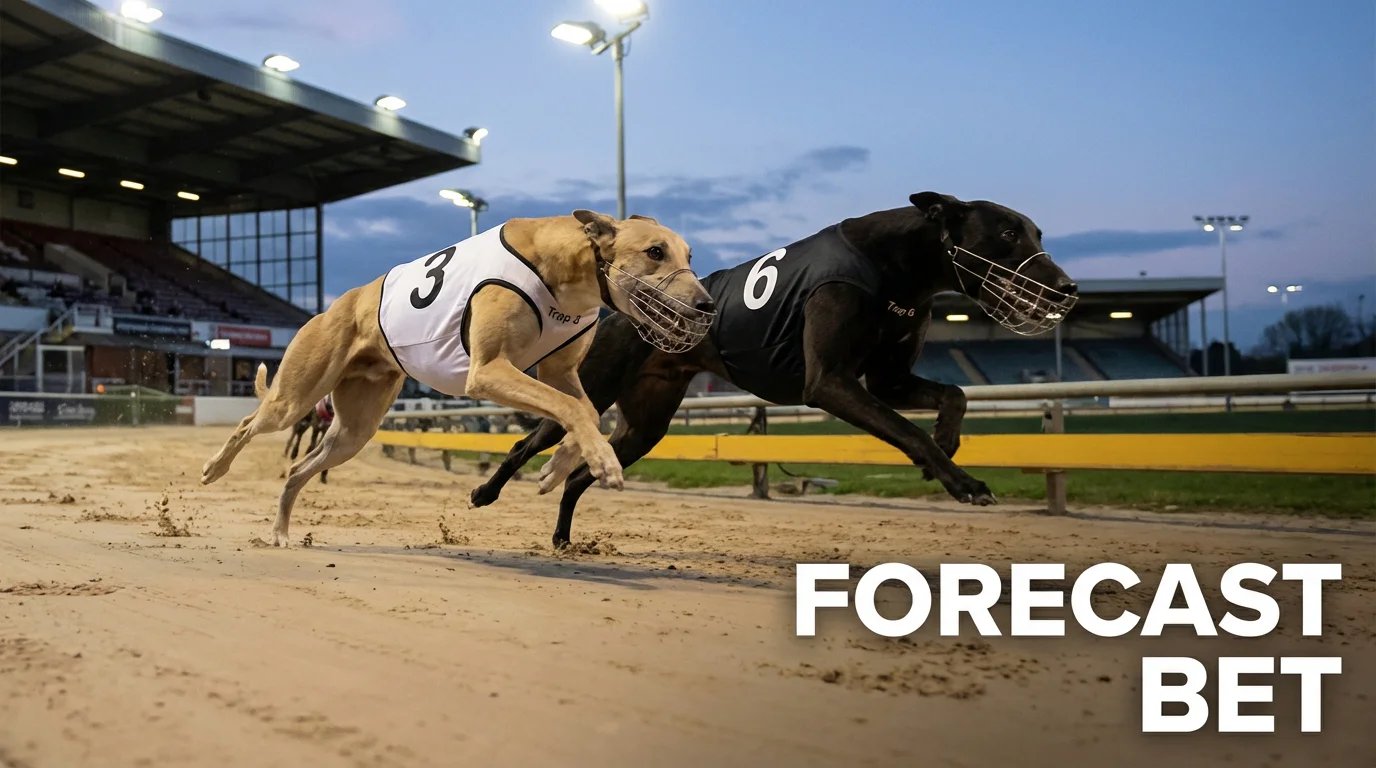
What Is a Forecast Bet?
A forecast bet is a wager on which two greyhounds will finish first and second in a race. Unlike a standard win bet — where you simply pick the winner — a forecast requires you to predict both the winner and the runner-up, making it a harder proposition with correspondingly higher returns. Forecast betting is one of the oldest and most established markets in UK greyhound racing, and it sits at the centre of the exotic bet landscape that distinguishes greyhound wagering from most other sports.
The mechanics are simple enough in theory. A race has six runners. You believe Dog A will win and Dog B will finish second. You place a forecast bet on A-B. If the result comes in exactly that order, you win. If it comes in any other combination — including B first and A second — you lose. That specificity is the trade-off for the enhanced payout.
Forecast bets in the UK are available in three main forms: straight forecast, reverse forecast, and Computer Straight Forecast (CSF). Each has a distinct structure, cost profile, and appropriate use case. Conflating them leads to both incorrect staking and misread results — a common source of confusion for punters new to greyhound markets. Understanding the differences is not optional if you intend to use forecast markets seriously.
Forecast betting is available on all standard greyhound races through major UKGC-licensed bookmakers, including BAGS meetings. Market availability on non-greyhound sports is limited. The forecast bet as a product is essentially native to greyhound and horse racing in the UK, and it is most widely used and most efficiently priced in the greyhound context because of the regularity of six-runner fields.
Straight Forecast
A straight forecast requires you to name the first and second-placed finishers in the correct order. It is the most basic forecast bet and the most unforgiving — the two selections must land in exactly the sequence you specified. There is no tolerance for reversal.
The payout on a straight forecast is calculated using the Computer Straight Forecast formula (which will be explained in detail below) or, in some cases, fixed odds quoted by the bookmaker at the time of the bet. The distinction between these two payout methods is significant and frequently misunderstood. When a bookmaker offers a straight forecast at fixed odds — for example, 12/1 on Dog A to beat Dog B into second place — you know your return before the race runs. When the payout is CSF-based, you do not know the exact return until after the result is confirmed and the formula has been applied.
Most bookmakers default to CSF-based payouts on straight forecasts for greyhound racing, since fixed-odds pricing of every possible two-dog combination in a six-runner field would require significantly more compilation work per race. A six-dog race has thirty possible straight forecast combinations (six choices for first times five remaining choices for second). Pricing all of them individually every race on a BAGS rota that runs eight or more meetings per day is not commercially viable for most operators.
When to use a straight forecast: when you have high confidence in both the winner and the runner-up specifically, and when you believe the race will separate clearly into a dominant front-runner and a specific chaser. Straight forecasts carry the highest expected return per unit stake of the three forecast types precisely because they are the hardest to land. A punter who correctly identifies a race where one trap is strongly dominant and one other dog is consistently the second-fastest at this grade and track can find real value in the straight forecast market.
One practical note: always check whether the bookmaker is paying a CSF or a fixed-odds dividend before placing. Some operators display a forecast price at the time of placing the bet — this is a fixed-odds straight forecast. Others simply accept the bet and return a CSF dividend after the result. The two payouts on the same race can differ substantially. If the displayed odds are materially lower than you expect for the difficulty of the bet, it may be worth querying the payout method before confirming the stake.
Reverse Forecast
Where a straight forecast locks you into a specific finishing order, a reverse forecast releases that constraint — at a cost.
This is where many first-time forecast bettors go wrong: they place a reverse forecast at a £1 stake and expect a £1 payout structure, not realising they have just committed £2. A £1 reverse forecast on Dog A and Dog B equals two £1 straight forecasts — one on A/B and one on B/A. Total outlay is £2. If the result lands in either order, you receive a single CSF dividend calculated for whichever combination actually finished first and second. You do not receive double the payout for placing a reverse. The “reverse” simply means you cover both orderings; it does not increase the dividend.
The payout on a reverse forecast is the same as the straight forecast CSF dividend on whichever combination wins — you do not receive both dividends, and the cost is split across two unit stakes. The net effect is that a reverse forecast typically needs to deliver a higher dividend than a straight forecast to be profitable relative to the doubled cost. That is the inherent mathematical tension of the bet type.
When does a reverse forecast make sense? When you are confident two dogs will dominate the race but are genuinely uncertain which will win outright. A strong favourite running against a proven closer in a race where the pace scenario is unclear is a classic reverse forecast setup. If you believe the race will come down to Trap 1 and Trap 4 but cannot call the winner with any conviction, a reverse forecast gives you coverage at a cost that can still be justified by the combined probability of either outcome.
The reverse forecast is also useful when two dogs are drawn in adjacent traps and have similar running styles, making the finishing order hard to predict but the top-two finishing sequence between them reasonably probable. At tracks with documented wide-trap bias, a reverse forecast on Traps 5 and 6 in a race where the inside runners are weak can yield meaningful returns at a sensible cost. That requires knowing the track, knowing the dogs’ trap histories, and having an opinion on the race — none of which is unreasonable to expect from a punter treating this as a skill exercise.
Computer Straight Forecast
The Computer Straight Forecast is the standard payout mechanism for forecast bets on UK greyhound racing, and it is one of the most misunderstood elements of the market. CSF does not refer to a bet type in the same sense as straight or reverse forecast — it refers to a dividend calculation method applied after the result. Understanding how CSF works is essential if you intend to use forecast markets regularly, because it affects what you should expect to get paid and whether a given forecast represents value before the race runs.
The CSF formula takes the starting price of the winner and the starting price of the second-placed dog and produces a calculated dividend. The formula is derived from a theoretical return based on those two SPs, adjusted to reflect the competitive context of the race. Without going through the full mathematical derivation, the practical effect is this: a race with a short-priced favourite winning and a long-priced second finisher will typically produce a higher CSF dividend than a race where both the winner and runner-up were short-priced. The presence of a long-odds second does significant work in inflating the CSF return.
The inverse is also true and is a more common source of disappointment: a race won by a big-priced outsider ahead of a well-fancied second can still produce a surprisingly modest CSF. This is counterintuitive. The outsider won, so the dividend should be large — but if the second-placed dog was the 6/4 favourite, the CSF formula anchors the return around that short SP for the runner-up, limiting the overall dividend. The formula is designed to produce a fair return across the combination, not simply to multiply the winner’s odds.
SP on greyhounds is taken later and moves faster than in horse racing — the window for value closes in seconds. This applies directly to CSF calculation: the SP used in the formula is the returned SP, not any early price you might have taken. If you back a dog at 5/1 early and it drifts to 8/1 SP, your win bet benefits from the BOG clause at participating bookmakers. Your CSF payout, however, will use the actual returned SPs of both dogs in the calculation, regardless of what early prices were offered. Understanding this asymmetry is important for anyone using forecast markets alongside win markets in the same race.
One practical implication: CSF dividends are not known in advance. You can estimate them using the current market prices, but the actual payout is only confirmed after racing. This makes CSF bets slightly harder to assess for value pre-race, because you are estimating a dividend based on SPs that may shift between now and the off. Several comparison tools and greyhound form services offer CSF calculators that allow you to input current prices and generate an estimated dividend — these are worth using if forecast betting is a regular part of your approach.
When to Use Each Forecast Type
Forecast bets are not interchangeable, and the choice between straight, reverse and CSF-based approaches should be driven by the specific race scenario rather than habit or preference for one format. Each type has a logical home.
Use a straight forecast when your race analysis produces a clear directional view — you believe Dog A will win and you have a specific reason to think Dog B will finish second. The reason matters here. “I think Dog B is the second-fastest in the field” is not the same as “Dog B consistently runs into second place at this grade and track, and the draw confirms it.” The latter justifies a straight forecast. The former is a guess dressed up as analysis.
Use a reverse forecast when your analysis identifies the two dogs likely to dominate the race but the finishing order between them is genuinely ambiguous. The doubled cost is justified when you have good reason to believe the top-two combination will separate from the rest of the field, even if you cannot confidently predict which of the two will win. This is common in races where one trap has clear pace advantage but another has late finishing speed that could overhaul it — the outcome depends on race pace, which is inherently harder to predict than raw ability.
In terms of race types that suit forecast betting generally: BAGS graded races with clear form lines and stable trap biases are better candidates than open races with wider fields and less predictable running patterns. A six-runner A3 at a track you know well, where Trap 1 has a documented first-bend advantage and the second-grade dog stepping down from A2 has a history of running into second place, is a forecast punter’s natural territory. A twelve-runner open invitation at an unfamiliar track with mixed form is not.
There is also a case for avoiding forecast bets in races with closely matched fields where any of four or five dogs could legitimately finish first or second. In those races, the probability of landing your specific combination is low, and the dividend — while potentially large — will rarely compensate for the frequency of losses over a reasonable sample. Forecast value comes from selectivity. Backing every race with a forecast bet because the potential payout looks attractive is how punters bleed money on what appears, on the surface, to be a high-return product.
One final practical consideration: some bookmakers cap CSF payouts on greyhound forecast bets. The cap is usually displayed in the terms and conditions and applies when the calculated dividend exceeds a specified threshold. This matters in races with extreme results — a long-odds winner ahead of a similarly priced second can generate a very large CSF, and if your bookmaker caps at, say, 500/1, you will not receive the full uncapped dividend. Checking the relevant T&Cs before placing larger forecast stakes is not paranoid — it is sensible risk management.
Forecast Bet Examples with Calculations
A few worked examples clarify the cost and payout structures across each forecast type. These are illustrative — actual CSF dividends depend on the specific race SPs and field size.
Example 1: Straight Forecast
Race: six runners. You back Dog A (Trap 3) to beat Dog B (Trap 6) into second place. Unit stake: £1. If Trap 3 wins and Trap 6 finishes second, the CSF formula is applied. If Trap 3 wins at SP 5/2 and Trap 6 finishes second at SP 7/2, the CSF dividend might return around £8–£10 per £1 staked depending on the precise field SPs. If the result is any other combination, the straight forecast loses entirely. Total outlay: £1.
Example 2: Reverse Forecast
Same race. You place a £1 reverse forecast on Trap 3 and Trap 6. This costs £2 (two unit stakes of £1). If either Trap 3 first and Trap 6 second, or Trap 6 first and Trap 3 second, the bet wins. The payout is the CSF dividend for whichever combination actually landed — you receive one dividend, not two. If the CSF for the winning combination is £9, you receive £9 for a £2 total outlay. Net profit: £7. Total outlay: £2.
Example 3: Straight Forecast, outsider wins
You back Trap 1 (4/1 SP) to beat Trap 5 (2/1 SP, the favourite) into second place. Trap 1 wins and Trap 5 finishes second. The CSF will reflect the short SP of the runner-up, producing a modest dividend — perhaps £6–£7 — despite Trap 1 being a 4/1 winner. The relatively short SP of the runner-up suppresses the dividend. If instead the runner-up had been a 12/1 outsider, the same winning trap at 4/1 might generate a CSF of £25 or more. This illustrates the asymmetric influence of the runner-up’s SP on the formula.
These numbers are approximations, not guarantees. CSF dividends can vary significantly from the estimates produced by any pre-race calculator depending on last-minute market movement. The principle, however, holds: the runner-up’s SP does as much work in setting the final dividend as the winner’s. That is the single most useful thing to understand about CSF before placing a forecast bet.
Forecasts Are a Precision Tool
Forecast bets are a precision tool, and precision tools reward precision thinking. A straight forecast placed on a race where you have done the work — identified the trap bias, read the grade history of each dog, accounted for the draw — is a legitimate value bet. The same bet placed because the payout looks attractive without that analytical foundation is simply a more expensive version of guessing.
The CSF mechanism is the foundation of everything in forecast betting, and understanding it is not optional. If you are betting forecasts without knowing that the runner-up’s SP materially shapes your dividend, you are flying blind. If you know it, you can use it — deliberately seeking races where the second-most-likely finisher is available at a long price, because their SP will do significant work in inflating your return if the combination lands.
Reverse forecasts have their place, and it is a more specific place than most punters assume. They are not a hedge on straight forecasts — they are a different analytical statement about the race. If you genuinely cannot call the finishing order between two dogs but can confidently identify that both of them will outperform the rest of the field, a reverse is the correct bet. If you are placing a reverse because you are not sure enough to commit to a straight, that is a different signal — and it might be telling you to skip the race entirely rather than pay double for weaker conviction.