
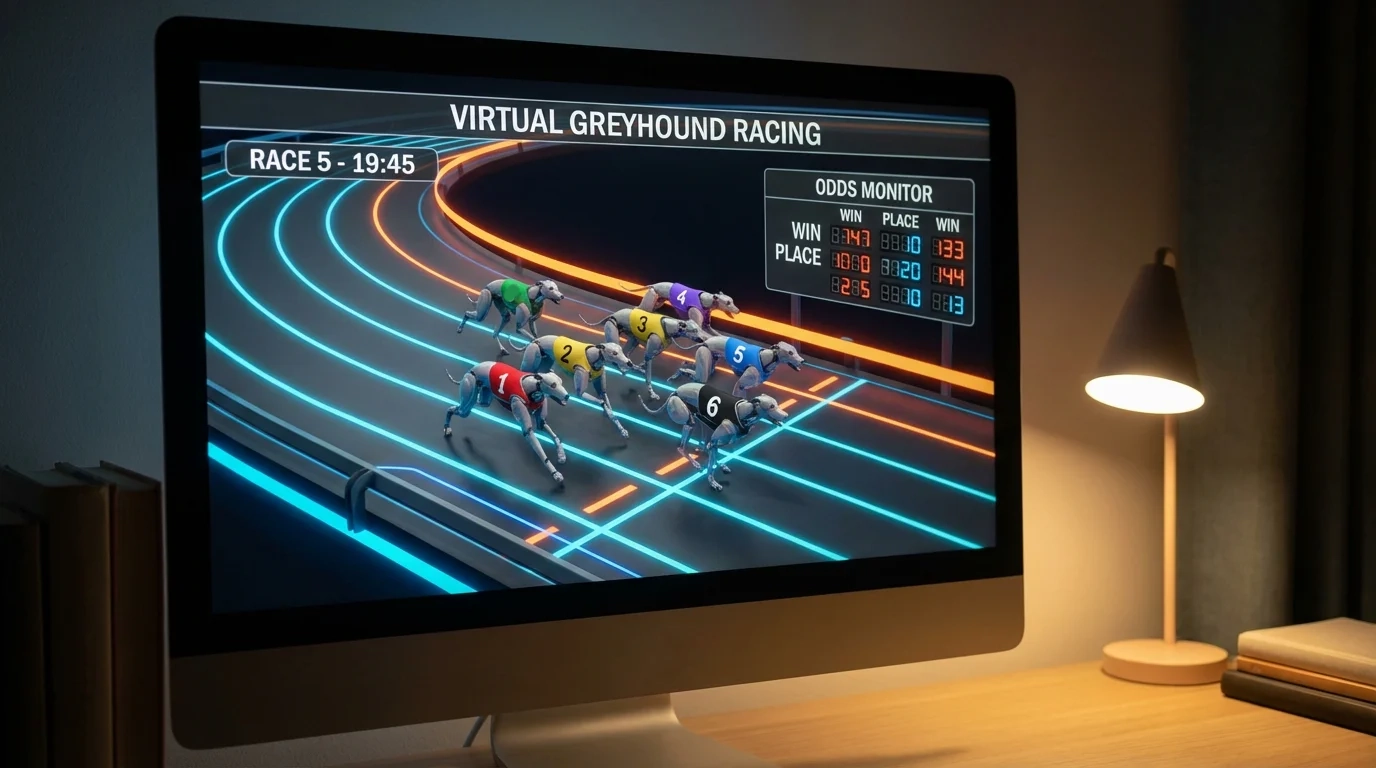
What Is Virtual Greyhound Racing?
Virtual greyhound racing is a computer-generated simulation of a dog race, presented as animated footage and available to bet on at most major UK licensed bookmakers. The races run to a fixed schedule — often every few minutes — and are entirely independent of any real greyhound track, real dogs, or live event. The simulation uses a visual format that mirrors real racing: six traps, a hare, a circuit, and a finishing order that determines which bets win. None of it is real, but the bets are, and so are the stakes.
The format was developed as a gap-fill product — something to bet on between live racing events, particularly during evenings and weekends when BAGS meetings are not running. Today it is a standalone product in its own right, running continuously on most major platforms and available 24 hours a day. In UK betting shops, virtual greyhound racing typically runs on dedicated screens throughout the day. Online, it occupies its own section on most licensed bookmaker sites, separate from real greyhound racing but using the same bet types: win, each-way, forecast, reverse forecast, and tricast.
The key distinction from real greyhound racing is that there is no live event to watch, no actual animal welfare dimension, and no external information that is relevant to the outcome. What the screen shows you is a pre-rendered or real-time generated animation, and the finishing order is determined entirely by the software’s random number generator before or as the race plays out. Understanding this distinction is not just a philosophical point — it has direct implications for how you should approach betting on virtual dogs versus real ones.
How RNG Determines Virtual Race Results
The result of a virtual greyhound race is determined by a certified Random Number Generator — the same core technology used in online casino games and licensed virtual sports products across the industry. Before the animated race plays out on screen, the software has already calculated which dog finishes where, based on a pseudo-random algorithm that produces statistically unpredictable outputs when applied to any individual race.
The RNG is certified by an independent testing laboratory — typically eCOGRA, iTech Labs, or a similar accredited body — as part of the broader software certification required for UKGC licensing. Certification confirms that the output is statistically random across a large sample of results and that no pattern can be reliably exploited to predict individual outcomes. The certification does not mean every individual race is 50/50 — the odds for each virtual dog vary, and those odds are calculated from the distribution of outcomes programmed into the system. A virtual favourite at 5/4 should, over a sufficient sample, win in roughly the proportion implied by those odds. In the short term, variance is as real as it is in any genuine random process.
The odds displayed for virtual greyhound races are set by the bookmaker based on the programmed probability distribution rather than on form, grading, or any other greyhound-specific variable. They are, in essence, the bookmaker’s assessment of the relative probability weights assigned to each simulated dog in that simulated field, with the standard margin built in. Different bookmakers can and do offer different virtual greyhound odds for what is nominally the same product, because they are either using different software suppliers or applying different margin structures to the same underlying probability distribution.
One important technical note: UKGC-licensed operators are required to ensure that their virtual sports products use certified RNG systems. Any virtual greyhound product on a UKGC-licensed platform has passed this certification requirement. Unlicensed offshore operators offering virtual dogs have no such obligation, and the integrity of their RNG cannot be assumed. This is a meaningful distinction for anyone considering using a non-UKGC platform for virtual betting — the product may look identical, but the accountability behind it is categorically different.
Virtual vs Real: Key Differences for Bettors
The most important difference between virtual and real greyhound betting is that no form analysis applies to virtual races. On a real GBGB meeting, you can examine the form string, check the trap bias data, assess the grade, compare times, and weigh the trainer’s recent record. All of that analysis has predictive value, however modest, because real dogs with real histories are running in real conditions at a real track. On virtual races, the dogs are fictional, the history is non-existent, and the outcome is random. There is no analytical edge available.
This is not a subtle difference — it is the central one. Real greyhound betting is a market where information asymmetry and analytical skill can produce a genuine edge for the informed punter. Virtual greyhound betting is, structurally, a fixed-house-edge product. The bookmaker’s margin is the only factor shaping your long-term expected return, and no amount of pattern-finding in previous virtual results will change that expectation. Every race is an independent random draw, and the result of the last virtual race has zero predictive value for the next.
The practical betting mechanics are identical. You place a win, each-way, forecast, or tricast on a virtual race using the same interface and the same bet slip as a real race. Settlement is immediate. The experience on screen can be indistinguishable from watching a real BAGS race if you are not paying close attention to the “Virtual Sports” label. This visual similarity is sometimes cited as a concern from a responsible gambling perspective — the rapid pace of virtual racing, typically every few minutes throughout the day and night, creates a continuous betting opportunity with no natural break imposed by a racing schedule.
Real greyhound racing has one other characteristic that virtual races lack: result integrity. Real races can be objected to, stewards can call an inquiry, and officially revised results affect all bets placed on the race. A virtual race result is final as soon as the animation ends — there is no inquiry mechanism, no stewards’ panel, and no scope for a revised finishing order. For bettors placing forecasts or tricasts, this makes settlement cleaner in one sense — but it also means there is no human oversight of any individual result.
Where to Bet on Virtual Greyhounds in the UK
Virtual greyhound racing is available on virtually every major UKGC-licensed online bookmaker. Bet365, William Hill, Betfair Sportsbook, Paddy Power, Ladbrokes, Coral, Sky Bet, and Betfred all offer virtual dogs as a standard product alongside their real sports betting sections. In most cases the virtual greyhound section is clearly labelled and separated from real greyhound racing, though the exact navigation path varies by platform.
In UK betting shops, virtual greyhound racing runs on dedicated screens as part of the in-shop fixture schedule, typically interspersed with virtual horse racing and other virtual sport formats. The in-shop version is managed by the same operator as the online platform and uses the same certified product, so the mechanics and house edge are consistent between the two channels.
Virtual greyhound products are also available as part of the gaming sections of some UK-licensed casinos and multi-product gambling sites. In these cases the product sits in a context that is more closely associated with casino gaming than sports betting, which is arguably a more accurate framing of what it structurally is. The distinction between virtual sports in a sports betting context and virtual sports in a gaming context is largely one of presentation — the underlying product is the same type of RNG-driven system either way.
Virtual Greyhound Odds and Markets
The odds available for virtual greyhound races follow the same format as real greyhound betting — fractional or decimal prices for each of the six simulated runners, with the same market types available: win, each-way, straight forecast, reverse forecast, and combination tricast on most platforms. The prices reflect the programmed probability distribution for each virtual dog, adjusted for the bookmaker’s standard margin.
One characteristic of virtual greyhound odds that differs from real racing is the predictability of the price range. Real greyhound markets produce a wide distribution of prices — some races are dominated by a single short-priced favourite, others have four or five runners at similar prices. Virtual greyhound fields tend to be priced more uniformly, because the programmed probability distribution is often designed to produce relatively balanced competition across the six dogs. You will see fewer 5/6 on favourites and fewer 20/1 outsiders in virtual fields than in equivalent real graded races. This is not a firm rule — different suppliers configure their probability distributions differently — but it is a broadly consistent pattern across UK virtual sports products.
The house edge embedded in virtual greyhound odds is fixed and consistent across every race. Unlike real greyhound markets, where the bookmaker’s margin varies with the quality of information available and the volume of bets placed, virtual margins are uniform and set in advance. Most virtual greyhound markets operate with an effective overround in the range of 115–120%, which is comparable to or slightly lower than standard BAGS fixed-odds markets. This is not an advantage — it simply means the cost of betting on virtual dogs is broadly similar to the cost of betting on real dogs, without the upside of applying any meaningful analysis to the result.
Virtual Dogs, Real Stakes
Virtual greyhound betting is a legal, UKGC-regulated product available at every major UK bookmaker, and there is no legitimate argument against someone choosing to bet on it with money they can afford to lose. The caveat is the one that applies to all fixed-house-edge products: there is no analytical route to a long-term positive expectation, and the pace of the product — a new race every few minutes, all day and night — makes it easy to accumulate losses quickly without noticing.
If you find yourself using virtual greyhound racing as a substitute for real racing when real meetings are not available, the responsible approach is to set the same session limits and stake limits you would apply to any other betting activity. The virtual product is designed to be entertaining and to generate rapid turnover, and both of those design goals are achieved most effectively when the punter is not paying close attention to the cumulative cost. Set your limits before you start, treat each session as a defined entertainment expense rather than an analytical exercise, and return to the form card when the real racing begins.