
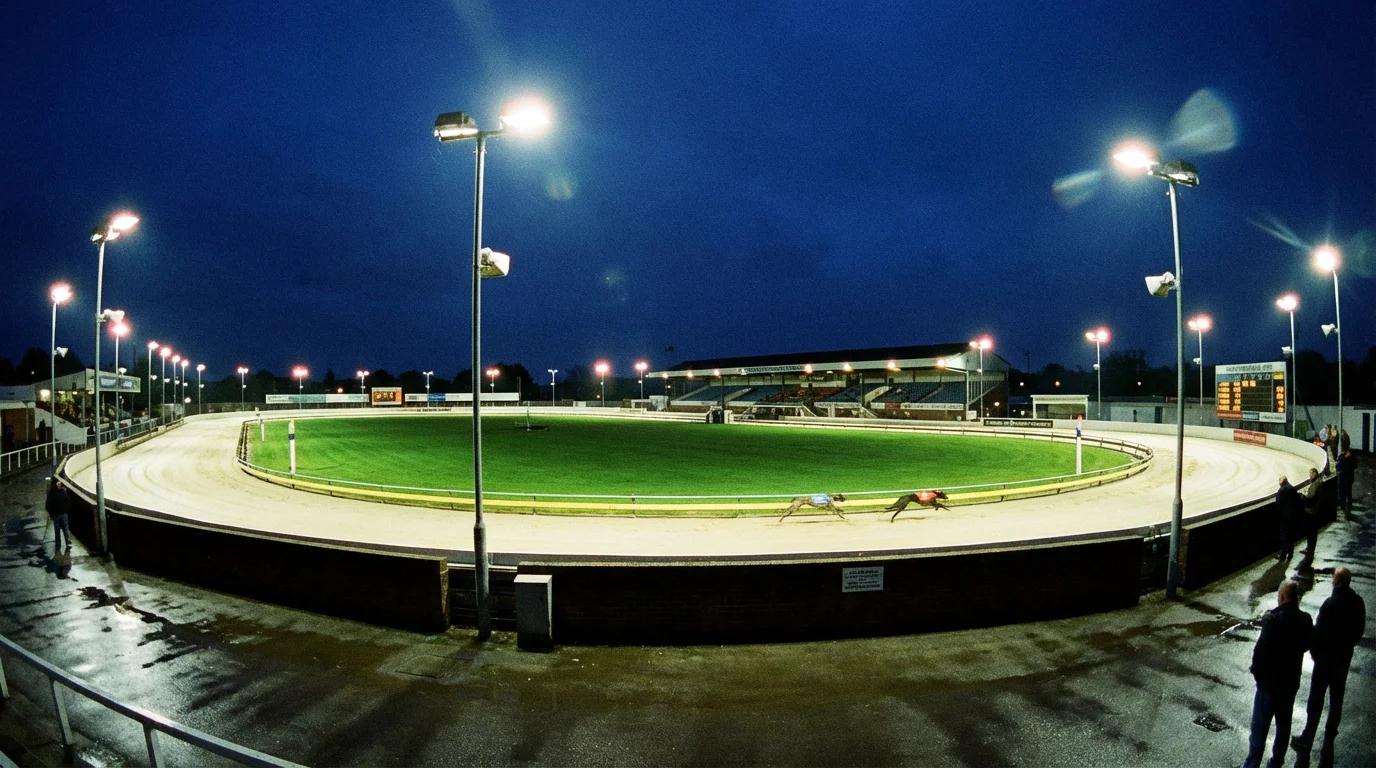
Romford Track Overview
Romford Greyhound Stadium is one of the most significant venues in British greyhound racing — a GBGB-licensed track in Hornchurch, Essex, that has been hosting competitive dog racing since 1929. It is a right-handed oval with a surface consistently rated among the most reliable in the BAGS programme, and it generates some of the highest betting volumes of any UK greyhound venue. For punters who study specific tracks in depth, Romford is one of the most data-rich environments available: long-running, heavily raced, and extensively documented in the Racing Post database.
The stadium operates both as a spectator venue and as a BAGS fixture provider, meaning it runs daytime meetings specifically designed to supply the bookmaker market alongside its traditional evening and weekend programmes. This dual schedule gives it an unusually large sample of race results across grades, distances, and seasons — which is analytically valuable for trap bias and form analysis. The track’s consistent surface maintenance means seasonal variation in going conditions is less pronounced here than at some other venues, producing a more stable form reference across the year.
Romford is widely regarded as a trapper’s track — a right-handed oval where the geometry of the first bend and the distance from traps to turn creates a structural advantage for dogs that break quickly and reach the rail first. This reputation is backed by the data and is reflected, to varying degrees, in how the market prices inside-drawn runners. The extent to which that market adjustment fully prices the trap advantage — or leaves a residual edge for the analytical punter — is discussed in the trap bias section below.
Distances and Race Types at Romford
Romford hosts racing across three primary distances: 400 metres, 460 metres, and 575 metres. The 400-metre sprint is the most frequently run and the most closely followed by the BAGS betting market. It is a genuine short sprint where early pace and trap position have maximum influence on the outcome, and the field reaches the first bend within two to three seconds of the traps opening. The 460-metre distance is an intermediate class that rewards a combination of early break and mid-race stamina, and it tends to produce slightly more variable results than the 400m, because the additional circuit exposure gives wide runners a better opportunity to recover from a slow start.
The 575-metre stayers race is a minority product at Romford but generates its own loyal following among punters who specialise in staying form. The form dynamics at this distance differ substantially from sprints: early pace matters far less, the bend radius and track configuration affect different running styles, and the trap bias data from 400m races does not apply. Stayers form at Romford should be treated as a separate analytical category with its own trap statistics and time benchmarks.
Graded racing at Romford follows the standard GBGB scale: A grades for open competition, B grades for bitches, and S grades for stayers. Open race meetings — including the track’s own feature events and invitation races — attract slightly higher-calibre dogs from other venues and carry higher prize money. These events produce less reliable form comparisons with standard BAGS graded racing, because the competitive level and the dog roster are different. Punters treating an open race result as a direct form benchmark for the next graded meeting should be cautious about the cross-comparison.
Romford Trap Bias Analysis
The trap bias at Romford’s 400-metre sprint distance is one of the most documented and analytically significant in UK greyhound racing. Historical data consistently shows Trap 1 winning at a rate meaningfully above the 16.7% neutral baseline for a six-runner field, with estimates from large samples typically placing the Trap 1 win rate in the range of 20–24% over extended periods. Trap 6 typically wins at a rate below neutral — historical samples cluster in the 11–14% range — reflecting the structural disadvantage of the outside draw at a right-handed track where the run to the first bend is longer and the rail is harder to access from the wide traps.
The mechanism is straightforward. Romford’s 400-metre track is a compact oval with a tight first bend. Dogs drawn in Traps 1 and 2 have a shorter path to the inside rail and can establish a leading position before the field converges at the bend. Dogs drawn in Traps 5 and 6 must either cross inward, risking traffic with dogs from traps 1 through 4, or run wide throughout the bend, covering extra distance and fighting a positional disadvantage that typically costs a length or more on a tight circuit. Over thousands of races, this geometric reality shows up as a measurable and consistent pattern in the results.
The analytical question is whether the market already prices this fully. The short answer is: partially, but not completely. Trap 1 dogs at Romford are routinely marked up by the market — the bookmaker compiling the tissue price is aware of the track’s reputation, and a quality dog drawn in Trap 1 will generally open at a shorter price than an equivalent dog drawn in Trap 6. However, the market adjustment is often insufficient for several specific scenarios. A dog with a strong form record that has run predominantly from middle or wide traps at other tracks, and is now drawn in Trap 1 at Romford for the first time, is frequently underpriced because the market is calibrating on the dog’s form record without fully weighting the new trap advantage. This is the specific overlay that systematic Romford analysis is designed to identify.
Seasonal variation in bias is also worth noting. Track surface conditions fluctuate across the year, and some track maintenance operations — resurfacing, rail position adjustments, drainage work — can temporarily shift the magnitude of the trap advantage. A pronounced inside bias in winter months, when the going is heavier and wider runners struggle more with the surface, may moderate in summer when conditions are faster and more uniform. Checking the most recent 30–60 day trap statistics on Racing Post’s Romford section before treating historical bias figures as current is standard practice for punters who take the track seriously.
BAGS Fixtures at Romford
Romford is a core BAGS participant and appears regularly in the weekday afternoon fixture schedule. BAGS meetings at Romford typically run on a rotating basis with other BAGS tracks, meaning Romford features in the schedule on certain days of the week rather than every day. The specific schedule varies by season and changes as annual BAGS agreements are renegotiated, but Romford’s prominence in the BAGS rota has been consistent across many years.
During a BAGS afternoon meeting at Romford, the track typically runs six to eight races across the sprint and intermediate distances, with race times staggered within the BAGS broadcasting schedule. The grade mix for BAGS meetings is usually A4–A6 for the sprint distances, with occasional B-grade races for bitches interspersed. Top-grade A1 and A2 races are more commonly found in Romford’s evening and weekend programmes, where the prize money and spectator attendance are higher.
Fixture schedules are published in advance through Racing Post and through Romford’s own channels. The GBGB website at gbgb.org.uk also maintains a fixture list that confirms which tracks are running on any given day. For punters planning a session around specific Romford BAGS racing, checking the schedule on Monday for the week ahead gives enough lead time to review the draw and opening prices before the card goes up.
Betting on Romford Online
All major UKGC-licensed bookmakers carry Romford greyhound markets for both BAGS and evening meetings. Bet365, William Hill, Betfair, Ladbrokes, Coral, Paddy Power, and Sky Bet all offer the full range of Romford markets — win, each-way, forecast, reverse forecast, tricast, and combination bets — across every race on the card. The consistency of Romford’s BAGS inclusion in the bookmaker schedule means market availability is reliable and rarely limited to win-only options, which can be the case for smaller or less frequently broadcast venues.
Live streaming of Romford BAGS meetings is available through most major licensed bookmakers who have live video rights agreements in place. The availability of streaming varies slightly by operator — checking the specific platform’s greyhound section before the meeting is the practical step. Betfair Exchange carries Romford pre-race markets and, for supported meetings, in-running markets on the exchange — giving access to both back and lay options for punters who prefer the exchange format over fixed-odds pricing.
For Romford form data, Racing Post provides the most complete publicly available resource: full card history by grade and distance, trap statistics filterable by timeframe, and sectional data where available. Greyhound-Data.com supplements this with an international form perspective for dogs that have run at other venues before arriving at Romford — useful when a dog is making its track debut and you need to form a view on how its style will suit the layout.
Romford Trap 1 Is an Edge, Not a Rule
The single most common error in Romford betting is treating the trap 1 advantage as a blanket selection strategy rather than a probabilistic input into a broader race analysis. A moderate dog drawn in Trap 1 is not automatically a value bet simply because the inside has a statistical edge at this track. The edge is meaningful when the dog in Trap 1 is genuinely competitive on form — when the trap advantage is the marginal factor that tips an otherwise tight race in one direction. It is not meaningful when the dog in Trap 1 is outclassed by three of its rivals regardless of draw.
Use the trap data as the sharpen-the-pencil step, not the pick-the-dog step. Read the form first. Identify the genuine contenders. Then check the draw, confirm the trap advantage applies at the distance and going, and assess whether the market has priced it correctly. When the form analysis and the trap analysis converge — and the market price still reflects uncertainty — that is Romford betting working at its best.