What Is a Tricast Bet?
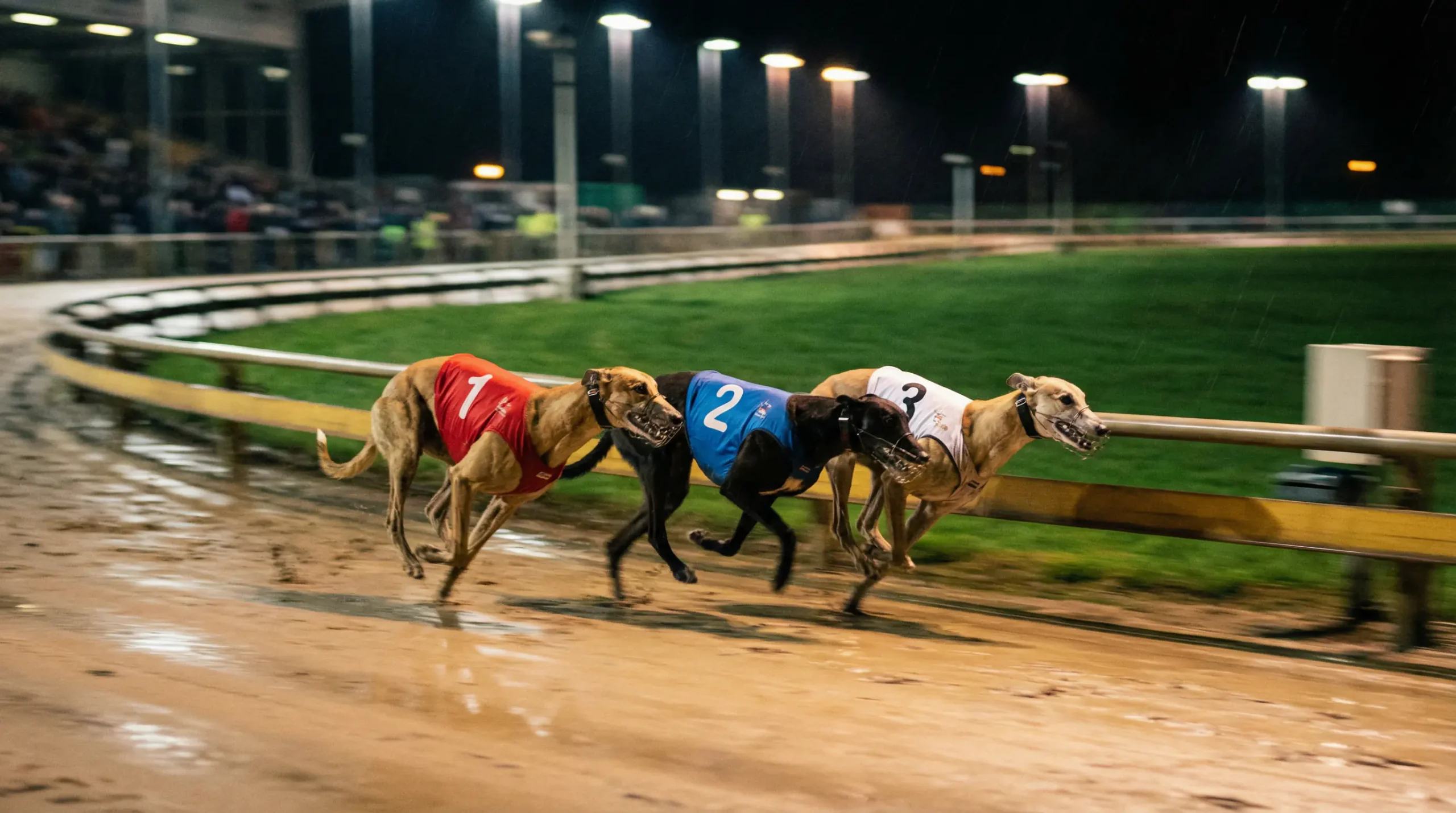
A tricast bet requires you to identify the first, second, and third-placed dogs in a greyhound race — in the correct finishing order. In a standard six-runner field, you are predicting exactly where three of the six competitors will land relative to each other. The odds against getting this right are substantial, which is why tricast payouts can reach multiples of what the equivalent win market would return. The trade-off is simple: higher potential reward, lower hit rate, and a bet that turns any race into a more complex analytical exercise than a straightforward win or forecast.
Tricasts are available at all major UK licensed bookmakers on GBGB-licensed greyhound races and are typically settled using a computer-generated dividend formula — the Computer Tricast — calculated from the starting prices of the three runners involved. Some bookmakers also offer fixed-odds combination tricast prices on selected markets, but the majority of tricast volume in the UK settles at the formula dividend.
Straight Tricast vs Combination Tricast
The straight tricast is the purest form: one selection for first, one for second, one for third — in that exact order, and no other. Trap 2 wins, Trap 5 second, Trap 1 third. Any other finishing arrangement, even one where all three of your dogs fill the top three spots in a different order, is a losing bet. The straight tricast produces the highest potential payout because you are specifying the maximum amount of information — and absorbing the maximum amount of risk.
The combination tricast covers every possible finishing order of your nominated selections. If you name three dogs — say, Trap 1, Trap 3, and Trap 5 — the combination tricast covers all six possible arrangements: 1/3/5, 1/5/3, 3/1/5, 3/5/1, 5/1/3, and 5/3/1. The bet wins as long as your three dogs fill the first three positions in any order. The cost is six times the unit stake, and the return is the Computer Tricast dividend for whichever order actually occurred.
Between these two options sits the partial combination tricast — sometimes called a combination forecast for three selections — but the mechanics matter less than the principle: any time you are specifying more than one selection without a fixed order for a specific position, you are multiplying your stake by the number of combinations covered. Understanding how many bets you are actually placing is the single most common point of confusion in tricast betting, and it directly determines whether the bet is worth placing at all.
In terms of which to use: a straight tricast is appropriate when your analysis gives you a strong directional view — you believe the race sequence will unfold in a specific way because of trap positions, pace patterns, and running styles that you’ve tracked. The combination tricast is correct when you have strong confidence in the identity of the top three but genuine uncertainty about the order. Paying six times the unit stake to cover all orderings is the cost of converting that uncertainty into a flexible position that wins regardless of how the podium is arranged.
Tricast Cost Calculator
The cost of a tricast bet depends entirely on whether it is a straight tricast or a combination tricast, and how many selections you include in the combination. The formula is simple but worth understanding before placing.
A straight tricast on three named dogs, in a specified order, costs exactly one unit stake. £1 unit stake = £1 total cost. The selection is precise, the number of bets is one, and the cost reflects that.
A combination tricast on three dogs covers 3 × 2 × 1 = 6 arrangements. At a £1 unit stake, the total cost is £6. This is the most common tricast bet in UK greyhound betting.
A combination tricast on four dogs — covering any three of your four selections in the top three positions, in any order — is more complex. The number of combinations is 4 × 3 × 2 = 24, giving a total cost of £24 at a £1 unit stake. This is where many punters are surprised by their bet slip total. Going from three to four selections in a combination tricast quadruples the number of bets. At £2 unit stake, a four-dog combination tricast costs £48 — a stake that can quickly exceed the realistic expected return even on a generous tricast dividend.
Practical guidance: for most greyhound bettors, the three-selection combination tricast at a sensible unit stake — 50p to £1 — is the right vehicle. It covers enough flexibility to survive an unexpected order, and it keeps the total outlay at a level where the dividend needs only to be in the region of £9–£10 to return a profit. A four-selection combination tricast, unless the dividend is expected to be unusually large, will rarely produce a long-term positive return simply because the stake cost is too high relative to the available dividend.
When Tricasts Offer Positive Expected Value
The fundamental challenge with tricast betting is the relationship between stake cost and expected dividend. A combination tricast costs six units; for the bet to show a profit, the tricast dividend must exceed six times the unit stake. In a market where bookmakers set odds to include a margin, and where the Computer Tricast formula uses the SPs of the winning dogs as its inputs, the question of whether a tricast offers genuine positive expectation is worth asking carefully before every bet.
Tricasts tend to offer best value when the three dogs you’re nominating include at least one longer-priced runner. The Computer Tricast formula inflates the dividend when one of the top-three finishers carries a large starting price, because the formula reflects the improbability of that outcome. A race where two short-priced favourites fill first and second, and a 10/1 shot grabs third, will produce a significantly higher tricast dividend than a race where three market leaders fill the podium at 5/2, 5/2, and 5/1. The outsider’s SP drives the dividend calculation upward.
This creates a specific scenario where tricast betting is worth considering: races where you believe the top two finishers will be from the tightly priced market leaders, but you also have a specific longer-priced runner that you think will grab third — a dog with the right running style to pick up places in the final bend but not the early pace to challenge for the first two positions. Using those three dogs in a combination tricast, and banking on the outsider’s SP to inflate the dividend, is exactly the type of structured reasoning that turns an exotic bet from a lottery into a calculable position.
The reverse scenario — nominally the easiest tricast to land — is three short-priced dogs filling the top three. This will often produce a tricast dividend that barely covers the combination cost, because the formula simply doesn’t generate large returns when all three SPs are low. The bet may win frequently, but the dividend structure makes it a poor long-term proposition. Tricasts are tools for identifying value in specific race shapes, not for backing the obvious race result at a price that fails to compensate for the complexity of the prediction.
Bookmakers Offering Tricast on Greyhounds
Tricast betting on greyhounds is available at all major UKGC-licensed bookmakers and is a standard market type on GBGB-licensed races. Bet365, William Hill, Betfair Sportsbook, Ladbrokes, Coral, and Paddy Power all offer combination and straight tricasts on both BAGS and evening meetings. The settling dividend is typically the Computer Tricast unless a fixed-price tricast has been explicitly offered and taken — which is rare in the standard market.
Most online betting platforms list the tricast as a market option on the race card alongside forecast and win markets. On mobile apps, the tricast option sometimes requires scrolling past the primary win and each-way markets to locate. If the bet slip does not display a tricast option, it may be that the race type has a specific restriction — open races with unusual field configurations occasionally limit exotic market availability.
One operational point worth noting: the minimum unit stake for a tricast combination is typically 10p at most UK bookmakers, with the maximum varying by operator and market. A combination tricast at 10p per line on three dogs costs 60p total and remains eligible for the full Computer Tricast dividend — a low-risk way to test a position without committing a meaningful stake to a high-variance bet type.
Three Dogs, One Exact Order
The tricast is greyhound betting’s most demanding standard market. It asks for a level of predictive precision that even experienced analysts get right infrequently, and the combination tricast’s six-times stake structure means you need a dividend that genuinely justifies the cost before the bet is worth placing at all. That is not a reason to avoid it — it is a reason to use it carefully, in specific race shapes where your analysis produces a genuine structural advantage.
The punters who bet tricasts profitably over time are generally not those placing them as a routine alternative to the win market. They are the ones who spend ten minutes on a race card, identify a race where the pace dynamics, trap positions, and running styles converge on a predictable finishing pattern — including one runner at a price that will inflate the dividend — and then act on that analysis with a precisely calibrated stake. The tricast, used that way, is one of the most satisfying bets in greyhound racing. Used any other way, it is an expensive way of learning a lesson the form card could have taught you for free.