
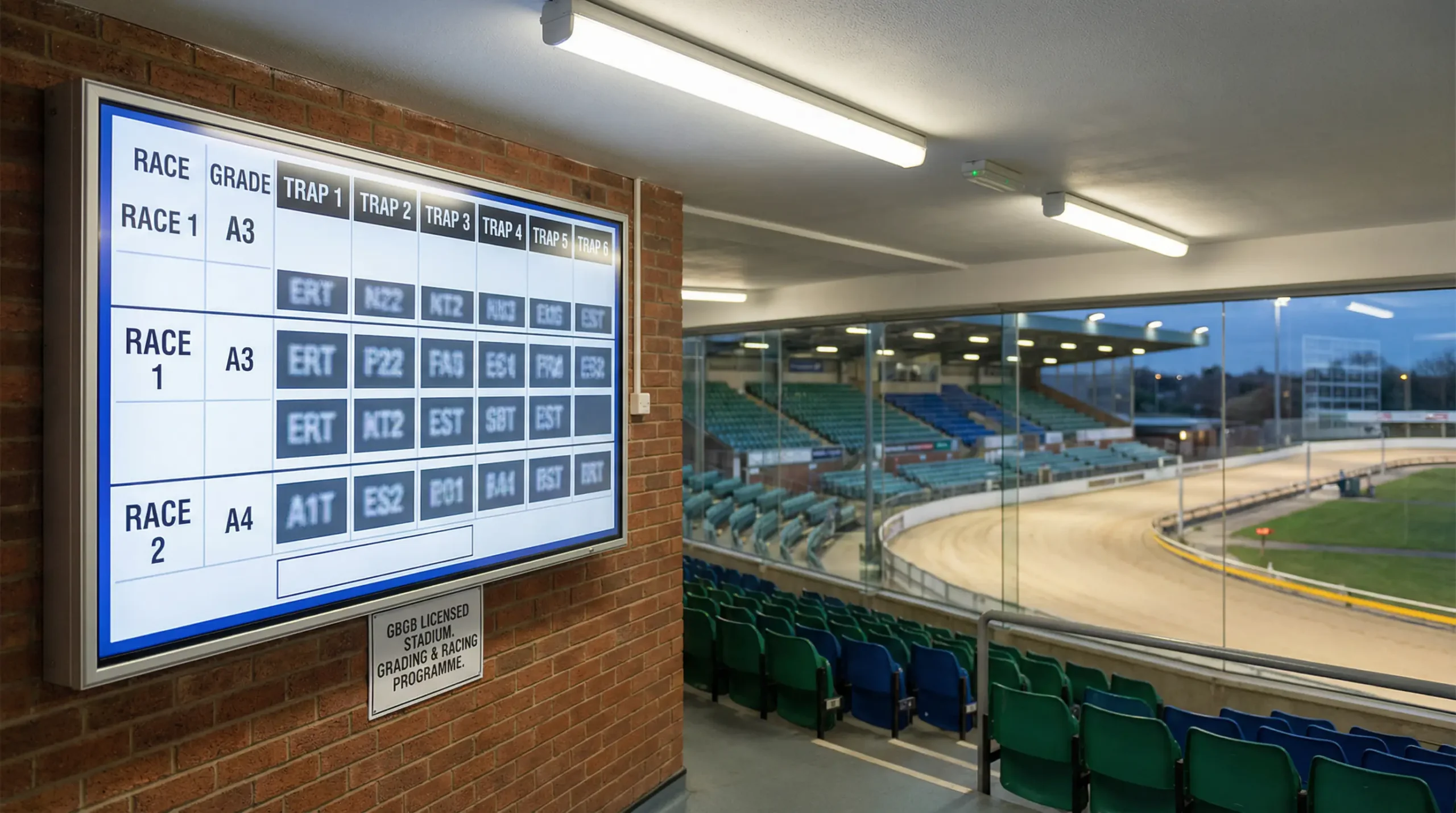
The GBGB Grading System Overview
Greyhound grading is the mechanism that determines which dogs run against each other at GBGB-licensed tracks. Its purpose is straightforward: to group dogs of similar ability so that races are competitive, results are unpredictable, and the betting market has genuine interest. Without grading, the fastest dogs would dominate every race card and the betting would lose its commercial function. With it, each race is theoretically a contest between six comparable athletes, and the form analysis required to identify the best bet becomes a genuinely interesting exercise.
The grading system is administered independently by each GBGB-licensed track, working within a framework established by the Greyhound Board of Great Britain (GBGB). The GBGB does not centrally allocate grades — it sets the standards, and each track’s racing manager is responsible for placing individual dogs in appropriate grades based on their recent performance at that venue. This means a dog’s grade is specific to each track it runs at, and a dog that is a B grade runner at one track may be entered in a higher or lower grade at a different venue depending on the local competition and the racing manager’s assessment.
The grade appears on the race card for every GBGB-licensed meeting, both in printed form and online via Racing Post and other greyhound form services. It is one of the first data points you read when approaching a race, and it functions as the baseline context for everything that follows in the form analysis — because a fast time in a low-grade race tells you less than a moderate time in a top-grade race.
What Each Grade Means: A1 to A8
The A grades — running from A1 at the top down to A8 or A9 at the bottom, depending on the track — represent the open graded racing category. These are non-sprint and sprint distance races for dogs that have qualified through trial and are competing in the track’s standard graded programme. A1 is the top grade at any track: the fastest dogs, the tightest races, and the highest betting interest. An A1 race at Romford or Wimbledon is a seriously competitive event where the market often has five or six genuine contenders priced within a narrow range.
Moving down the scale, A2 through A4 represent the upper-middle tier — competitive racing for dogs that are quality performers but not quite at the peak of their track’s graded card. A5 through A8 represent progressively lower tiers, occupied by dogs in the early stages of their track careers, older dogs past their competitive peak, or animals that simply haven’t shown the speed to hold a higher grade. The race quality diminishes as the number rises, and so does the predictability — lower grades often produce more one-sided races where a single dog holds a clear ability advantage over the rest of the field.
Sectional times vary substantially across the A grades. At a standard 400-metre track, the difference in expected race time between an A1 and an A5 race might be two to three seconds — a large margin by greyhound standards, where hundredths of a second separate the finishing positions within a race. This time differential matters for cross-grade comparisons: if a dog has recently dropped from A3 to A5, its previous times in the higher grade will flatter it relative to the current competition, and those adjusted times are part of what the market is already pricing. Spotting cases where the market has not fully adjusted for a grade change is a specific analytical opportunity.
B, S, D and Special Grades
Beyond the A grades, GBGB-licensed tracks use a set of additional grade designations for different race types and dog classifications. The most common is the B grade — Bitch — which designates races restricted to female dogs only. B grades run from B1 at the top downward in parallel with the A scale, and they exist because bitches are generally slightly slower than dogs of equivalent quality, making mixed-sex races commercially uncompetitive. Most tracks run a B-grade programme alongside the A grades, and the betting on B-grade races follows the same principles as A-grade racing with the additional variable of heat and season affecting bitch performance at different times of year.
The S grade designates Stayers races — longer-distance events that reward stamina over sprint pace. S-grade races are run at the extended distances available at GBGB tracks, typically 550–600 metres or longer depending on the venue’s layout. The form analysis for stayers differs from sprints because early pace and trap position matter less; the race is decided over several bends rather than a single burst from the traps, and a dog’s ability to maintain pace in the third and fourth bends becomes the critical variable. Trap bias data for stayers is different from sprint bias data at the same track and should be assessed separately.
The D grade designates Derby or Decider-type races at some tracks — single-round heats leading to a final — though usage varies by venue. Some tracks use D grades for developmental racing for younger dogs making their early competitive starts. The specific meaning of D at any given track is worth checking via the track’s own programming schedule or the Race Card on Racing Post. Open races — marked with an O designation — are invitation or qualification events open to dogs from multiple tracks, often with increased prize money and sometimes higher calibre competition than standard graded racing at the same venue.
How Grade Changes Signal Betting Opportunities
Whether you are looking at A grades, B grades, or the specialised formats, the most valuable information in the grading system is not the label itself — it is the direction of travel. A dog’s grade history is one of the most underused analytical variables in greyhound betting. Most punters look at the form string — the finishing positions in recent races — and assess ability based on those numbers. Fewer look at what grade each of those races was run in, and fewer still track the trajectory of grade changes over a sequence of runs. That gap between what is available and what is used is where betting value lives.
A grade drop — moving from A3 to A4, for instance — signals one of several things. The dog may have underperformed consistently and the racing manager has moved it down to find more competitive ground. It may have been recovering from a physical issue. Or the trainer may have deliberately managed the dog down through a period of low-key racing to sharpen it for a target race in a lower grade where it holds a clear ability advantage. Distinguishing between these three scenarios is the analytical challenge, and the form string provides the evidence: a pattern of mid-field finishes in the higher grade, followed by a sudden grade drop, looks different from a consistent runner placed in lower company after a significant absence.
The grade-drop scenario where a dog is being deliberately placed for a win is sometimes called a “grader” — a dog whose trainer has a history of taking it down through the grades before targeting a specific race at a price. Racing managers are aware of this practice and manage the grading programme to limit obvious exploitation, but it still occurs frequently enough to be a productive lens for analysis. When you see a dog drop two grades after a series of creditable near-miss finishes in higher company, the market has often not fully priced the implied improvement, and the opening race at the lower grade is frequently the one to back it.
Grade rises are the mirror image. A dog winning comfortably in A5 company will be elevated to A4, where it faces significantly stiffer competition. If the winning margin in A5 was narrow, the step up in class may expose it as a grading artefact — a dog that was placed competitively in easier company rather than a genuine A4 performer. Conversely, a dog winning A5 by several lengths at a very fast time for the grade is a genuine upgrade candidate, and its first run at A4 may still be at a price that underestimates its true ability because the market is calibrating on grade rather than on the raw performance data.
Trainer Strategy and Grade Manipulation
Trainers in UK greyhound racing operate within the grading system in ways that are entirely legal but analytically significant. A trainer who manages a talented dog’s grade carefully can create a structural betting advantage: the dog is placed in races where it has a genuine ability edge, but because the grade it is running in is not the highest grade it is capable of competing in, the market prices it at a longer price than its true probability of winning would suggest.
This is not a conspiracy — it is rational commercial behaviour. Trainers earn prize money when their dogs win, and a victory in A4 company at 3/1 is worth more in prize money than a defeat in A2 company at 6/4. The betting angle is secondary to the racing angle, but for the punter who tracks specific trainers and their grade management patterns, the two angles overlap: when a trainer with a documented history of placing dogs correctly for winnable races enters an A4 runner that has been winning A3 races at other tracks, or a dog returning from a strategic absence, that context is worth factoring into the analysis.
Racing managers are the counterweight to trainer grade management. Their job is to ensure competitive racing, and they have the authority to upgrade dogs that they believe are running below their ability, based on time comparisons and sectional data. The interplay between trainer strategy and racing manager response is a dynamic that experienced greyhound analysts follow closely. A track with an aggressive racing manager who upgrades quickly tends to produce tighter graded races with less exploitable grade advantage. A track where grading is more permissive tends to produce more predictable results for dogs that have been carefully placed by their handlers.
Grades Are a Map, Not a Guarantee
The grading system does what it is designed to do: it creates competitive racing by grouping dogs of similar ability. What it cannot do is guarantee that the competition within a grade is perfectly balanced in any individual race. Two A3 dogs may have arrived at A3 from very different directions — one dropped from A1, one rising from A5 — and their actual ability levels may differ significantly despite the shared grade label.
Use the grade as the first filter, not the last. It tells you the context in which recent form was produced. It flags potential grade change signals worth investigating. It does not tell you which dog in the race will win. For that, you still need the form string, the trap analysis, the time comparisons, and a clear view of the specific race. The grade is the map. Reading the map is not the same as knowing the terrain.