
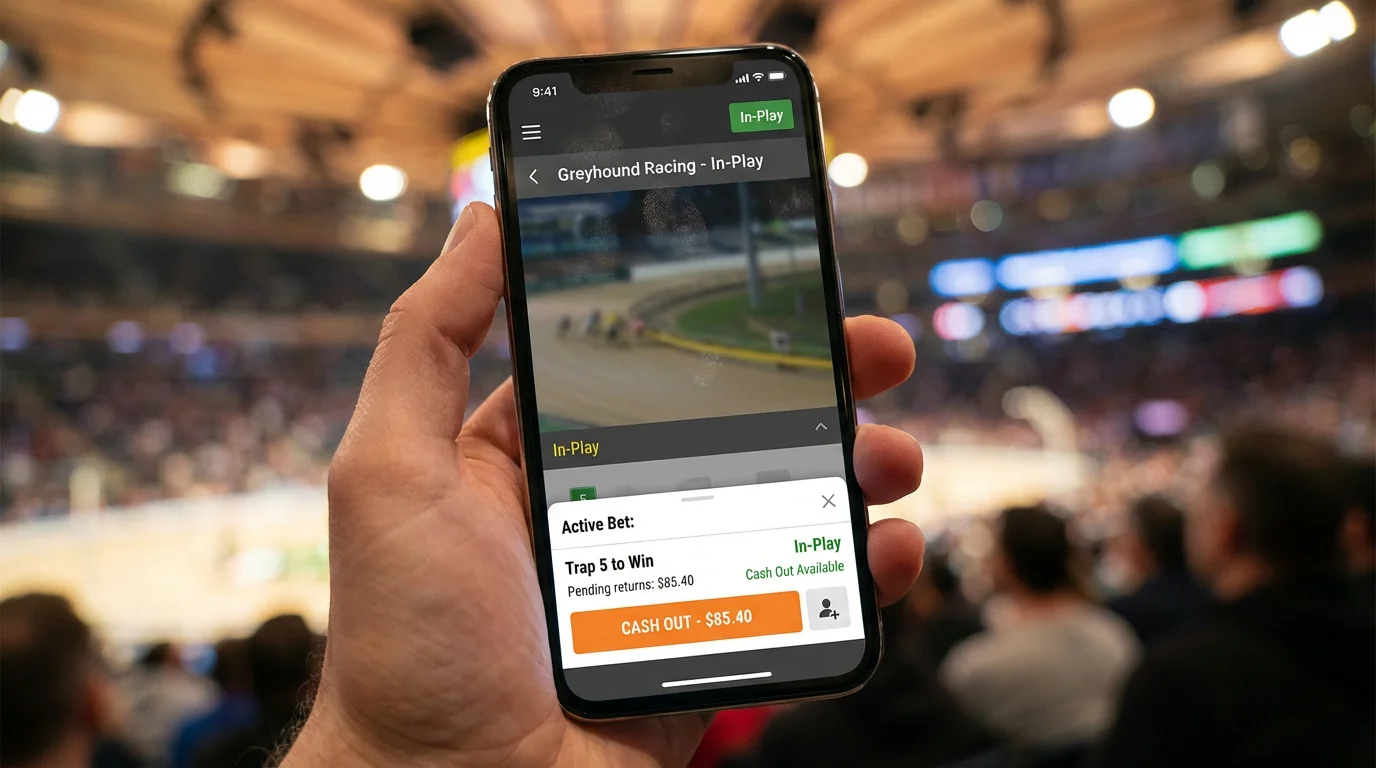
What Is Cash Out on Greyhound Bets?
Cash out is a bookmaker feature that allows you to settle a greyhound bet before the race finishes — or, for accumulator bets, before all legs have settled — at a value calculated by the operator based on the current state of the event. The value offered reflects the probability of your selection still winning, adjusted for the remaining uncertainty and the bookmaker’s margin. If your selection is leading at the bend, the cash out value will be higher than your stake but lower than the full winning return. If your selection is trailing or has encountered trouble, the cash out value may be below your stake — a partial recovery rather than a full return.
For greyhound racing specifically, cash out is available in two distinct contexts. The first is in-race cash out: during the approximately 30 seconds that a BAGS or evening meeting race is in progress, the bookmaker offers a real-time settlement value based on the current in-running position. Prices update rapidly — often several times per second — as the race progresses and the outcome becomes clearer. The second context is pre-race accumulator cash out: before or during the final legs of a greyhound accumulator, you can settle the entire bet at a value reflecting the probability of the remaining legs winning. This form of cash out does not require an in-progress race and is available to manage multi-race positions without the time pressure of the in-race window.
Cash out is a mechanical feature, not an analytical one. It does not require form knowledge or odds assessment — it requires only a decision about whether the offered value at a specific moment is preferable to the uncertain outcome of letting the bet run. The analytical content lies in developing a principled framework for when to accept the offer and when to let the bet run, which is covered in the strategic sections below.
Which UK Bookmakers Offer Cash Out on Dogs
Cash out on greyhound bets is offered by all major UKGC-licensed bookmakers as a standard feature across BAGS and evening GBGB-licensed meetings. Bet365, Betfair Sportsbook, William Hill, Ladbrokes, Coral, Paddy Power, Sky Bet, and Betfair Exchange all provide cash out on qualifying greyhound races and accumulators. The availability of cash out on any specific race depends on whether the meeting is within the operator’s supported coverage set — this is almost universally the case for BAGS meetings at major tracks, but may not apply to smaller evening fixtures at less frequently broadcast venues.
The mechanics differ slightly between platforms. Bet365’s cash out interface updates continuously during the race and during accumulator settlement, with the current cash out value displayed on the open bets screen. Betfair’s cash out on its sportsbook product works equivalently; on the exchange, the equivalent mechanism is trading out of a position by placing an opposing bet at the current in-running price, which is mathematically similar to taking cash out but requires an active order placement rather than a single button press. William Hill, Ladbrokes, and Coral all offer cash out with similar interfaces — the cash out value is displayed on the bet slip or active bets screen and updates automatically during qualifying events.
Partial cash out is offered by several major operators as an extension of the standard feature. Rather than settling the entire bet, partial cash out allows you to settle a fraction of the stake — typically a percentage you select — at the current cash out value, leaving the remainder of the bet to run to natural settlement. This provides a middle position between full cash out and holding the bet, which is analytically useful when you want to reduce exposure on a selection that is in a vulnerable position without abandoning the full potential return if it recovers.
How Cash Out Value Is Calculated
The cash out value offered by a bookmaker is not a neutral fair-value calculation. It incorporates the bookmaker’s margin — specifically, the margin is applied twice: once to the original odds at which the bet was placed, and once to the current in-running probability assessment used to calculate the settlement value. The practical effect is that the cash out value is consistently slightly below the mathematically fair value of the remaining position. Over a large number of cash outs, systematically accepting the bookmaker’s cash out offer produces marginally worse expected returns than always letting bets run to settlement.
The calculation logic is: the bookmaker estimates the current probability of your selection winning, applies its margin to that probability to generate a cash out implied probability, and then calculates what stake at the original odds would produce the same current expected value. A simplified example: you backed a dog at 4/1 for £10, and at the halfway point of the race it is leading and the bookmaker estimates its probability of winning at 75 percent. A fair-value cash out would offer approximately 0.75 × £50 total return = £37.50. The bookmaker’s offered cash out, after applying its margin to the in-running probability, might be £33 to £35. The gap between fair value and the offered amount is the bookmaker’s margin on the cash out transaction.
For accumulator cash out, the calculation compounds across the remaining legs. Each unsettled leg carries the bookmaker’s margin, and those margins multiply together as the remaining legs compound. A two-leg remaining accumulator carries approximately the square of the single-bet margin in the cash out calculation, which is one reason accumulator cash out values can look surprisingly low relative to the theoretical payout if all remaining legs win. The compounding of margins in accumulator cash out is the most common source of punter frustration with the feature — the offered value feels much less than it should, and it is, though by a mathematically predictable amount rather than an arbitrary one.
When Cash Out Makes Strategic Sense
The strategic case for cash out on greyhound bets rests on three specific scenarios where accepting the offered settlement is a rational choice rather than simply a risk-averse one. In each scenario, the cash out is being used as a risk management tool consistent with a pre-established betting framework, not as an emotional response to an uncertain race position.
The first scenario is a confirmed winning position mid-race. Your dog has broken cleanly from Trap 1 at a right-handed track with a strong inside bias, leads comfortably into the first bend, and its exchange price has compressed from 3/1 to 1/4 — it is the strong odds-on leader with one bend remaining. The cash out value at this moment reflects a probability of completion much higher than 50 percent, and accepting it locks in a substantial portion of the expected return while eliminating the residual risk of an unlikely but possible incident in the closing stages. This use of cash out is analogous to taking a fixed profit in a financial trade where the position has moved strongly in your favour — it is not cowardice, it is position management.
The second scenario is a materially changed race position. Your selection has been hampered at the first bend, drifted wide, and is now trailing the field by three lengths with one bend remaining. The cash out value is below your stake but represents meaningful recovery — say, 40 percent of your original bet returned — when the probability of winning has deteriorated significantly based on what you can see. Accepting the partial recovery preserves capital relative to a likely losing bet. This is the most common productive use of cash out for greyhound bettors who follow races on streaming.
The third scenario is accumulator insurance at the penultimate or final leg. You have a four-fold accumulator where three legs have won, and the final leg is approaching. The cash out value on the three-leg in-running accumulator is significant, and the fourth selection is in a competitive race where the outcome is genuinely uncertain. Taking partial cash out at this point — settling, say, 50 percent of the position — guarantees a meaningful return regardless of the final leg while retaining exposure to the full accumulator return if the last selection wins.
The Case Against Cashing Out on Greyhounds
The arguments against systematic cash out use on greyhound bets are mathematically clear, even if they are psychologically difficult to internalise. The fundamental one: because cash out values are set below fair value, systematically accepting cash out produces a lower expected return than consistently letting bets run to settlement. The bookmaker’s double-margin on cash out transactions is a real cost, and the punter who uses cash out habitually is paying that cost on every position they close early, compounded over the full betting record.
The second argument is specific to greyhound racing: the events during a race that make cash out feel urgent — a dog leading at the first bend, a selection running wide, a rival breaking faster from the adjacent trap — resolve within 30 seconds. Unlike a football match where the situation prompting a cash out decision may persist for 30 minutes, a greyhound race is over before most punters have fully processed what is happening. The time pressure felt in the in-play cash out moment is a genuine cognitive constraint, and decisions made under that pressure are more likely to be emotionally driven than analytically considered. A pre-race plan for when to use cash out — established at the calm moment of placing the bet, not during the race — is far more reliable than a decision improvised in the final five seconds of a live race.
The third argument concerns the selection process. If a greyhound selection was worth backing at the pre-race price based on form analysis, the probability that the bet was correctly placed does not change because the race has started and the dog is temporarily in a disadvantageous position at the first bend. The form analysis that justified the bet still applies to the remaining portion of the race — the dog has shown form over the full distance, and first-bend position is one variable among several that determine the outcome. Cashing out every time a backed selection is not immediately leading sacrifices the medium-term expected return for the short-term emotional comfort of resolving the uncertainty, which is a consistent losing strategy over time.
Cash Out Is a Tool, Not a Rescue Plan
Cash out is most valuable when it is used according to a rule established before the race, in scenarios that were anticipated as part of the betting plan. It is least valuable when it is used as a reflex response to the anxiety of watching a bet in an uncertain position — which is the situation in which it is most frequently pressed. The feature exists partly because bookmakers profit from the double-margin on settled positions; that profit comes disproportionately from punters who cash out impulsively rather than strategically.
Use it in the three scenarios described above. Set the rule before the bet is placed. And in every other situation — the dog that is running third at the bend but has the form to finish strongly, the accumulator with two legs remaining on well-researched selections — let the bet run. The selection process did the analytical work. Trust it to the finish line.