
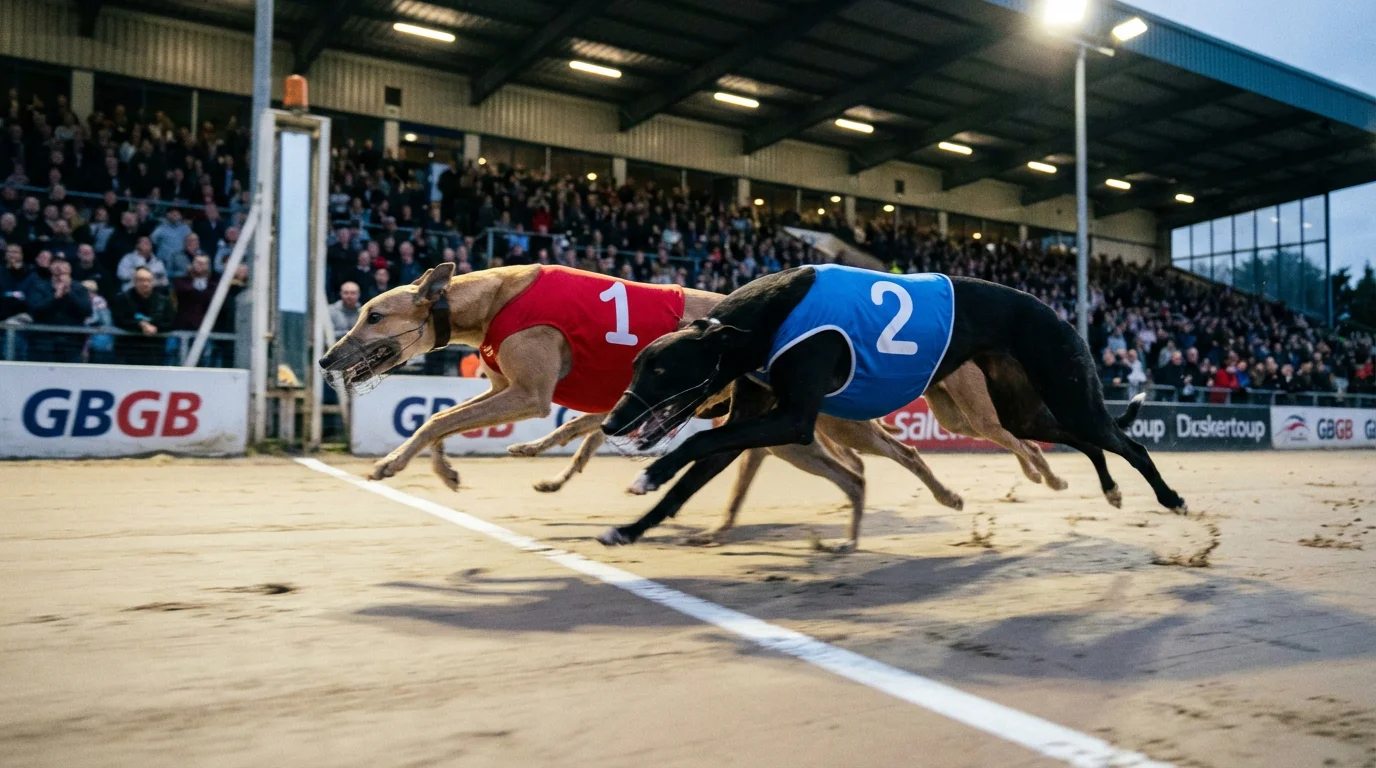
Each-Way Basics for Greyhound Bettors
An each-way bet is two bets in one: a win bet and a place bet, placed at the same time for the same stake. The win part pays out at the full odds if your selection wins. The place part pays out at a fraction of the odds — typically one quarter — if your selection finishes within a specified number of positions. If the dog wins, you collect on both halves. If it finishes second or third (within the place terms), you collect only on the place half. If it finishes fourth or worse, both halves lose.
In greyhound racing, each-way betting is available at all major UK bookmakers licensed by the UK Gambling Commission (UKGC) and follows the same structural principle as horse racing — but with field-size rules that are specific to dogs. This distinction matters enormously in practice, because greyhound fields are standardised at six runners for most GBGB graded races, with seven or eight runners only appearing in certain open and stakes events. The place terms — and therefore the actual value of the place portion — change depending on how many dogs are in the race, so understanding the rules by field size is the first practical task for any punter considering each-way betting on dogs.
Most bettors come to each-way greyhound bets from a horse racing background, where the instinct is sound: take an each-way on a price you like and collect something if it runs into a place. On dogs, the same instinct applies, but the arithmetic works differently, and what constitutes a value each-way bet requires a cleaner calculation than you might be used to.
Place Terms: 5, 6, 7 and 8 Runner Fields
The place terms for greyhound each-way bets are governed by the number of runners in the race. Unlike horse racing, where place terms can vary significantly by race type and bookmaker, greyhound place terms in the UK follow a reasonably consistent industry standard, though individual operators retain the right to deviate.
For a standard five or six runner race — the most common field size in GBGB graded racing — the standard each-way terms are two places at one quarter of the win odds. This means the place part of your bet pays out if your dog finishes first or second, at one quarter of whatever odds you took. In a six-runner field, backing the second favourite at 4/1 each-way gives you a place return of 1/1 (4/1 ÷ 4) if the dog finishes in the top two. That is a modest but real insurance against a narrow defeat.
For seven or eight runner races — which appear in open races, stakes events, and selected feature nights at GBGB tracks — the standard terms expand to three places at one quarter of the odds. Your dog must finish first, second, or third to collect on the place portion. The third place being paid out at a full quarter of the win odds represents a meaningfully better return for each-way punters in larger fields.
If a race is declared as having fewer than five runners, most bookmakers will void the each-way portion entirely and settle the stake as a win-only bet. Non-runners in greyhound racing are relatively rare compared to horse racing, but re-grading or late withdrawals do happen — worth checking the final race card if you have an each-way bet on an event where the field size was borderline.
Calculating an Each-Way Payout
The calculation is straightforward once you know the field size and the place terms. Start by treating the each-way bet as two separate bets: the win portion and the place portion, each at the same unit stake.
Take a practical example: you back Trap 4 each-way at 6/1, staking £5 each-way. Your total outlay is £10 (£5 win + £5 place). The race has six runners, so the terms are two places at one quarter odds. The place odds are therefore 6/4 divided by 4 = 6/16, which simplifies to 3/8.
If Trap 4 wins: the win portion returns £5 × 6 = £30 profit, plus the £5 stake back = £35. The place portion also wins: £5 × (6/4) = £5 × 1.5 = £7.50 profit, plus the £5 stake back = £12.50. Total return: £47.50.
If Trap 4 finishes second: the win portion loses — £5 gone. The place portion wins: £12.50 returned. Net return: £12.50 against £10 total staked, for a net profit of £2.50. Not a life-changing sum, but the each-way bet has turned a narrow defeat into a small profit rather than a total loss.
If Trap 4 finishes third in a six-runner field: no place payout — the terms only cover the top two. Both halves of the bet lose. This is the critical difference from a seven-runner field, where third would collect. Always confirm the terms before placing.
When Each-Way Greyhound Bets Offer Value
Each-way betting offers genuine value in greyhound racing under specific conditions, and spotting those conditions is where analysis pays off. The core question is always whether the implied probability of the place half — paying one quarter of the win odds for a top-two finish — reflects what the race is actually likely to produce.
Each-way bets are structurally weakest when the race has a dominant short-priced favourite. In a six-runner field where Trap 1 is priced at 4/7 and every other runner is 4/1 or bigger, the place portion of an each-way bet on any other runner is essentially a bet on the second-placed dog — which could be any of five roughly equal candidates. At 4/1 each-way, the place return of 1/1 doesn’t adequately compensate for the difficulty of picking the specific dog that finishes runner-up behind a heavy favourite. The maths don’t stack up.
Each-way bets work best when the race is genuinely competitive and when the dog you’re backing has a realistic route to finishing in the top two without being the market favourite. A 7/2 shot in an open race with seven or eight runners, where the field is balanced and no single dog has an overwhelming advantage, is a natural each-way candidate. Three places are paid, the odds are long enough to produce a meaningful place return, and the field size means the second and third positions are genuinely accessible.
The other scenario where each-way betting on greyhounds makes sense is when you have a strong conviction that a price is wrong — your selection is materially better than its odds suggest — but you are uncertain about the draw, the going, or a specific rival. Taking an each-way position lets you extract value from your analysis while maintaining a meaningful return even if something goes wrong at the traps or in the first bend.
Bookmaker Differences in Place Terms
Standard place terms across the UK licensed betting market are fairly consistent for greyhound racing, but they are not universal. The industry standard of two places for up to six runners and three places for seven or more is a convention, not a legal requirement, and individual bookmakers occasionally deviate — particularly for special events, feature races, or during promotional periods. All UK licensed bookmakers are regulated by the UK Gambling Commission and must publish their terms clearly before settlement.
A handful of operators have historically offered enhanced place terms on greyhounds as a promotional tool. Three places in a six-runner race, at a quarter of the odds, represents a significantly better deal for each-way punters — it means your dog finishing third in a standard BAGS field still collects on the place portion, which under normal terms would be a dead bet. If you find an operator offering this regularly for greyhound racing, it is worth noting and factoring into which site you use for each-way betting on dogs.
The reverse also applies: some operators restrict place terms to one place only on certain race types, or reduce the place fraction from a quarter to a fifth under specific conditions. These are typically flagged in the bookmaker’s terms and conditions under the greyhound each-way rules section, and the bet slip will show the terms before you confirm. Reading the slip is not optional — confirming the terms displayed matches what you expect takes five seconds and can save a significant misunderstanding at settlement.
Each-Way Is Not a Safety Net
There is a persistent belief among casual bettors that each-way betting is inherently safe — a way to protect against a win bet that comes up just short. It is not. An each-way bet is two bets, and both can lose. More importantly, the structural cost of the each-way format — doubling your stake to cover both portions — means that collecting only on the place half produces a return that is often only marginally better than breaking even. In a six-runner race at standard terms, collecting the place portion of a 2/1 each-way is a return of 50p in the pound. You haven’t lost everything, but you’ve barely broken even on a bet that cost twice as much as a straight win.
Each-way betting on greyhounds is most profitable when used selectively, in the specific scenarios where the combination of odds, field size, and race dynamics produces a genuinely better expected return than a straight win bet on the same selection at the same stake. Backing every race each-way because it feels safer is a reliable route to marginal losses accumulating into significant ones over time. The format is a tool, not a strategy — useful in the right race, counterproductive in the wrong one.