

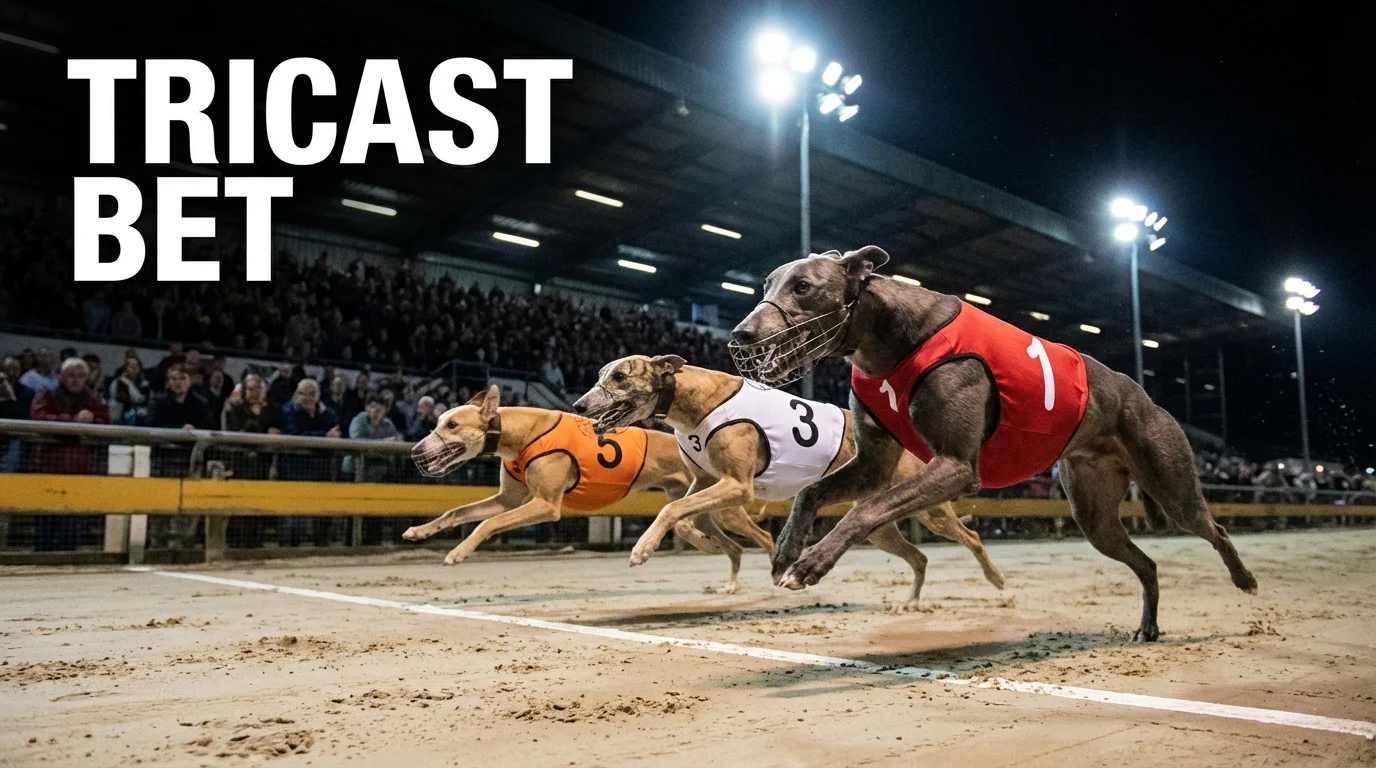
What Is a Tricast Bet?
A tricast bet requires you to predict which three dogs will finish first, second and third in a race, in the correct order. It is the logical extension of the forecast bet: where a straight forecast names two dogs and their finishing positions, a tricast names three. The additional selection makes the bet significantly harder to land, and the returns are correspondingly larger — often substantially so, since the tricast dividend is calculated using a formula that accounts for the combined starting prices of all three placed dogs.
In the standard six-runner greyhound race, a straight tricast covers one specific outcome out of 120 possible finishing orders for the top three positions. That is a large number of possible sequences, and the implied difficulty of landing a specific one is reflected in the payout. The Computer Tricast formula — the standard calculation method used by UK bookmakers — produces dividends that can range from modest to very large depending on the prices of the three placed dogs. A short-priced winner, short-priced second and long-priced third can yield a surprisingly decent return. Three short-priced dogs finishing in the expected order yields much less.
Tricast betting sits at the more complex end of the greyhound bet menu, and it rewards the punter who uses it selectively with a clear analytical basis. Used randomly or as a routine part of every bet, it burns through a bankroll quickly. The cost structure — particularly for combination tricasts — and the low individual bet success rate make it a precision instrument rather than a daily staple.
Market availability for tricast on greyhound racing is not universal across all bookmakers. Some operators offer it as standard on all BAGS meetings; others restrict it to higher-grade races or specific fixtures. Before building a tricast strategy around a particular platform, it is worth confirming that the market is available consistently on the races you intend to target. The mechanics of the bet itself — which determine where and how you find value — are the next thing to understand.
Straight Tricast vs Combination Tricast
The tricast market divides into two distinct bet types that differ in both cost and coverage: the straight tricast and the combination tricast. Understanding the difference is essential before placing, because they represent fundamentally different analytical statements about the race — and very different budget commitments.
A straight tricast is a single bet on three named dogs to finish first, second and third in an exact specified order. If your selection comes in any other sequence — if the dog you picked for second finishes third, or the one you picked to win finishes second — the bet loses entirely. There is no consolation for getting the right three dogs in the wrong order. The straight tricast is the purest expression of confidence: you are saying not just that these three dogs will dominate the race, but that you know exactly how they will separate from each other. That is a high-precision claim, and it should be made only when the form provides genuine grounds for it.
A combination tricast covers all possible finishing orders of three selected dogs. In a six-runner field, three dogs can finish in the top three positions in six possible sequences — 3 × 2 × 1 = 6. A combination tricast places a unit stake on each of those six sequences, meaning a £1 combination tricast actually costs £6. If any of the six possible ordering combinations lands, the bet wins. Only one combination pays out — the one that matches the actual result — but you only need one of them to land.
The cost relationship between straight and combination tricast is the key decision variable. A £1 straight tricast costs £1 and wins only if the exact order lands. A £1 combination tricast costs £6 and wins if any order of those three dogs lands in the top three. The combination is six times more expensive per selection set, but it removes the need to predict the specific order. Whether that is a worthwhile trade depends entirely on how confident you are in the order as well as the selection.
When is a straight tricast the right choice? When the race structure strongly implies a specific finishing order — a dominant front-runner who rarely gets caught, a reliable settler who consistently runs into second from a specific trap, and a third dog who finishes with a run but rarely gets past the established pace. That combination exists in BAGS graded racing more often than you might expect, particularly in lower grades where field quality is more predictable and individual dog characteristics are more consistent.
When does a combination tricast make sense? When you have high confidence in the three dogs likely to dominate the race, but limited conviction about the order between them. The race looks like a three-dog race but the pace and trap dynamics do not clearly differentiate between the selections. The combination covers the analytical uncertainty about order while still requiring a correct top-three identification. That is the bet’s legitimate home.
There is a middle ground that some punters use: placing a straight tricast on the most likely ordering while also placing a second straight tricast on the second-most-likely ordering, rather than a full combination tricast at six times the cost. This approach costs two units instead of six, covering the two most probable sequences without paying for the four others. It requires a clear view about which two orderings are most likely — a view that is sometimes available when the race has a dominant pace structure but one uncertain position in the top three. It is not a standard market option on most platforms; you place it as two separate bets.
Tricast Cost and Combinations
The cost of a tricast bet is determined by the bet type and the unit stake. For a straight tricast, the cost is simply the unit stake — one bet, one combination. For a combination tricast, the cost is the unit stake multiplied by the number of permutations covered.
For three selections in a combination tricast: 3! = 3 × 2 × 1 = 6 combinations. At £1 per combination, total cost is £6. This is the standard combination tricast on a six-runner race.
It is also possible to place a tricast covering more than three dogs in a “full cover” or “perm” format, though this is less common in greyhound betting than in horse racing. A tricast perm covering four dogs selects four dogs for the top three positions and covers all possible tricast combinations from that pool. The number of combinations from four dogs is 4 × 3 × 2 = 24, making the cost 24 units. Five dogs produce 60 combinations; six dogs produce 120. The cost escalates rapidly, and the practical value of perming more than three dogs into a tricast on a six-runner greyhound race is limited — at that point, you are effectively betting on nearly every possible result, and the dividend needs to be very large to justify the outlay.
The Computer Tricast formula calculates the dividend using the starting prices of the first, second and third-placed dogs. Like the Computer Straight Forecast (CSF), the dividend is not known in advance. It is calculated after the result and paid as a declared dividend. The formula is designed to produce a fair theoretical return based on the combined SPs, adjusted for the field size and the specific combination. In practice, the dividend is highly sensitive to the price of the third-placed dog — a long-odds third finisher can multiply the tricast dividend substantially compared to a short-priced one finishing in the same position.
The practical implication: when you are assessing a potential tricast before the race, the uncertainty is not just about whether your selections finish in the top three, but also about what price each of them will return at SP. A race where you expect a long-odds outsider to fill third place is more likely to generate a high tricast dividend than one where three short-priced dogs dominate. This influences which races are worth targeting with tricast bets, and it means that race selection for tricast purposes is a slightly different exercise than it is for win or forecast betting.
One cost management point worth making explicit: a combination tricast at £1 per line costs £6 in total. Many punters set a nominal stake without thinking through the full cost — they intend to bet £1 but are actually committing £6. If you are accustomed to win bets at unit stakes, the combination tricast cost structure requires a conscious adjustment to your bankroll allocation per race. A £6 outlay on a combination tricast from a betting bank of, say, £100 represents 6% of the bank on a single exotic bet. That is a meaningful exposure for a low-success-rate wager, and it should factor into the decision about whether to use this bet type at all on a given race.
When Tricasts Offer Positive Expected Value
Positive expected value from a tricast bet requires several conditions to align simultaneously, which is why tricasts should be treated as occasional bets rather than routine ones. Each condition on its own is necessary but not sufficient — all of them need to be true for the bet to be worth placing.
The first condition is that you can identify a race with a clear top-three structure. This means the form strongly suggests three specific dogs will finish ahead of the rest of the field with reasonable consistency, and the remaining dogs have limited realistic prospects of finishing in the top three. In a six-runner race, this is a more tractable analysis problem than it sounds — if two dogs are significantly superior to the field and a third has a structural advantage via trap or grade, the remaining three are largely running for fourth place onwards. That kind of race structure does occur in BAGS graded racing, particularly in grades where class differences within the field are more pronounced.
The second condition is that the likely top-three dogs include at least one at a generous price. A tricast involving three evens-or-shorter dogs will produce a low Computer Tricast dividend, and the combination tricast cost of £6 per unit stake at those prices will rarely be justified. The formula rewards long-priced finishers. A tricast where one of the top three is a 10/1 or 12/1 runner — and where you have genuine reason to believe that dog will finish in the top three despite its price — is the situation where the dividend is likely to justify the bet cost.
The third condition is that the combination tricast cost is proportionate to your assessment of the probability of landing it. A combination tricast pays if any of six orderings land. If you genuinely believe all three selections will finish in the top three with a combined probability of, say, 30%, then a £6 combination tricast requires a dividend of at least £20 to be break-even in expected value terms. If the current Computer Tricast estimate based on prevailing prices suggests a dividend in excess of that threshold, the bet has positive expected value. If not, it does not.
Straight tricasts are harder to justify on expected value grounds but can be individually profitable when the form strongly implies a specific finishing order. A race where Trap 1 has run first or second in eight of its last ten starts, the second selection is a consistent settler who finishes second or third at this grade, and the third selection is the most likely remaining contender — that is the type of race profile where a straight tricast is worth the single unit stake at the right dividend.
Grade transitions provide another specific context where tricasts can offer value. When a dog drops a grade for the first time after finishing consistently in the top three in a higher grade, it carries a significantly elevated probability of dominating its new field. If that dog is accompanied in the same race by two others with a similar drop-in profile, the top-three field within the race becomes more predictable than the odds suggest. Grade-drop scenarios are one of the most reliable form-reading signals in BAGS racing, and they translate directly into tricast opportunity when multiple dogs in the same race are stepping down simultaneously.
The consistent error in tricast betting is to place them routinely as an attempt to maximise returns on races you find interesting, rather than selectively on races where the analytical conditions genuinely support it. Tricast frequency is inversely correlated with tricast profitability over most bettors’ records. Less often, and better-chosen, is the only approach that consistently works over time.
Bookmakers Offering Tricast on Greyhounds
Tricast availability on greyhound racing is not consistent across all major UK bookmakers, and it is worth knowing which operators offer it reliably before incorporating tricast into a regular betting strategy.
The operators most consistently offering tricast on BAGS greyhound meetings include Betfair, William Hill, Ladbrokes, Coral, and Betfred. Bet365 offers tricast on greyhound racing but the market may not be available across all meetings. Most operators will list the tricast market alongside win, each-way and forecast options in the race detail view, but its absence from a specific race is not unusual — particularly on lower-grade meetings, very small fields, or non-BAGS fixtures at smaller venues.
The Computer Tricast dividend is returned by most operators as the official declared dividend, applied uniformly regardless of whether you placed with a fixed-odds sportsbook or a tote-style pool. The dividend is calculated after the result using the same formula, and the payout should be consistent across operators unless individual operators apply a cap on tricast dividends — a less common practice than forecast dividend capping, but one that exists at some platforms.
Betfair’s exchange does not offer a traditional tricast market in the same way fixed-odds bookmakers do. On Betfair, tricast-style betting would require placing individual win and place bets on the exchange, which is not a direct equivalent. For punters who specifically want tricast returns, fixed-odds sportsbooks are the practical option, though it is worth comparing Computer Tricast estimates against the available win and place exchange prices to assess whether the composite exchange approach produces better or worse expected returns on specific races.
One practical note on timing: tricast markets on greyhound races sometimes open later relative to the off than win or forecast markets. If you intend to place a tricast and the market has not yet appeared in the race listing, refreshing the page a few minutes closer to the race time usually resolves the issue. On BAGS meetings, where races run to tight schedules, leaving enough time to confirm market availability before the off is sensible housekeeping.
Three Dogs, One Exact Order
A tricast is a precision bet, and the emphasis belongs firmly on “precision.” The straight tricast demands that you are right about three things simultaneously: which dog wins, which finishes second, and which finishes third, all in the exact order you specified. That is a significant analytical claim. The combination tricast relaxes the order constraint but multiplies the cost by six. Neither version is forgiving of casual application.
Used correctly — selectively, on races where the form structure clearly identifies three dogs likely to dominate, at prices where the Computer Tricast dividend justifies the bet cost — the tricast is a legitimate part of the greyhound punter’s toolkit. Used as a daily habit or a way to extract larger returns from races where the analysis is thin, it is an efficient way to lose money at a faster rate than simpler bet types.
The dividend is attractive precisely because the bet is hard to land. That is its only special property. Do not mistake the attractiveness of the potential return for evidence that a specific tricast represents value — those are entirely different things. One is a feeling; the other is a calculation. The punter who consistently makes the calculation, places the bet only when it passes, and otherwise skips the tricast market entirely is the one who has correctly understood what the bet is for.
