

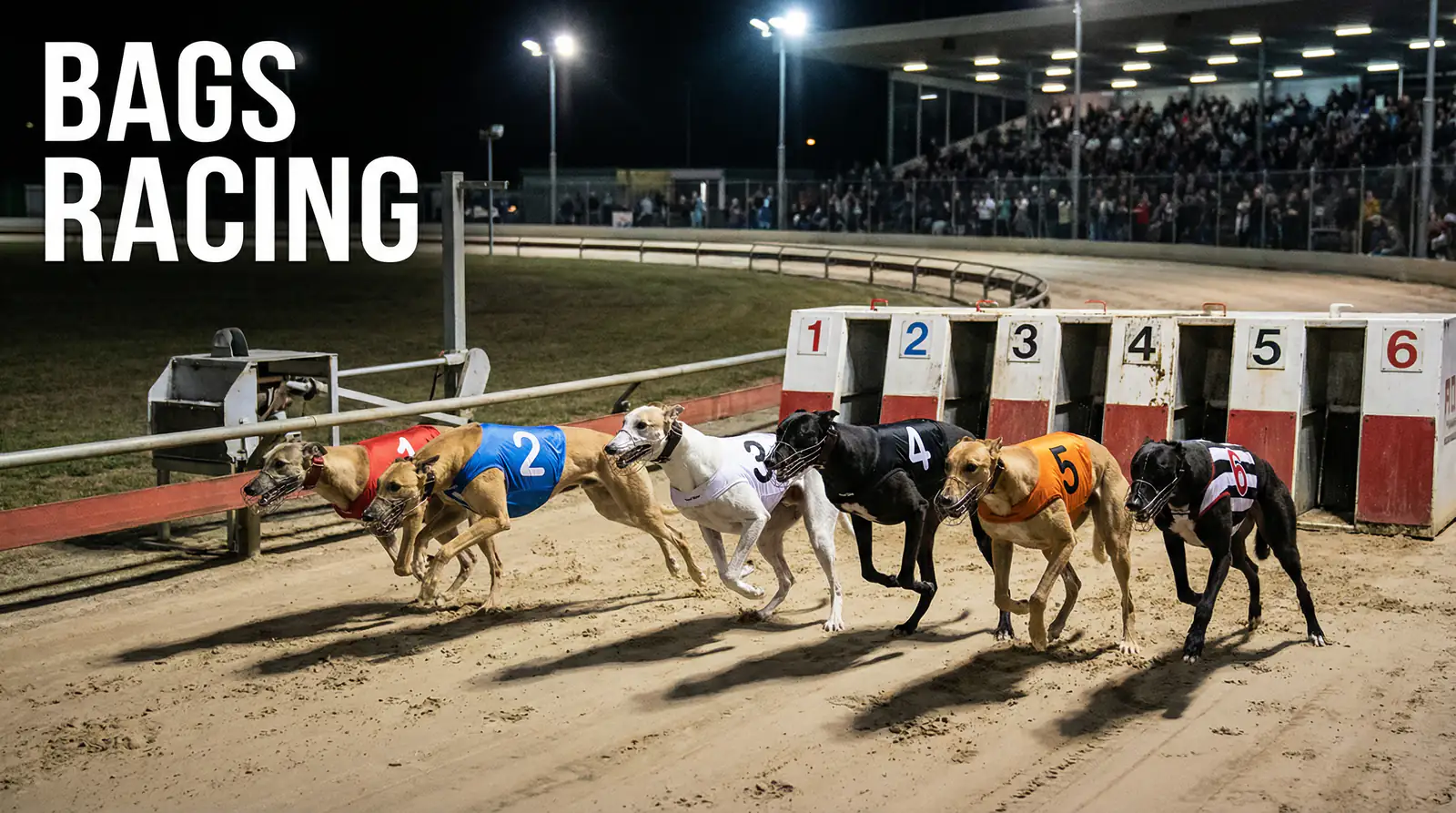
What BAGS Is and Who Runs It
BAGS stands for Bookmakers’ Afternoon Greyhound Service. It is a commercial arrangement between a consortium of major UK bookmakers and a rotating selection of licensed greyhound tracks, designed to produce a continuous schedule of racing throughout the afternoon and evening specifically for betting shop and online coverage. In practical terms, it is the reason you can walk into a Ladbrokes or William Hill at 1 pm on a Tuesday and find live greyhound racing on every screen.
The service was established in 1967 as a direct response to pressure on bookmakers following off-course betting legalisation under the Betting and Gaming Act 1960. Before BAGS, afternoon racing was thin and coverage was patchy. Bookmakers needed a reliable, predictable supply of racing to fill the working day. The tracks needed the income. The arrangement that emerged has remained structurally intact for over fifty years, though the participants and commercial terms have evolved considerably.
BAGS is administered through agreements between the GBGB — the Greyhound Board of Great Britain, which is the sport’s regulatory and licensing body — and the individual bookmaker groups who fund the service. The GBGB does not itself run BAGS fixtures; it licences the tracks that participate and sets the welfare and integrity standards those tracks must meet. The actual commercial relationships, including which operators contribute and how much, sit between the bookmakers and the tracks directly, with media rights holders involved in the distribution chain.
For bettors, the administrative structure matters less than the output: BAGS generates somewhere in the region of 60 to 70 race meetings per week across its participating venues, with most days carrying between eight and twelve fixtures. Each meeting typically runs six races. That volume of content is what keeps bookmaker platforms active during hours when horse racing is not running, and it is what gives greyhound betting its unusual status as a genuinely year-round, all-day product in the UK market.
The GBGB publishes a register of licensed tracks on its website at gbgb.org.uk, and the BAGS schedule is distributed to licensed operators. Understanding who controls what matters when something goes wrong — if a meeting is abandoned or a result is queried, the chain of responsibility runs through the track’s GBGB licence, not through the bookmaker taking bets on it.
It is also worth understanding what BAGS is not. It is not a separate governing body, not a brand name visible to the public on bookmaker platforms, and not a product that is explicitly marketed to punters by name. Most people who bet on greyhound racing at 3 pm on a Wednesday have no idea they are engaging with a BAGS fixture specifically. The branding is invisible. What is visible is the race, the trap draw, the odds, and the outcome — and for most betting purposes, that is all you need.
The financial dynamics behind BAGS matter because they affect how tracks operate and how dogs are trained and raced within the system. Tracks receive a media rights fee from bookmakers for each BAGS meeting. That fee is a significant part of many tracks’ operating revenue. It influences how often meetings are scheduled, how prize money is structured within graded races, and which tracks find it commercially viable to remain open. The health of the BAGS ecosystem is, in a very direct sense, the health of commercial greyhound racing in the UK.
BAGS Track Rota
Not every GBGB-licensed track participates in BAGS, and those that do do not run BAGS fixtures every day. The service operates on a rota system that rotates track allocations across the week, with a core group of venues carrying the bulk of the schedule and others appearing less frequently.
The regular BAGS venues include tracks such as Romford, Crayford, Monmore, Hall Green, Sheffield (Owlerton), Sunderland, Perry Barr, and Swindon, among others. These tracks have invested in the infrastructure — timing systems, photo finish equipment, CCTV-grade camera setups and live streaming capability — required to meet BAGS technical specifications. Without that infrastructure, a track simply cannot participate, regardless of how much it might want the income.
The rota is structured to maintain geographic spread and avoid scheduling conflicts. On a typical weekday, BAGS fixtures will run from early afternoon through to late evening, with different tracks taking different time slots. A punter checking a bookmaker’s greyhound section at 3 pm will typically find Romford or Crayford running, with Monmore or Hall Green picking up the later slots. The precise rota changes from week to week and is published in advance through official GBGB channels and Racing Post.
Weekend scheduling is different. Saturday and Sunday afternoons carry more high-profile open-race meetings that are not BAGS fixtures — these are run for the sport itself rather than exclusively for bookmaker coverage, and they attract higher-grade dogs and larger prize funds. BAGS racing tends to be concentrated in the graded category: structured, predictable, and optimised for consistent betting content rather than sporting spectacle. That distinction matters for form analysis, which is covered in more detail later.
Tracks that drop out of the BAGS rota, through closure, financial difficulty, or failure to meet technical standards, leave visible gaps in coverage. The closure of Walthamstow in 2008 — once one of the highest-profile London tracks — removed a significant fixture from the BAGS landscape and shifted volume to Romford and Crayford. Those shifts in the rota have real consequences for punters who have built form databases around specific venues. Understanding which tracks are stable participants and which are periodic contributors is part of using the BAGS product intelligently.
BAGS and Betting Availability
The rota determines which racing exists. What happens once that racing is available to bet on is a separate but equally important question.
Every major UKGC-licensed bookmaker — bet365, Ladbrokes, William Hill, Betfair, Coral, Betfred and others — carries BAGS meetings in full as part of their standard greyhound offering. This is not optional for operators who want to remain competitive in the UK market. BAGS coverage is effectively a baseline expectation. When you open the greyhound section of any mainstream UK betting app, the fixtures you see scrolling through the afternoon and evening are overwhelmingly BAGS meetings.
Markets available on BAGS races follow a standard template. Win betting is universal. Each-way is available on fields of five runners or more. Forecast and reverse forecast markets are offered by most operators. Computer Straight Forecast (CSF) dividends are the norm rather than fixed-odds forecast payouts. Tricast betting on BAGS races is offered by several operators, though coverage varies. The key point is that BAGS creates a standardised environment: punters can expect roughly consistent market availability across the rota regardless of which specific track is running.
Pricing is where variation emerges. Bookmakers compile their own odds on BAGS races, and the differences between early prices and starting price (SP) can be meaningful on shorter-priced races. Some operators offer Best Odds Guaranteed on BAGS greyhounds, which means that if the SP returned is higher than the price taken at the time of bet, the higher price is paid. BOG availability on greyhounds is less consistent than on horses, and it is worth checking the specific operator’s terms before assuming it applies.
Streaming of BAGS races has become a standard feature for the major operators, subject to having a funded account and a settled bet. The stream quality and latency vary between platforms. For in-play betting — which is limited on greyhounds due to the short duration of races — streaming access is more or less essential, and the absence of it on a particular platform should be factored into the decision of which bookmaker to use for live betting.
One structural quirk worth knowing: because BAGS races are run under commercial contracts with bookmakers, the prize money on offer is often lower than at prestige open meetings. Lower prize money does not mean lower quality greyhounds across the board, but it does mean the grading structure operates differently. BAGS graded races move dogs up and down grades more frequently, and the form patterns that result require a different reading approach than you would apply to a high-value open competition.
The pricing efficiency on BAGS races also tends to be lower than on high-profile events. A bookmaker team that is pricing 80 or more races per day across the BAGS rota cannot apply the same depth of analysis to each race that it applies to a Derby semifinal. That means the occasional mispriced favourite, the overlooked wide runner at a track with documented trap bias, or the unexpectedly well-graded dog coming off an unlucky run can represent genuine value. The volume of racing is the punter’s friend as much as it is the bookmaker’s — it creates more opportunities for analytical edges to express themselves.
BAGS vs Non-BAGS Meetings
The distinction between BAGS and non-BAGS meetings is one that most casual greyhound punters never consciously make, but it runs through almost every meaningful decision in the sport.
BAGS meetings are graded. They are designed by track racing managers to slot dogs into appropriately competitive fields, with each race structured so that no dog is dramatically superior to the rest of the field. The intention is consistent racing, predictable scheduling, and manageable wagering conditions. A BAGS meeting at Romford on a Wednesday afternoon is not a spectacle — it is a business operation producing a defined number of betting opportunities at defined intervals. That is not a criticism; it is the correct framing. Understanding the intent helps you read the product accurately.
Non-BAGS meetings are a different animal. These include prestige opens like the English Greyhound Derby, the Scottish Greyhound Derby, track classics, and the various invitation events that allow the sport’s elite dogs to compete against each other outside the graded structure. These meetings generate their own media rights, attract sponsorship, and often deliver significantly larger fields and higher prize funds. The form analysis approach for a Derby trial is fundamentally different from reading a BAGS grade A3 at Monmore.
From a betting perspective, non-BAGS meetings can offer more interesting markets but present harder form-reading challenges. The field quality is higher, the dogs have often competed at multiple tracks under different conditions, and the market is more efficiently priced because professional punters pay more attention to prestige events. Conversely, BAGS races are sometimes under-priced on specific dogs simply because the volume of races means bookmakers cannot analyse every market with the same scrutiny. That inefficiency is where informed greyhound punters find the most consistent opportunities.
There is also a practical availability difference. Non-BAGS meetings from Irish tracks — the GRI (Greyhound Racing Ireland) venues — are covered by most major UK bookmakers but under different commercial arrangements. Irish greyhound racing has historically been a significant source of betting content, particularly in the evenings, and tracks like Shelbourne Park and Dundalk appear regularly in UK bookmaker listings. These are not BAGS fixtures, but for practical betting purposes they sit alongside them in the greyhound section of most platforms.
The short version: if you are building a form-reading routine, start with BAGS grades. The volume of data is higher, the conditions are more controlled, and the patterns — trap bias, grade transitions, trainer form — are easier to identify and validate over time.
Grade codes used in BAGS racing follow the GBGB standard. The primary sprint grades run from A1 at the top down to A8 and beyond, with A1 representing the fastest graded category at that track. Different tracks calibrate their grades independently, which means an A3 at Romford is not necessarily equivalent in class to an A3 at Swindon. This is not an oversight in the system — it is a deliberate localisation to reflect the specific population of dogs racing at each venue. The practical implication is that form from one BAGS track does not automatically transfer to another without adjustment, and the punter who understands a single track’s grading scale has a significant advantage over one who treats all A-grade races as interchangeable.
Trainer patterns are also more readable within the BAGS structure than in open competition. BAGS trainers tend to work with a defined kennel of dogs that regularly appear at one or two tracks. That repetition creates trackable patterns: a trainer who consistently improves dogs from their first run at a new grade, or one who regularly enters dogs in slightly below-grade races before stepping them up, leaves a readable signature across the data. Racing Post’s trainer statistics for specific tracks are one of the most underused tools available to recreational greyhound punters.
BAGS Fixture List: How to Find Today’s Racing
Finding today’s BAGS fixtures is straightforward once you know where to look, but the information is scattered across several sources and none of them is officially labelled as “the BAGS list” for public consumption.
The Racing Post is the most comprehensive single source. Its greyhound section at racingpost.com publishes a full racecard for every BAGS meeting, with race times, trap draws, form strings, and prices from multiple bookmakers. The listings are updated in real time throughout the day. You do not need to distinguish between BAGS and non-BAGS meetings from Racing Post — every fixture with a full racecard and a standard time slot is effectively available through mainstream bookmakers, and that covers BAGS comprehensively.
The Greyhound Board of Great Britain website at gbgb.org.uk publishes the licenced track list and meeting schedules, though the presentation is aimed at industry participants rather than punters. The schedule data is accurate but requires cross-referencing with bookmaker listings to confirm which meetings have live betting coverage.
Your bookmaker’s greyhound section is the most direct route for betting purposes. Every operator with BAGS coverage will display today’s fixtures automatically, ordered by start time. The limitation of using bookmaker platforms as your primary fixture source is that you see only the races they are covering — if a meeting is abandoned or a track has a technical issue and pulls out of BAGS for a day, the fixture simply disappears from the list without explanation. Having a Racing Post account as a backup reference prevents confusion.
For planning purposes: BAGS fixtures typically start between 12:30 pm and 1:00 pm on weekdays and run continuously until around 10:30 pm. Saturdays carry BAGS in the afternoon but leave the evening schedule more open for non-BAGS meetings. Sundays vary more significantly by season. If you intend to specialise in specific tracks — which is the sensible long-term approach — it pays to note which tracks appear most frequently at which time slots, since form currency (how recently a dog has run) is more valuable when you can predict when a dog is likely to next appear.
Some punters find it useful to set calendar alerts around specific BAGS venues rather than checking the fixture list daily. If Romford runs every Monday and Thursday evening as a matter of rota regularity, knowing that in advance allows you to prepare form notes the night before rather than scrambling through the card twenty minutes before the first race. That preparation gap is where the analytical edge either develops or evaporates. The punter who has already identified the three dogs worth watching at that meeting walks in with an advantage that no amount of pre-race form-scanning can replicate in the time available.
It is also worth knowing that fixture cancellations on BAGS tracks — due to weather, track maintenance, or mechanical failures — are handled differently from horse racing. There is no automatic rescheduling. The racing simply does not happen, and the bookmaker coverage switches to other available meetings. Weather rarely affects BAGS racing as dramatically as it does the turf code, since all major BAGS tracks use sand or similar all-weather surfaces. Track maintenance closures are typically announced a week or more in advance and are listed on the GBGB fixture schedule.
The Engine Room of Dog Betting
BAGS is, without much argument, the engine room of UK greyhound betting. It is what makes greyhounds a daily product rather than a weekend one, and it is what distinguishes the UK’s relationship with dog racing from virtually every other country. The sheer volume of BAGS fixtures — consistent, scheduled, graded — creates an environment where patient, methodical punters can build genuine expertise. The races are not glamorous. The prize money is modest. The dogs are workmanlike rather than exceptional. But for a punter who wants a real-data edge rather than a tip-sheet flutter, that is precisely the point.
Every form pattern you identify in BAGS racing is testable against a larger sample size than any other betting market in the UK. A trap-1 bias at Romford does not manifest itself once a season — it manifests across hundreds of races per year. That frequency is both the challenge and the opportunity. The punter who treats BAGS as background noise is essentially ignoring a market that rewards close attention. The one who builds a routine around it, track by track, grade by grade, is playing a different game entirely — and a more profitable one.
There is a certain irony in the fact that the most accessible, highest-volume betting product in British greyhound racing is also the least glamorous. BAGS never gets a Channel 4 broadcast slot. Its champions are anonymous to the general public. But it runs every day, and it pays out every day — and that, in the end, is exactly what a serious punter needs from a market.
