

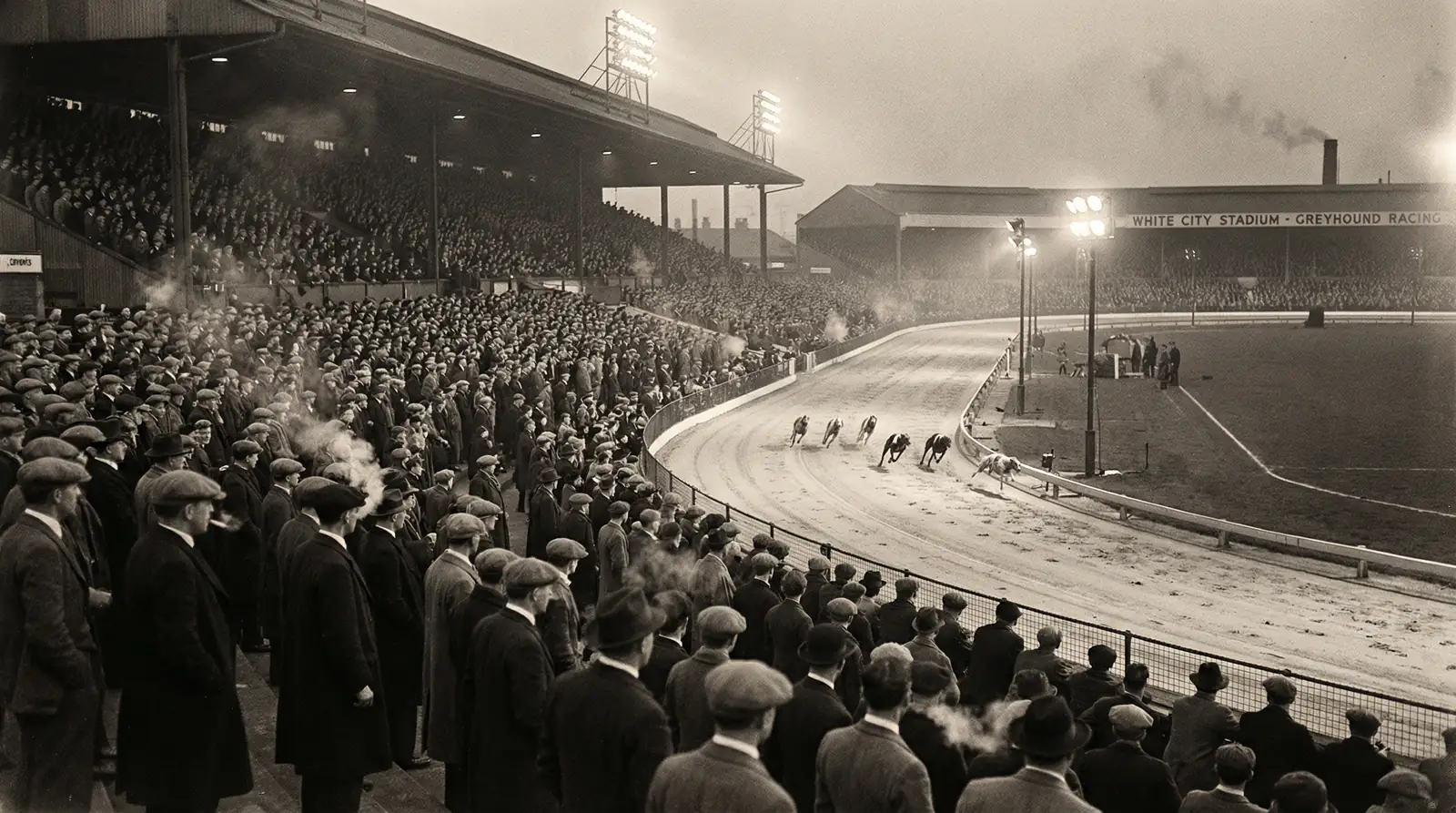
Origins: The First UK Greyhound Tracks (1926)
Commercial greyhound racing arrived in the United Kingdom from the United States, where mechanical-lure oval track racing had been developed in the early 1920s as a format distinct from coursing — the traditional pursuit of a live hare across open country. The first licensed greyhound track in Britain opened at Belle Vue, Manchester, on 24 July 1926, followed within weeks by White City in London. Both meetings attracted immediate public interest on a scale that surprised even their promoters. The format — short races, a mechanical lure, numbered traps, and a betting market on every race — proved uniquely well-suited to the urban working-class audience of interwar Britain.
The commercial logic was obvious from the start. Greyhound racing could be run under floodlights on compact urban sites, providing an evening entertainment product with a natural betting environment. The simplicity of the format — six dogs, one track, a clear finishing order — made betting accessible to audiences with no racing background and created a market that bookmakers and the Tote could service efficiently. Within two years of Belle Vue’s opening, dozens of tracks had opened across England, with stadium owners recognising that the racing surface was, in commercial terms, a vehicle for the betting market more than a sport in the traditional sense.
The Greyhound Racing Act 1934 provided the principal legislative basis for on-course Tote operations at licensed greyhound venues, formalising the commercial and regulatory framework within which the Tote could operate at dog tracks. The structural linkage between the sport and the betting market — which remains the defining characteristic of UK greyhound racing nearly a century later — was formally consolidated within the sport’s first decade. Track operators, from the first years of commercial greyhound racing, understood that their primary product was a betting market. The race was the mechanism; the bet was the purpose.
The Golden Age of Dog Racing (1930s–1960s)
The 1930s through to the late 1950s represented the period of peak attendance and social centrality for UK greyhound racing. At its height, greyhound tracks were among the most attended venues in British entertainment. Weekly attendances at major London stadiums — White City, Wembley, Wimbledon, Harringay — regularly exceeded 50,000 spectators. Provincial tracks in Birmingham, Manchester, Sheffield, and Newcastle drew comparable proportional audiences from their local populations. Dog racing was not a fringe pursuit; it was a mainstream urban leisure activity embedded in the weekly routines of millions of working-class families across Britain.
The betting market at this peak was dominated by the on-course Tote and by the ring of bookmakers operating legally on the track aprons. Off-course cash betting was illegal for most of this period, restricted by a legislative framework that had not kept pace with the public appetite for gambling. The paradox — a highly popular activity conducted partly illegally through off-course credit betting and street bookmakers operating in de facto tolerance by local police — defined the character of mid-twentieth century British gambling in ways that the Betting and Gaming Act 1960 eventually addressed. When betting shops were legalised in 1961, greyhound racing was immediately the primary sport on which the new shops built their turnover, ahead of horse racing in many areas simply because the frequency of greyhound racing provided a more continuous market throughout the day.
The 1950s and early 1960s also saw the consolidation of the major greyhound track ownership groups. The Greyhound Racing Association and its competitors built portfolios of major urban stadiums, recognising the economies of scale in the betting market and the commercial advantage of controlling media rights to their meetings. This corporate structure — stadium owners as the primary commercial interests in greyhound racing, sustained by the betting levy rather than by spectator admission — established the pattern that has defined the industry’s economics ever since.
Decline, Regulation and GBGB Formation
From the mid-1960s onward, UK greyhound racing entered a prolonged period of declining attendance that reflected broad changes in British leisure habits: television, increased car ownership, and a wider range of entertainment options drew working-class audiences away from the stadiums that had been their evening destination. Track closures accelerated through the 1970s and 1980s as urban sites became commercially valuable for redevelopment. Major venues that had been fixtures of the sports landscape for decades — White City, Harringay, Wembley, Clapton — closed progressively as their land values outpaced their commercial viability as racing venues.
The regulatory response to these pressures was fragmented through most of this period. The National Greyhound Racing Club — the predecessor regulatory body — operated with limited statutory authority, and the industry’s governance was complicated by the commercial interests of stadium owners, the welfare concerns of animal protection bodies, and the betting industry’s evolving relationship with a sport that provided significant turnover but was increasingly dependent on a shrinking number of tracks. The Greyhound Racing Act 1985 provided a clearer legislative framework for the sport, but the structural decline continued through the 1990s.
The formation of the Greyhound Board of Great Britain in 2009, consolidating the regulatory functions of the National Greyhound Racing Club and the British Greyhound Racing Board, represented the industry’s most significant attempt at structural reform. The GBGB took on responsibility for licensing, welfare standards, integrity, and the commercial development of the sport within a single body. The consolidation was accompanied by a formal financial commitment from the bookmaking industry to fund the GBGB through a percentage of greyhound betting turnover — the mechanism that has sustained the sport’s regulatory and welfare infrastructure in the years since.
The Rise of Online Greyhound Betting
The internet transformed UK greyhound betting more profoundly than any development since the legalisation of betting shops in 1961. The first wave of online bookmakers — appearing in the late 1990s and early 2000s — offered greyhound markets as a natural complement to their horse racing product, and the structural characteristics of BAGS racing made it particularly well-suited to the online environment. The continuous schedule of BAGS afternoons provided a market throughout the working day, the quick settlement of individual races suited the pace of online betting, and the availability of historical form data online gave punters access to the analytical resources that had previously required specialised publications.
Betfair Exchange‘s launch in 2000 introduced a structurally different relationship between the greyhound betting market and its participants. The ability to lay outcomes — to act as bookmaker rather than as bettor — opened analytical strategies that did not exist in a fixed-odds environment. The exchange’s price transparency also created a public record of informed market opinion on every race, visible to any user, which supplemented the form-based analysis available through Racing Post and similar services. The exchange price on a greyhound race in its final minutes before the off became, over time, one of the most reliable available signals of where well-informed money was positioned.
The introduction of live streaming for BAGS meetings — initially through bookmaker platforms in the mid-2000s — completed the transformation of greyhound betting from an on-course or in-shop experience to a fully remote one. A punter could now read the form at home, follow the market on a betting app, watch the race on a streaming feed, and cash out in-play — all from a single platform without being present at the track. The attendance figures that had declined steadily through the 1970s and 1980s became largely irrelevant to the commercial operation of BAGS racing; what mattered was the turnover flowing through licensed operators’ digital channels, and that turnover continued to grow as mobile betting became the dominant format.
Current Landscape and Future of UK Dog Racing
UK greyhound racing in the 2020s operates as a sport whose commercial survival is structurally dependent on the betting market. Approximately 20 GBGB-licensed tracks remain active, providing the BAGS schedule that generates the daytime betting volume on which the bookmaking industry’s greyhound revenues are built. Spectator attendance at most venues has declined to a fraction of its mid-twentieth century peak, and the economics of individual tracks are sustained primarily by the media rights income from the BAGS arrangement, the statutory levy, and prize money distributions from the GBGB’s funding mechanisms.
Animal welfare has become an increasingly prominent dimension of the sport’s public profile, with a series of welfare investigations, media reports, and GBGB policy responses shaping both the regulatory standards and the industry’s public communications. The GBGB’s welfare framework has been progressively strengthened since its formation, with mandatory injury reporting, rehoming requirements, and racing retirement protocols forming part of the conditions of track licensing. The commercial betting industry’s continued financial commitment to the GBGB is partly a function of the reputational risk of association with welfare failures at licensed venues.
The betting market for greyhound racing has never been more accessible. The BAGS programme provides continuous markets from Monday to Saturday afternoons across multiple tracks simultaneously, all available through major licensed bookmaker apps at competitive prices with integrated streaming. The analytical tools available to punters — form databases, exchange price data, trap statistics, sectional timing — have expanded considerably from the printed race card and on-course price board that defined the greyhound betting experience for the sport’s first five decades. What has not changed is the fundamental commercial relationship at the heart of the sport: the track exists because the bet exists, and as long as the bet remains commercially viable, some version of UK greyhound racing will continue to provide it with a vehicle.
The Track Survived Because the Bet Survived
The history of UK greyhound racing is, at its core, the history of a betting market that found a sport to attach itself to, and then kept that sport alive long past the point where spectator economics alone could have sustained it. Belle Vue’s crowds in 1926, the floodlit stadiums of the 1950s, the early betting shops of the 1960s, the BAGS programme, the internet, the exchange, the app — each development in that chain served primarily the betting market, and the racing existed within that chain as the regulated mechanism for generating verifiable, tamper-resistant results on which the betting market could function.
That is not a cynical reading of the sport’s history — it is an accurate one, and it is the context in which the current betting market makes complete sense. The punter betting on a BAGS race at Romford on a Tuesday afternoon is participating in a commercial arrangement whose commercial logic has remained essentially unchanged since the first Tote ticket was printed at Belle Vue in the summer of 1926. The dogs are faster, the markets are more efficient, and the bet confirmation takes a fraction of a second. The economics are the same.
