

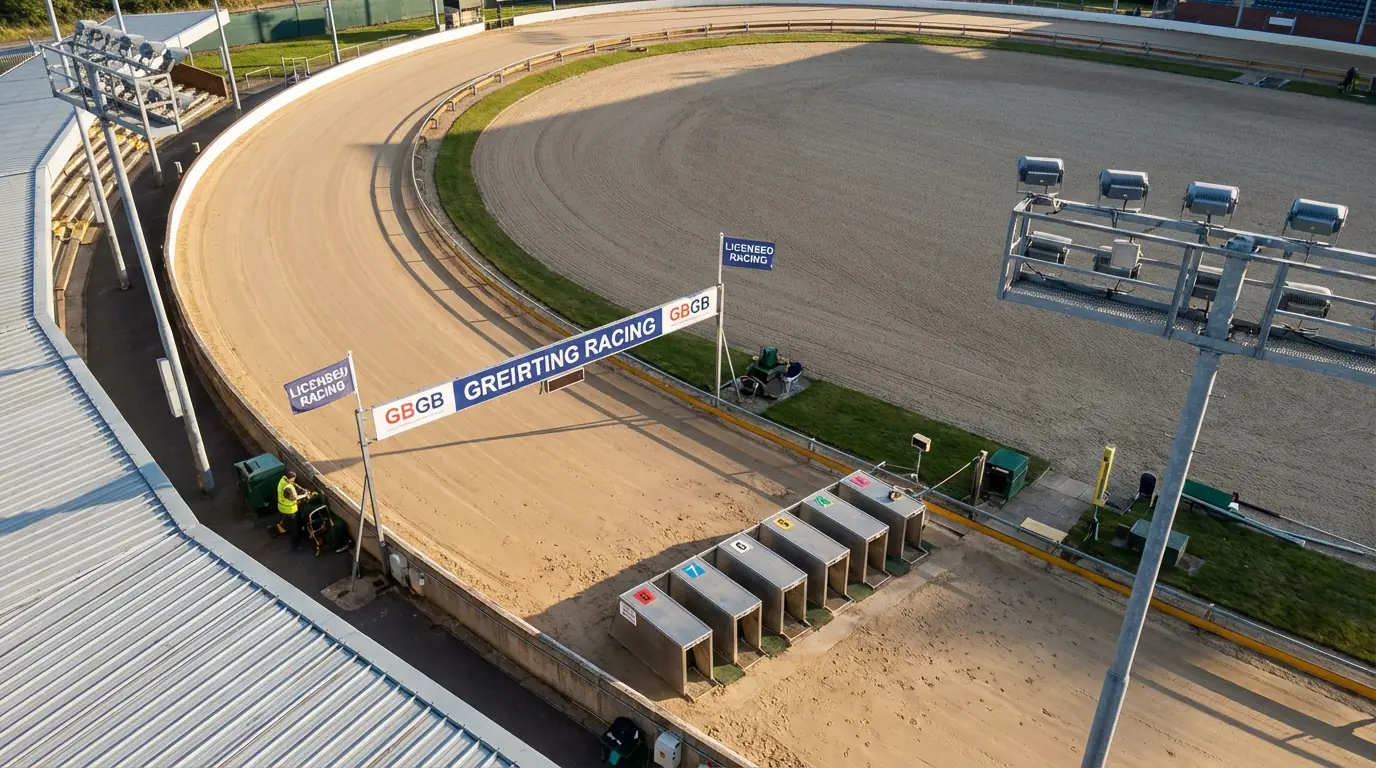
What Is the GBGB?
The Greyhound Board of Great Britain is the regulatory body for commercial greyhound racing in England, Scotland, and Wales. The GBGB was formed in 2009 through the merger of the National Greyhound Racing Club (NGRC) and the British Greyhound Racing Board (BGRB), consolidating the sport’s regulatory and commercial functions under a single body. It operates as a non-profit body funded primarily through levies on bookmaker turnover from greyhound racing. Its core function is the licensing and regulation of greyhound racing tracks, racing personnel — including trainers, kennels, and race officials — and the dogs themselves, from racing registration through to retirement.
The GBGB is not the same as the UK Gambling Commission. The UKGC regulates the betting operators — the bookmakers who take bets on greyhound racing. The GBGB regulates the sport itself. These are parallel regulatory frameworks that interact but are formally distinct. A punter needs to understand both: the UKGC licence of the bookmaker they use determines the consumer protections available to them; the GBGB licensing status of the track they are betting on determines the integrity and consistency of the races themselves.
The GBGB website at gbgb.org.uk publishes the current list of licensed tracks, the racing calendar, the rules of racing, integrity procedures, and welfare standards. It is the primary public reference for understanding which venues operate within the official regulatory framework and which do not. For any punter who regularly bets on greyhound racing, familiarity with the GBGB’s role and its public documentation is a basic element of informed participation in the market.
GBGB-Licensed Tracks and Their Standards
GBGB-licensed tracks number around 20 active venues in Great Britain at any given time, though the exact count changes as track licences are granted, renewed, suspended, or allowed to lapse. Major current tracks include Romford, Crayford, Hall Green, Monmore Green, Sheffield (Owlerton), Sunderland, Swindon, Yarmouth, and Pelaw Grange, among others. These venues form the backbone of the BAGS commercial programme and the evening fixture schedule that supports the mainstream UK greyhound betting market. Notable historic venues such as Wimbledon, which closed in 2017, no longer feature in the active GBGB roster.
All GBGB-licensed tracks must meet a defined set of operational standards covering track surface quality, trap mechanics, hare operation, race officiating, result integrity, and animal welfare. Track inspections are conducted by GBGB officials, and tracks that fail to maintain the required standards are subject to licence conditions, suspension, or revocation. The consistency of surface maintenance and operational standards across GBGB-licensed tracks is what gives form comparisons their validity — if two tracks were operating to wildly different standards, a dog’s time at one venue would be meaningless as a benchmark for performance at another.
Grading at GBGB-licensed tracks operates within the framework established by the Board, though individual racing managers have discretion in applying that framework to their specific venue’s programme. The GBGB sets the parameters — grade definitions, qualification standards, the rules governing upgrades and downgrades — and track racing managers operate within them. This creates a degree of consistency in what grades mean across venues while allowing local variation in the competitive landscape at any specific track.
Track registration for dogs is a GBGB function. Before a dog can race at any GBGB-licensed venue, it must be registered with the Board under its official name and identity, with its ownership, breeding, and kennel affiliation recorded. The registration system creates a verifiable identity trail for every dog that competes in official racing, which is the foundation for form records, integrity investigations, and anti-doping compliance. When you look up a dog’s history on Racing Post, the underlying data derives from the GBGB registration and results system.
How GBGB Regulation Benefits Bettors
The primary benefit of GBGB regulation for greyhound bettors is result integrity — the confidence that the races being bet on are conducted according to consistent rules, by officials whose conduct is subject to oversight, at venues whose track surfaces and operational standards are periodically inspected. This may sound abstract, but its practical value becomes clear when you consider what form data would mean in the absence of standardised conditions. A race time at an unregulated venue on an uninspected surface is not a valid benchmark for anything. The form records that underpin greyhound betting are only analytically meaningful because the conditions under which those records were set are governed by a consistent framework.
GBGB regulation also governs the trap draw process. The allocation of traps to dogs in BAGS and graded racing follows rules designed to ensure the draw is impartial and conducted consistently across all licensed venues. Without that procedural consistency, trap bias analysis — one of the most practically useful analytical tools in greyhound betting — would be contaminated by the possibility of manipulated draw processes inflating or deflating the observed advantage of specific trap positions. The regulated draw procedure is the prerequisite for trap statistics having any analytical validity.
Anti-doping and performance integrity provisions are administered by the GBGB through its testing programme, which covers both prohibited substance testing of racing dogs and investigation of racing irregularities reported by stewards or flagged through integrity monitoring systems. This programme does not eliminate all potential manipulation — no testing regime does — but it creates a deterrent and an investigative framework that meaningfully raises the cost of attempted race fixing compared to an unregulated environment. For bettors, the existence of this programme is not a guarantee of perfect integrity; it is the baseline assurance that integrity is being actively monitored and that systemic abuse is exposed more quickly than in its absence.
GBGB and Integrity in Greyhound Racing
Greyhound racing integrity is a topic that attracts periodic media attention in the UK, and the GBGB’s role in managing integrity concerns is worth understanding clearly. The Board operates an integrity function that investigates suspicious race results, unusual betting patterns flagged by the Gambling Commission’s integrity monitoring systems, and complaints from licence holders about conduct by other licence holders. The integrity function has the authority to commission tests, interview licence holders under caution, and refer matters to law enforcement when criminal conduct is identified.
The relationship between the GBGB and the UKGC on integrity matters is formal and documented. Unusual betting activity on a specific greyhound race — a significant movement in exchange prices, a concentration of bets on a specific runner that is inconsistent with the public form — may be flagged by the UKGC to the GBGB for investigation. The two bodies work from parallel data sets: the UKGC monitors the betting market, the GBGB monitors the racing operation, and the combination provides a more complete picture of any specific integrity concern than either body could develop independently.
For bettors, the practical implication of this integrity framework is that GBGB-licensed racing is subject to meaningful — if not perfect — oversight. The historical form records used for analysis reflect races conducted under regulated conditions. The results used for betting settlement are the official GBGB results, not results compiled by a third party without independent verification. When you bet on a GBGB-licensed meeting, you are operating within a framework where the race data you rely on has been produced under conditions designed to support its integrity. That is not a minor consideration when the entire analytical enterprise of greyhound betting depends on historical form data being meaningful.
Non-GBGB Venues: What to Know
Greyhound racing does take place outside the GBGB framework in the UK, at venues known informally as flapping tracks. These are independent venues that operate outside the GBGB licensing system, typically on a smaller scale with different rules, different registration requirements for dogs, and without the operational standards and integrity oversight that GBGB licensing mandates. Flapping meetings are not illegal in themselves — they operate under separate licensing arrangements — but they are structurally different from GBGB-licensed racing in ways that matter directly to bettors.
The most significant differences are three. First, form from flapping meetings does not translate meaningfully to GBGB racing. A dog’s track record at an unregulated venue cannot be cross-referenced with GBGB grade and time data in any reliable way, because the competitive standards, track conditions, and result integrity procedures are different. Second, most major UKGC-licensed bookmakers do not offer markets on flapping meetings — the betting market for non-GBGB racing is thin and largely confined to on-track and informal betting. Third, and most directly: if you encounter a platform offering bets on greyhound races that are not drawn from the GBGB fixture list, you cannot apply the same form-based analytical framework, and you should not assume the same level of result integrity.
The GBGB fixture list at gbgb.org.uk is the authoritative source for which meetings on any given day are within the regulated framework. Checking that the race you are betting on appears on that list takes seconds and confirms that the analytical tools available to you — form records, trap statistics, time benchmarks — apply to the race in question. If the race is not listed, those tools do not apply, and the bet is being placed without the informational foundation that makes greyhound betting analytically tractable.
The Board Exists for the Dogs and the Bets
The GBGB serves two constituencies simultaneously: the welfare of the dogs and the integrity of the commercial betting market. These interests align more often than they conflict — a well-regulated sport with consistent standards, transparent results, and accountable personnel produces better races to watch, better form data to analyse, and more confidence in the integrity of the markets built on those races. The betting industry’s commercial interest in race integrity and the welfare community’s interest in dog welfare both point toward the same regulatory conclusion: consistent standards, applied consistently, across all licensed venues.
For the punter, the GBGB is the institution that makes greyhound form meaningful. Know which tracks it licenses, trust the fixture list, and treat the form records produced under its oversight as the analytical resource they are — imperfect, but produced within a framework that is materially more reliable than the alternative.
