

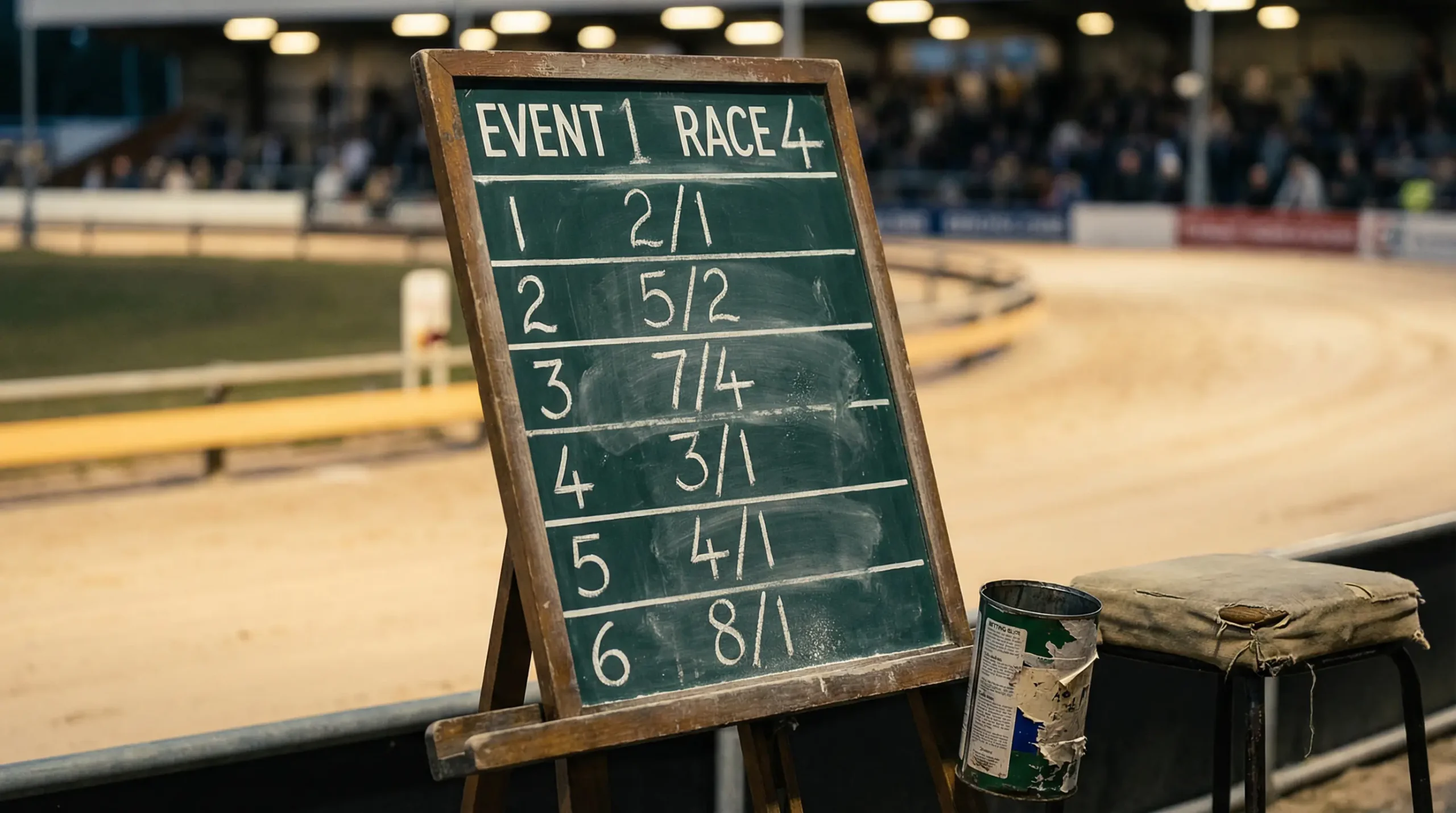
Fractional vs Decimal Odds on Dogs
UK greyhound betting has historically been expressed in fractional odds — the format that states net profit relative to stake, expressed as a ratio. A price of 3/1 (spoken as “three-to-one”) means that for every £1 staked, you receive £3 profit on a winning bet, plus your original £1 stake returned, giving a total return of £4. A price of 5/2 means £5 profit for every £2 staked — equivalently, £2.50 profit per £1 staked, giving a total return of £3.50 per pound. The denominator indicates the stake unit; the numerator indicates the profit at that unit.
Fractional odds can be slightly cumbersome for quick return calculations, particularly on non-round denominators. The industry-wide shift toward decimal odds — standard in European betting and now offered as the default by most UK online bookmakers — was driven by this calculation friction. Decimal odds represent total return per unit staked, including the stake itself. A decimal price of 4.0 is equivalent to the fractional 3/1: stake £1, receive £4 total. A decimal price of 3.5 is equivalent to 5/2: stake £1, receive £3.50 total. The conversion formula is straightforward — decimal odds equal the fractional odds expressed as a fraction plus one: 3/1 becomes 3 + 1 = 4.0; 7/4 becomes 7/4 + 1 = 1.75 + 1 = 2.75.
For greyhound betting specifically, most BAGS race cards and online bookmaker interfaces allow punters to switch between fractional and decimal display. Neither format changes the bet or the return — they are two representations of the same price. The choice of format is a matter of calculation preference. Decimal odds make accumulator return calculations simpler because you multiply the decimal prices together directly: a double at 4.0 and 3.5 returns 4.0 × 3.5 = 14.0 per unit staked, meaning a £5 double returns £70. Fractional odds require converting to decimals anyway before multiplication, so for punters who regularly build accumulators, default decimal display is the more practical setting.
Odds-on prices — where the implied probability of winning exceeds 50 percent — are expressed fractionally as prices where the denominator exceeds the numerator: 4/7, 1/2, 2/5. These mean you stake more than you profit: at 2/5, staking £5 returns £7 total (£2 profit). In decimal format, all odds-on prices are below 2.0. Greyhound races with a dominant favourite may produce odds-on prices on the market leader, and these should be treated with particular attention — an odds-on selection in a six-runner race is being offered at a price implying more than 50 percent probability of winning in a field where statistical neutrality would suggest approximately 17 percent. That is a large market commitment, and the form evidence supporting it needs to be commensurately strong.
What Is Starting Price (SP) in Greyhound Racing?
The starting price is the official odds returned at the moment a greyhound race begins — the price at which a bet is settled if it was placed at SP rather than at a named early price. SP is not a single bookmaker’s price; it is a compiled figure that represents the prevailing market price at the off, calculated from the prices offered by the major on-course and off-course bookmakers in the final moments before the race starts. For GBGB-licensed greyhound racing, SP compilation follows an established methodology used across the industry and used as the settlement basis for SP bets at all major UK licensed bookmakers.
SP is the default settlement price for bets placed at many outlets — particularly in betting shops — where the customer accepts the prevailing price at the time of settlement rather than fixing an early price. For online bettors, the choice is usually explicit: take the displayed price at the time of placing the bet, or select SP. The strategic choice between the two depends on whether you expect the price to move in your favour or against you before the off. A dog that is expected to attract late market support may shorten from its early price — in that case, taking the early price locks in the better return. A dog that is likely to drift — perhaps because the market is overconfident in a rival — may go off at a longer SP, in which case waiting for SP produces a better settlement price.
SP also functions as the settlement basis for forecast and tricast dividends, where the Computer Straight Forecast and Computer Tricast formulas use the SPs of the first and second, or first, second, and third finishers, to calculate the dividend. In this context, SP is not just a price display format but a mathematical input into a complex return calculation — which means the identity and SP of every dog in the finishers matters, not just the dog you backed. An outsider finishing second in a CSF bet pushes the dividend up substantially because its high SP amplifies the formula output.
Calculating Returns: A Step-by-Step Example
Return calculation for straightforward win bets is the arithmetic of the odds format applied to the stake. For fractional odds: multiply the numerator by the stake, divide by the denominator, then add the stake back. For decimal odds: multiply the decimal price by the stake. Both routes produce the same total return figure.
A worked example using fractional odds: a £10 win bet at 7/2. Profit = (7 ÷ 2) × £10 = 3.5 × £10 = £35. Total return = £35 + £10 stake = £45. In decimal: 7/2 = 4.5 in decimal format. £10 × 4.5 = £45 total return. Net profit = £45 − £10 = £35. The two routes agree.
For each-way bets, the calculation splits into two parallel win bet calculations. The win portion settles at the full odds. The place portion settles at a fraction of the full odds — typically one quarter (1/4) — if the dog finishes in the paid places. A £5 each-way bet is actually two £5 bets: one on the win, one on the place. Total stake is £10. If a dog at 9/2 wins in a six-runner race: win portion returns £5 × (9/2) + £5 = £22.50 + £5 = £27.50. Place portion (1/4 odds for finishing first in a six-runner field that pays 2 places): place odds = 9/2 ÷ 4 = 9/8. Place return = £5 × (9/8) + £5 = £5.625 + £5 = £10.625. Total return from the each-way bet = £27.50 + £10.625 = £38.125. Net profit = £38.125 − £10 stake = £28.125.
Accumulator calculations use decimal odds exclusively for efficiency. Convert all fractional odds to decimal, multiply the chain, multiply by the stake. A three-fold accumulator at 5/2 (3.5), 2/1 (3.0), and 6/1 (7.0): 3.5 × 3.0 × 7.0 = 73.5. On a £2 stake: £2 × 73.5 = £147 total return. Net profit = £145. The bet slip calculation on any major bookmaker platform replicates this automatically, but understanding the underlying arithmetic allows you to assess whether a displayed return is plausible before confirming the bet.
How to Compare Greyhound Odds Across Bookmakers
Odds comparison across bookmakers is one of the most straightforward value-enhancement tools available to any greyhound punter. The same dog in the same race can be priced differently at different licensed operators — sometimes by a small amount, occasionally by a significant margin — and the difference compounds meaningfully over a large volume of bets. Consistently betting at the best available price on each selection produces a higher long-run return than betting habitually at any single operator regardless of its prices on a specific race.
The primary tools for greyhound odds comparison in the UK are odds comparison websites and the “best odds” feature built into most Racing Post race card pages. The Racing Post card typically displays a comparative price column showing the available prices at several major bookmakers simultaneously, updated in near-real-time as the market moves. For BAGS racing, this comparison is available from the moment prices go up — typically 30 minutes or more before the race — giving punters a clear view of where the best price sits before committing to a specific platform.
The specific selections where odds comparison is most productive are those where you have already decided to bet on a specific dog based on form analysis and are simply choosing where to place the bet. In that scenario, the only remaining variable is price, and the comparison tool resolves it directly. The comparison is less useful as a selection aid — identifying a dog that happens to be available at a slightly longer price than elsewhere is not a form-based reason to back it. The form view should come first; the price comparison confirms the best execution of that view.
Betfair Exchange prices are worth including in any odds comparison for greyhound bets. The exchange typically offers better prices than fixed-odds bookmakers — reflecting the absence of a bookmaker margin — but the comparison must account for the commission charged on winning exchange bets. A Betfair price of 4.2 at 2% commission produces a net return of 4.2 × 0.98 = 4.116 per unit staked, which should be compared against the best fixed-odds price available. If the best bookmaker price is 4.0, the exchange is still superior net of commission. If the bookmaker price is 4.1 and the race has limited exchange liquidity, the fixed-odds option may be more practical even if marginally inferior on paper.
Early Prices and Ante-Post Greyhound Markets
Early prices on greyhound racing — prices taken before the final market forms in the last 30 minutes before the off — are a specific type of market with distinct characteristics. They are the prices used to trigger Best Odds Guaranteed upgrades at operators that offer BOG on dogs, and they are the prices against which significant pre-race market movement is measured. Taking an early price on a greyhound is a commitment to that price regardless of where the SP settles, and the decision requires a view on whether the dog is more likely to shorten or drift between the early price and the off.
Ante-post greyhound markets are a smaller category — prices available on race days or weeks in advance, typically for feature events such as the English Greyhound Derby, the Scottish Derby, or major invitation events. Ante-post betting is available at a handful of major operators and on Betfair Exchange during the build-up to these events. The ante-post market on a greyhound classic operates similarly to ante-post horse racing: you take a price before the field is confirmed, accepting the risk of a non-runner for a potentially longer price. Non-runner rules on greyhound ante-post bets vary by operator — some offer each-way or void-if-non-runner terms, others settle at SP if the dog runs regardless of the ante-post price taken — and verifying the specific terms before placing an ante-post bet on a greyhound classic is standard practice.
The Odds Are Already an Opinion
Every price on a greyhound race card — fractional, decimal, SP, early price — is a quantified opinion about the probability of a specific outcome. It is not a fact. It is the bookmaker’s assessment, built on the tissue compiler’s reading of the form, adjusted for market volume, competitor prices, and the operator’s commercial margin requirements. When the price is wrong — when the true probability of a dog winning is materially different from what the price implies — that discrepancy is the only legitimate basis for a bet.
Read the odds fluently, convert between formats when you need to, compare across operators before confirming, and remember at every point that the price you are looking at started as someone else’s analytical conclusion. Your job is to identify when their conclusion is mistaken, and what that mistake is worth at the price on offer.
