

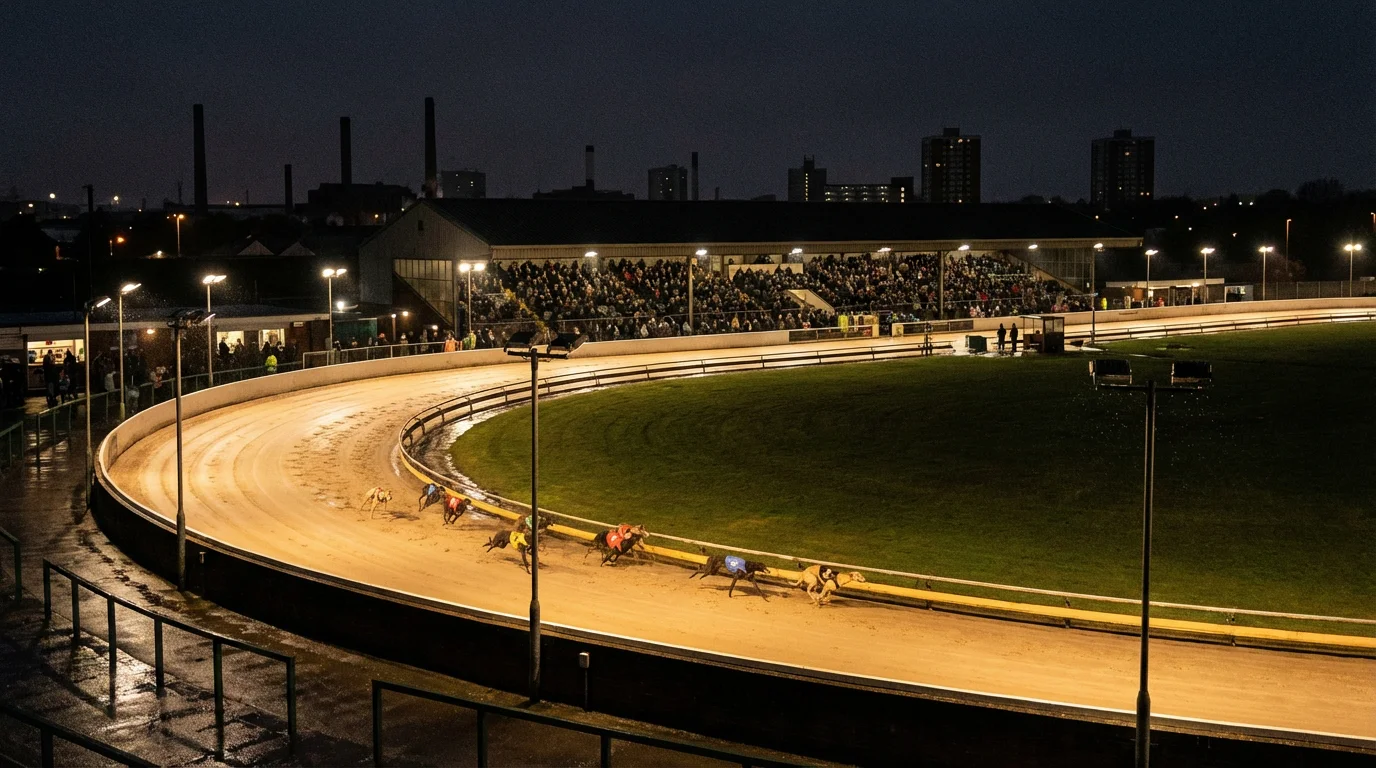
Monmore Track Overview
Monmore Green Stadium in Wolverhampton is one of the most commercially active greyhound venues in the Midlands and a regular fixture in the BAGS daytime schedule. GBGB-licensed and operating continuously since 1928, Monmore Green has established a reputation as a reliable, well-managed track with consistent surface conditions and a strong BAGS presence that keeps it in the rotation of the UK’s most frequently bet greyhound venues. For punters who specialise in Midlands tracks, Monmore is a natural primary focus — it generates substantial form data, appears regularly in the betting schedule, and has a track configuration that produces identifiable pattern tendencies over time.
The stadium operates a right-handed oval with a configuration that sits between the compact circuit of Crayford and the more open layout of Wimbledon. The bend geometry is moderately tight — tighter than Wimbledon but not as unforgiving to wide runners as the smallest BAGS circuits — which produces a trap bias profile that is measurable but not as extreme as at the tightest right-handed ovals. Monmore is often described as a balanced track, in the sense that while inside draw advantage exists, it does not dominate race outcomes to the degree seen at some London venues.
The track’s Midlands location gives it a dog roster that draws heavily from kennels in the West Midlands, Staffordshire, and surrounding counties, alongside trainers who supply dogs from further afield for high-profile open meetings. The local kennel network at Monmore is relatively stable and well-documented, which benefits form analysts who track trainer and handler patterns as part of their selection process. Dogs that run regularly at Monmore tend to have deep form records at the track, making grade and time comparisons more reliable than at venues with higher turnover of one-off runners.
Distances and Race Types at Monmore
Monmore runs racing across three primary distances: 462 metres, 630 metres, and 480 metres, with the 462-metre sprint being the most frequently run distance in BAGS and standard graded competition. The 462m configuration at Monmore is slightly longer than the standard 400m found at some other BAGS venues, which has a practical effect on race dynamics: the additional distance gives wide runners marginally more opportunity to establish a competitive position before the first bend, producing a slightly more open race structure than a pure sprint at a tighter circuit.
The 480-metre intermediate distance produces a different competitive dynamic again — dogs with sustained early-to-middle pace tend to perform well, and the race is decided across two bends rather than one. Form from the 480m should be kept analytically separate from the 462m sprint: the pace profile of the winning dog is different, the trap relevance changes, and the time benchmarks are distinct. A dog with a strong 462m record does not automatically translate into a 480m performer, and vice versa.
The 630-metre stayers distance at Monmore carries specific betting interest from punters who follow Midlands staying form. Like Wimbledon’s longer distances, Monmore’s stayers programme represents a separate analytical domain with its own dog roster, trainer tendencies, and trap bias profile. The inside advantage at stayers distances tends to be less pronounced than at sprints — the race runs for longer, giving positional disadvantages more time to be overcome — but the specific data for Monmore’s 630m should be consulted rather than assumed from sprint bias patterns.
Monmore Trap Bias Analysis
Trap bias at Monmore’s 462-metre sprint distance shows a consistent inside advantage across extended historical samples, with Trap 1 win rates typically falling in the 18–21% range — above the neutral 16.7% baseline but less extreme than the most pronounced right-handed oval biases seen in London. Trap 6 tends to win at below-neutral rates, generally in the 13–16% range, reflecting the geometric disadvantage of the outside draw on a right-handed circuit where the first bend favours inside-positioned dogs.
The middle traps at Monmore — Trap 3 and Trap 4 — perform close to neutral on aggregate, which is analytically consistent with a moderately tight right-handed oval. Dogs drawn here are neither significantly advantaged nor disadvantaged by their position, and their form record and running style carry proportionally more weight in the race assessment. When two dogs of similar form quality are matched in a Monmore sprint, with one drawn inside and one in the middle, the inside advantage is real but not decisive — the middle-drawn dog is still in the race and can produce a result if it has a genuine pace advantage.
An important seasonal variable at Monmore is the going condition. The track surface tends to be heavier in winter months when drainage is more actively tested, and heavy or slow going amplifies the inside advantage because wide runners struggle more with the surface and the extra distance. In fast conditions during summer, the advantage moderates and the race becomes more neutral from a draw perspective. Checking the going description in the race card before applying winter bias statistics to a summer meeting is standard practice for Monmore analysis.
Monmore has also been subject to periodic maintenance and resurfacing work over the years, and each significant surface intervention should be treated as a potential reset point for trap bias data. A resurfaced inside line may run differently from the established historical pattern for several months after the work is completed. When Racing Post trap statistics show an unusual pattern at Monmore — significantly different from the long-run averages — it is worth checking whether recent track work might explain the deviation before drawing conclusions from the anomaly.
BAGS Fixtures at Monmore
Monmore is a consistent BAGS participant and appears in the weekday afternoon schedule with regularity throughout the year. Its Midlands location in the Wolverhampton conurbation means it operates within a cluster of nearby BAGS tracks — Hall Green and Sheffield are both within the same regional circuit — and the fixture schedule rotates to ensure that multiple Midlands venues are not all running BAGS simultaneously. On any given BAGS afternoon, Monmore may be one of two or three tracks broadcasting concurrently, with race times staggered to maximise the density of live betting markets across the schedule.
BAGS meetings at Monmore typically feature six to eight races concentrated in the sprint and intermediate distances, with grade levels running predominantly A4–A6 for the main card. The fixture schedule is published through Racing Post’s greyhound section and the GBGB website, and Monmore’s own social media channels publish advance schedule information that is useful for punters planning their week around specific meetings.
Betting on Monmore Online
All major UKGC-licensed bookmakers carry Monmore markets across BAGS and evening meetings as standard. Win, each-way, forecast, reverse forecast, and tricast markets are available on every race in the card, and streaming of BAGS meetings is provided by most major licensed operators subject to account requirements. Betfair Exchange carries Monmore pre-race markets and in-running availability for supported fixtures, giving exchange punters the same access to back and lay markets that they have at London BAGS venues.
For form research, Racing Post provides the complete Monmore race history with trap statistics, time comparisons, and handler records. The Monmore-specific data on Racing Post is sufficiently deep to support granular analysis by grade and distance, and the Going Allowance data where published gives additional context for interpreting time comparisons across meetings where the surface conditions varied. Greyhound-Data.com supplements the Racing Post data with international form context for dogs making their Monmore debut from other venues — a useful reference when assessing a dog that has performed well at Sheffield and is appearing at Monmore for the first time.
One specific betting context worth noting for Monmore: the track’s feature events — including its own classic races and invitation meetings — attract dogs from across the country and generate stronger-than-usual market depth on the Betfair Exchange. For punters who prefer exchange betting, Monmore feature nights offer better liquidity than standard BAGS afternoons, which is worth factoring into the decision between exchange and fixed-odds for specific races.
Monmore Rewards the Midlands Specialist
Monmore is not a track that reveals its patterns to a punter who visits occasionally and applies generic logic. The inside advantage is real but moderate. The dog roster is stable and locally-based. The trainer patterns are trackable. The seasonal and surface variables affect the form in ways that take time to calibrate. All of that points toward the same conclusion that applies to every serious track-based betting approach: the punter who studies Monmore consistently, builds a database of times and performances across grades and conditions, and develops a genuine feel for the track’s specific tendencies will always hold an edge over the one who shows up with a general form guide and an eye for a short price.
Monmore’s combination of BAGS regularity, surface consistency, and manageable form complexity makes it one of the better starting points for a punter looking to build a track-specialist approach to greyhound betting. The data is available, the patterns are findable, and the market does not fully price them — which is exactly the environment where patient, focused analysis pays off.
