

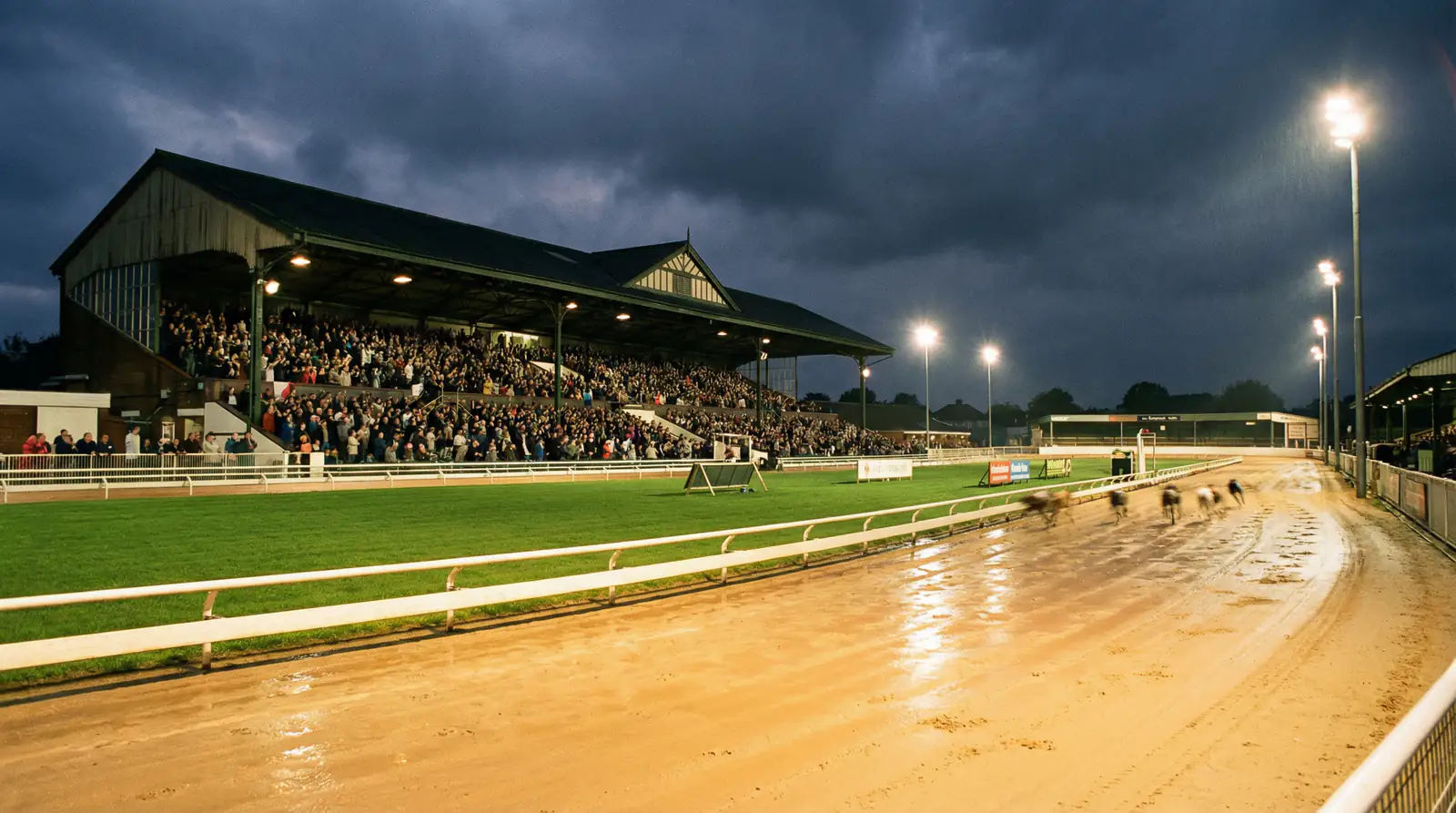
Wimbledon Track Overview
Wimbledon Greyhound Stadium — historically located at Plough Lane in South London — hosted racing from 1928 until its closure and demolition in 2017, when the site was redeveloped for the new AFC Wimbledon football ground. The venue was one of the most commercially significant greyhound tracks in the UK during its operational life, running both BAGS daytime content and premium evening meetings under GBGB licence. Wimbledon held a particular historical importance in the sport as the long-standing home of the English Greyhound Derby, the sport’s most prestigious event, before the Derby was relocated following the stadium’s closure. Punters and analysts researching Wimbledon form should note that the venue is no longer operational; historical form data from the track remains available in the Racing Post database but no current BAGS or evening meetings are staged here.
For betting purposes, Wimbledon presents a different analytical challenge to a compact track like Romford. The circuit is larger, the bends are more sweeping, and the configuration creates a track that is distinctly more accommodating to wide runners than most other London venues. Dogs that run naturally along the outer lanes — animals that drift wide through the bends rather than cutting to the rail — find Wimbledon particularly suitable, and the form profile of winners at this track reflects that tendency. Understanding which running styles suit the Wimbledon layout is the foundational step in reading its form intelligently.
The track’s reputation as a fair racing surface is well-earned. The going is maintained consistently, the bend geometry is regular, and the race data accumulated across nearly a century of meetings gives punters and analysts a deep historical reference base. Wimbledon’s position as a prestige venue also means it attracts higher-grade dogs than many BAGS-only tracks, which has implications for form comparisons — a dog performing well in an A2 race at Wimbledon is competing against a stronger field than an equivalent A2 runner at a smaller provincial track.
Distances and Race Types at Wimbledon
During its operational life, Wimbledon ran racing across four primary distances: 400 metres, 480 metres, 640 metres, and 820 metres. The two sprint distances — 400m and 480m — were the most frequently run in BAGS and graded competition. The 400-metre event was a genuine short sprint where the first bend established the running order quickly; the 480-metre distance added a brief additional straight and a second-corner entry point that tended to benefit dogs with a slightly longer early-pace profile.
The 640-metre and 820-metre stayers distances were minority products by volume but carried significant betting interest on feature meeting nights. Wimbledon’s stayers programme was among the most established in British greyhound racing, and the form comparisons across stayers running at this track were relatively reliable because the sample depth was sufficient to produce meaningful time benchmarks.
The Derby meeting in June brought a distinctly different race format: knockout rounds from heats through to a final, with dogs often running multiple races across consecutive weeks. Following Wimbledon’s closure, the English Greyhound Derby was held at various venues including Towcester Racecourse and subsequently at other GBGB-licensed tracks. Analysts working with historical Wimbledon form should treat pre-2017 data as a separate reference category, distinct from current active BAGS venues.
Wimbledon Trap Bias Analysis
Wimbledon’s trap bias profile was more nuanced than the straightforward inside advantage seen at tighter right-handed tracks. The sweeping bend configuration gave wide runners more room to manoeuvre at the first turn, reducing the structural disadvantage of the outside traps relative to what you would find at Romford or Crayford. Historical data for Wimbledon sprint distances generally showed a moderate Trap 1 advantage — typically in the 18–22% win rate range — rather than the more pronounced bias observed at compact venues.
The middle traps at Wimbledon — particularly Trap 3 and Trap 4 — performed closer to neutral than they did at most right-handed ovals. Dogs drawn in these positions could access both the rail and the middle of the track without a severe disadvantage at either extreme. Trap 5 and Trap 6 win rates at Wimbledon were typically in the 13–17% range — below neutral but not as suppressed as outside trap rates at more compact venues.
The more important variable at Wimbledon was the individual dog’s running style relative to the track’s geometry. A wide runner — a dog that naturally drifted toward the outer lanes through the bends — could be a genuine advantage selection here in a way unusual at other right-handed tracks. This makes historical Wimbledon form data particularly interesting for analysts researching how wide runners perform on sweeping versus tight circuits, though the data is now a closed historical dataset rather than a live reference.
BAGS Fixtures at Wimbledon
Wimbledon was a significant BAGS participant prior to its closure in 2017, providing a major London venue for the daytime betting schedule. Since the stadium’s demolition, it no longer appears in the BAGS rota. Punters looking for archived Wimbledon form data can access the full historical race record through the Racing Post greyhound section and the GBGB historical database.
Betting on Wimbledon Historical Form Online
Since Wimbledon’s closure, its historical form data remains accessible through the Racing Post greyhound database and through Greyhound-Data.com. The depth of historical data available for Wimbledon — nearly a century of racing up to 2017 — makes it a rich analytical reference for studying trap bias patterns, wide-runner performance, and how dogs from other active GBGB tracks performed when visiting this venue. Betfair Exchange’s historical price data is also accessible through third-party tools for punters researching pre-2017 Wimbledon exchange markets.
Wimbledon’s Legacy in UK Greyhound Form Analysis
Though no longer operational, Wimbledon’s historical form record remains analytically relevant for greyhound researchers. The track’s sweeping bend configuration, its wide-runner-friendly layout, and its deep record of Derby and high-grade competition make it a useful historical reference point for understanding how running styles interact with different circuit geometries. Punters building track-comparison frameworks will find the archived Wimbledon data a useful counterpoint to the tighter right-handed circuits that dominate the current BAGS rota.
