

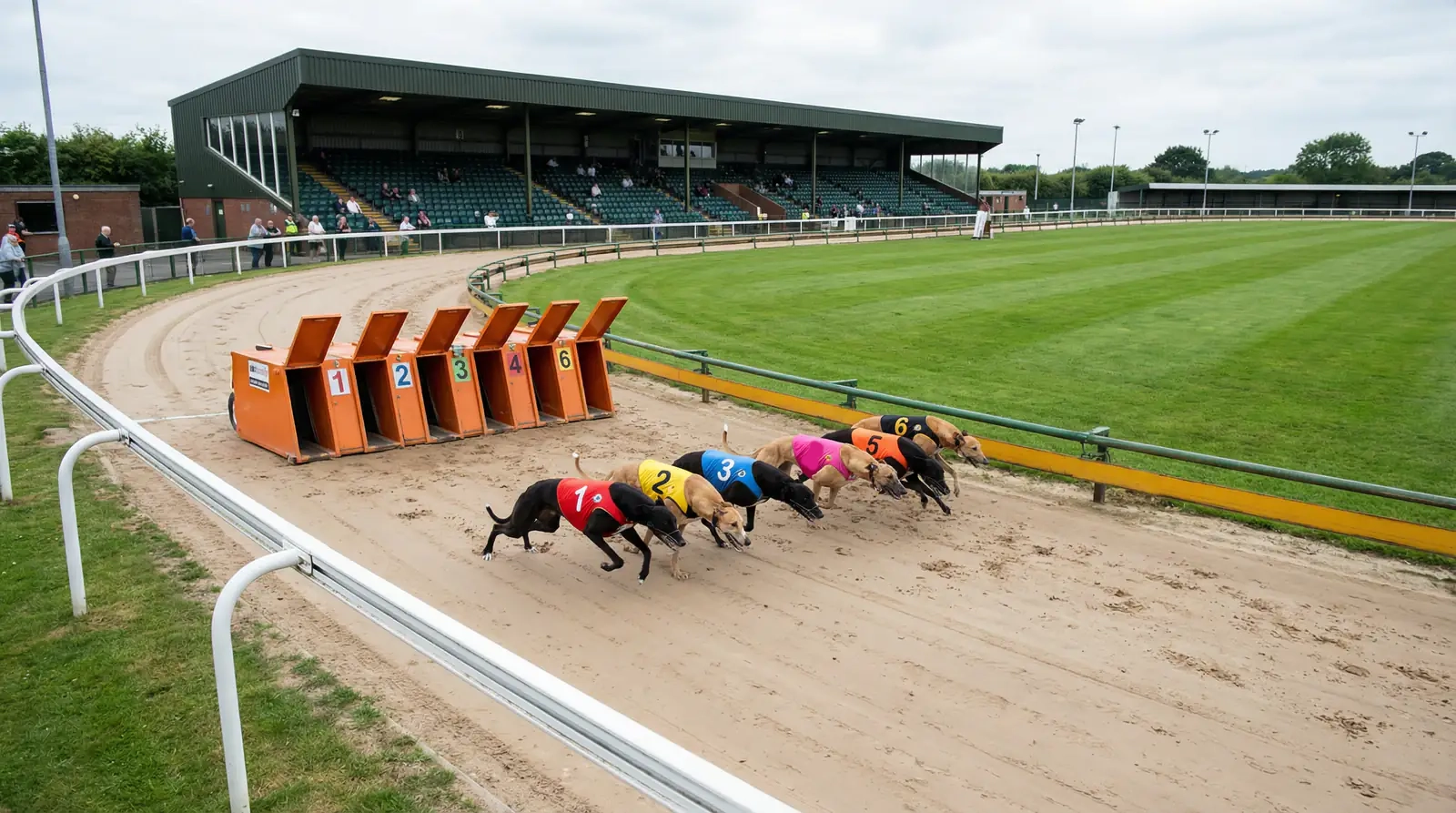
What BAGS Is and Who Runs It
If you’ve ever walked into a UK betting shop on a Tuesday afternoon and found wall-to-wall greyhound racing, that was BAGS at work. The Bookmakers’ Afternoon Greyhound Service is a commercial arrangement between major UK bookmakers and a select group of licensed greyhound stadiums, designed to supply a continuous programme of racing content during hours when other sports are thin on the ground. It has been running in various forms since 1967 and remains one of the most structurally important fixtures in British betting.
BAGS is operated under agreements negotiated collectively between the bookmaking industry and the stadiums, with the Greyhound Board of Great Britain (GBGB) serving as the sport’s regulatory body overseeing all GBGB-licensed meetings including BAGS. The tracks receive a media rights fee in exchange for staging meetings at specific times, on specific days, to a schedule that suits the retail betting calendar rather than the traditional evening or Saturday-afternoon attendance model. From the stadium’s perspective it is a commercial lifeline. From the bookmaker’s perspective it is content that fills a screen and generates a betting market every 15 minutes throughout the working day.
The service runs predominantly Monday to Saturday during afternoon hours, with some extended coverage on quieter sporting days. The races themselves are run to the same regulatory standards as any other GBGB-licensed meeting — the dogs are graded, the traps are drawn, and the results count toward the dogs’ official form records. The only meaningful difference for the athlete on four legs is the timing. For the punter, however, the difference is significant: BAGS meetings generate a density of betting markets that simply doesn’t exist anywhere else in British sport.
It is worth being clear about what BAGS is not. It is not a separate competition, a separate governing body, or a different class of racing. A BAGS race is a normal graded race run at a GBGB-licensed track, subject to the same stewarding, same drug testing protocols, and the same form-card documentation as any evening meeting. The BAGS label simply identifies when and why the meeting exists.
BAGS Track Rota
Not every GBGB-licensed track participates in BAGS, and those that do share a rota rather than all running simultaneously. The exact schedule changes over time as commercial agreements are renegotiated, but core participants have historically included Crayford, Romford, Hall Green, Monmore, Sunderland, Sheffield (Owlerton), Yarmouth, Swindon, and Pelaw Grange, among others. On any given weekday afternoon, three to five of these tracks will be broadcasting simultaneously, with races staggered so that a new result lands every few minutes across the combined card.
The rota logic is straightforward: bookmakers need a pipeline of content, and spreading meetings across multiple tracks produces more markets per hour than any single venue could. A punter sitting in a betting shop can effectively cycle through live results from Crayford at 1:03, Hall Green at 1:09, Romford at 1:15, and back to Crayford at 1:21 — a rhythm that keeps both the screen and the betting counter active throughout lunchtime and into the mid-afternoon.
For bettors who specialise by venue, the rota has a practical consequence: your preferred track may not be running on a given day, or may only contribute four races to an afternoon card rather than a full programme. Checking the BAGS fixture schedule before planning a session is basic practice. The Racing Post publishes daily BAGS fixtures on its greyhound section at racingpost.com/greyhounds, and most major bookmaker websites show upcoming meetings in their greyhound sections.
BAGS and Betting Availability
The commercial purpose of BAGS is to generate betting markets, and it does this very efficiently. Every BAGS race at every participating track is immediately available to bet on across the major UK licensed bookmakers — both in-shop and online. This is why greyhound betting volume in the UK is so heavily weighted toward BAGS meetings rather than evening fixtures. The audience is simply much larger during business hours, and the near-continuous pace of BAGS racing encourages turnover in a way that an isolated Saturday evening card does not.
For online bettors, BAGS availability means a live greyhound market is almost always open somewhere during a weekday afternoon. This matters when you’re considering the depth and quality of the markets available. Because bookmakers know BAGS meetings will attract consistent volume, they invest in proper odds compilation and offer the full range of bet types — win, each-way, forecast, reverse forecast, tricast, and combination markets — on every race. The same can’t always be said for smaller evening meetings at non-BAGS tracks, where the market might be a simple win-only offering with limited staking options.
Streaming coverage is another BAGS benefit. Most major licensed bookmakers provide live video of BAGS meetings to customers who have placed a qualifying bet or have a funded account. The quality of the broadcast varies by track, but it is generally sufficient for race-watching purposes. This combination of broad market availability, streaming access, and continuous scheduling makes BAGS the practical backbone of UK greyhound betting, regardless of whether punters consciously think of it in those terms.
One nuance worth noting: odds for BAGS races are compiled by bookmakers using a combination of form analysis and in-house tissue prices, and because multiple tracks are running at the same time, there is less individual scrutiny per race than you might get for a graded Stakes event. This cuts both ways. Bookmakers may shade their margins slightly tighter on BAGS markets because the volume justifies it, but there is also less transparency in the compilation process for any given race. Punters who do their homework on a specific BAGS track and grade have a real information advantage over the generalised market.
BAGS vs Non-BAGS Meetings
The distinction between BAGS and non-BAGS racing matters to bettors for two main reasons: market availability and form integrity. On availability, BAGS races are accessible across virtually every major UK bookmaker from the moment markets open, while non-BAGS evening meetings may only appear on a handful of platforms or with a reduced range of markets. If you want to bet a combination tricast on a Friday night card at a smaller venue, you may find that the bookmaker you normally use doesn’t carry it at all.
On form integrity, both BAGS and non-BAGS races are held to the same GBGB standards — they count equally toward a dog’s official form record and are subject to the same stewarding. However, there is a practical consideration around race preparation. Handlers and kennels know that a BAGS afternoon meeting is a professional obligation with commercial teeth behind it; the media rights fees flow partly from the quality and regularity of the racing. This doesn’t mean non-BAGS meetings are less competitive, but the commercial incentive structure is different, and some analysts argue that BAGS meetings produce marginally more predictable form patterns as a result.
Betting markets for BAGS races also tend to have tighter spreads and more responsive pricing in the minutes before a race, simply because more money is flowing through them. If you’re trying to take a price before the market moves, a BAGS race on a Wednesday afternoon at Hall Green will react faster to significant money than a Tuesday evening trial at a smaller open-licence track.
BAGS Fixture List: How to Find Today’s Racing
Finding the BAGS schedule is straightforward once you know where to look. The most complete and up-to-date source is the Racing Post greyhound section, which publishes the full day’s card including BAGS and non-BAGS meetings with race times, trap draws, and form data. The GBGB website at gbgb.org.uk also maintains a fixture list, though it covers all GBGB-licensed racing rather than specifically flagging BAGS status.
Most licensed bookmakers display their greyhound schedule under a dedicated section — Betfair, bet365, William Hill, and Ladbrokes all show upcoming races filtered by track and time, making it easy to see which venues are running and when. The advantage of checking directly on the bookmaker’s site is that you immediately see which markets are open and what bet types are available for each race, saving the step of cross-referencing separately.
If you follow a particular track, checking its official social media or website can give you the weekly BAGS schedule several days in advance. Tracks involved in BAGS typically publish their meeting schedule Monday morning for the week ahead. For regular punters who plan their betting sessions, this forward visibility is useful — it lets you identify which afternoons your preferred track is running, which grade is racing, and whether there are any particularly interesting entries coming up based on the trial results posted after kennels submit their dogs.
The Engine Room of Dog Betting
Strip away the history and the stadium atmospherics, and BAGS is a content supply contract dressed up as racing. That is not a criticism — it is just what it is. The arrangement sustains tracks that might otherwise struggle to remain viable during the low-attendance afternoon hours, it gives bookmakers a product that generates consistent handle throughout the working day, and it gives punters access to a near-continuous stream of competitive racing with full betting markets. Every party gets something from it.
For the serious greyhound punter, the practical implication is simple: most of your betting will happen on BAGS meetings, whether you plan it that way or not. Learning which tracks are in the rota, understanding how the rota rotates across the week, and developing familiarity with the form patterns at your two or three preferred BAGS venues is more valuable than any generalised tip sheet. The races come fast, the margins are real, and the bookmaker on the other side of every BAGS market knows the form just as well as you do. The edge, if there is one, comes from knowing your corner of this machine better than the man who compiled the tissue.
